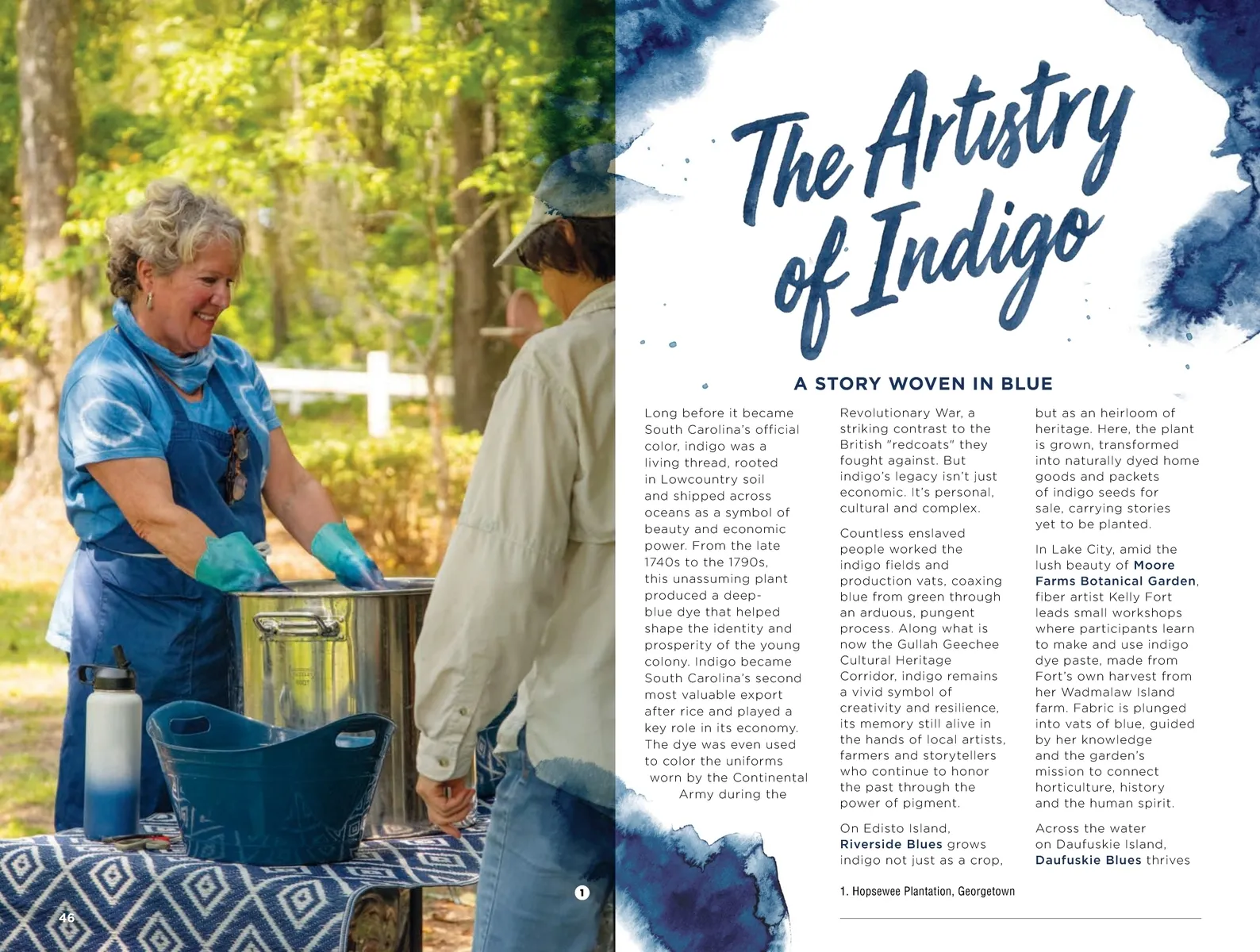
A STORY WOVEN IN BLUE Long before it became South Carolina’s official color, indigo was a living thread, rooted in Lowcountry soil and shipped across oceans as a symbol of beauty and economic power. From the late 1740s to the 1790s, this unassuming plant produced a deep-blue dye that helped shape the identity and prosperity of the young colony. Indigo became South Carolina’s second most valuable export after rice and played a key role in its economy. The dye was even used to color the uniforms worn by the Continental Army during the Revolutionary War, a striking contrast to the British "redcoats" they fought against. But indigo’s legacy isn’t just economic. It’s personal, cultural and complex. Countless enslaved people worked the indigo fields and production vats, coaxing blue from green through an arduous, pungent process. Along what is now the Gullah Geechee Cultural Heritage Corridor, indigo remains a vivid symbol of creativity and resilience, its memory still alive in the hands of local artists, farmers and storytellers who continue to honor the past through the power of pigment. On Edisto Island, Riverside Blues grows indigo not just as a crop, 1 but as an heirloom of heritage. Here, the plant is grown, transformed into naturally dyed home goods and packets of indigo seeds for sale, carrying stories yet to be planted. In Lake City, amid the lush beauty of Moore Farms Botanical Garden , fiber artist Kelly Fort leads small workshops where participants learn to make and use indigo dye paste, made from Fort’s own harvest from her Wadmalaw Island farm. Fabric is plunged into vats of blue, guided by her knowledge and the garden’s mission to connect horticulture, history and the human spirit. Across the water on Daufuskie Island, Daufuskie Blues thrives 1. Hopsewee Plantation, Georgetown 46
South Carolina Vacation Guide SC 2026: Page 46