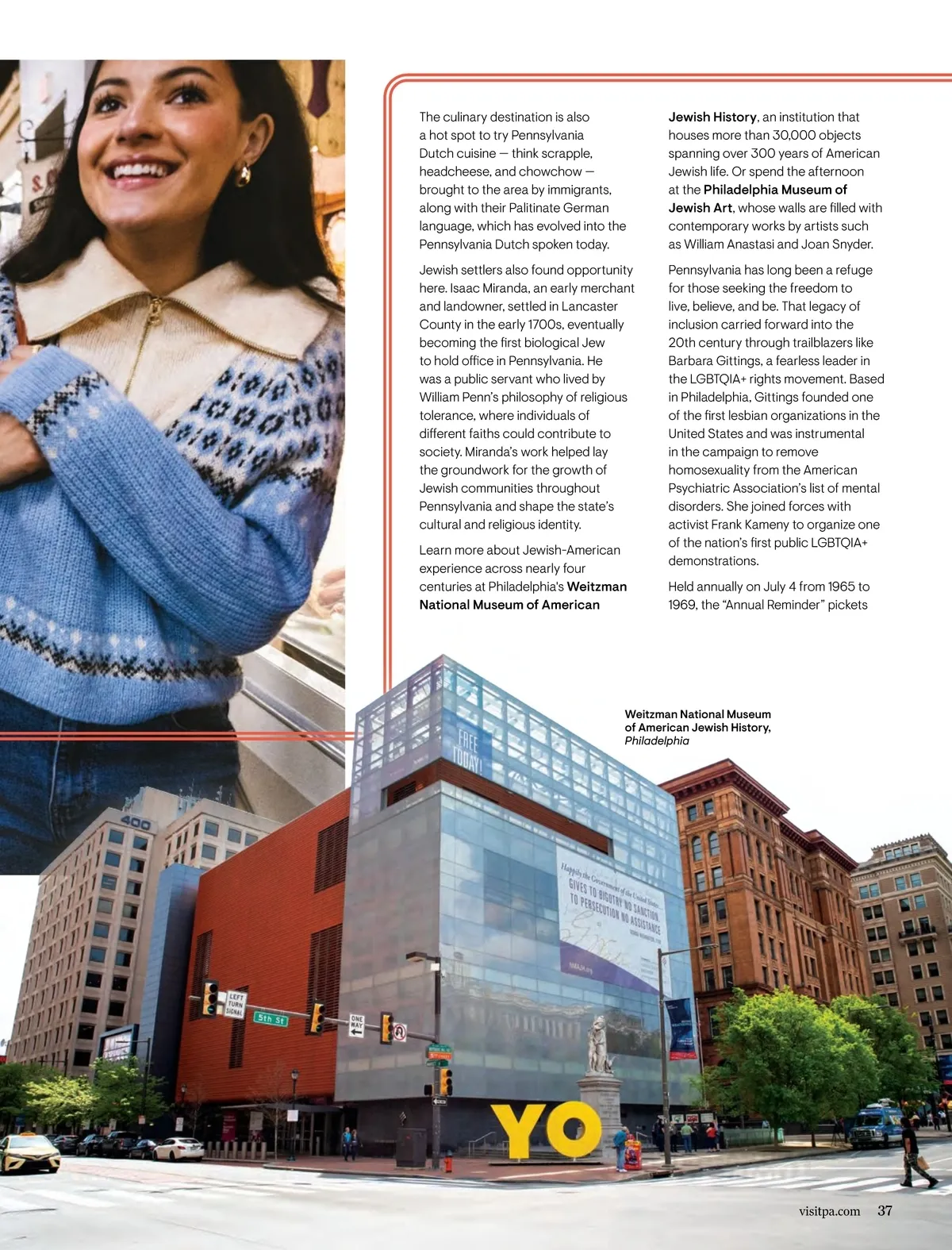
The culinary destination is also a hot spot to try Pennsylvania Dutch cuisine — think scrapple, headcheese, and chowchow — brought to the area by immigrants, along with their Palitinate German language, which has evolved into the Pennsylvania Dutch spoken today. Jewish settlers also found opportunity here. Isaac Miranda, an early merchant and landowner, settled in Lancaster County in the early 1700s, eventually becoming the first biological Jew to hold office in Pennsylvania. He was a public servant who lived by William Penn’s philosophy of religious tolerance, where individuals of different faiths could contribute to society. Miranda’s work helped lay the groundwork for the growth of Jewish communities throughout Pennsylvania and shape the state’s cultural and religious identity. Learn more about Jewish-American experience across nearly four centuries at Philadelphia's Weitzman National Museum of American Jewish History , an institution that houses more than 30,000 objects spanning over 300 years of American Jewish life. Or spend the afternoon at the Philadelphia Museum of Jewish Art , whose walls are filled with contemporary works by artists such as William Anastasi and Joan Snyder. Pennsylvania has long been a refuge for those seeking the freedom to live, believe, and be. That legacy of inclusion carried forward into the 20th century through trailblazers like Barbara Gittings, a fearless leader in the LGBTQIA+ rights movement. Based in Philadelphia, Gittings founded one of the first lesbian organizations in the United States and was instrumental in the campaign to remove homosexuality from the American Psychiatric Association’s list of mental disorders. She joined forces with activist Frank Kameny to organize one of the nation’s first public LGBTQIA+ demonstrations. Held annually on July 4 from 1965 to 1969, the “Annual Reminder” pickets Weitzman National Museum of American Jewish History, Philadelphia visitpa.com 37
Pennsylvania Pennsylvania Travel Guide 2026: Page 37