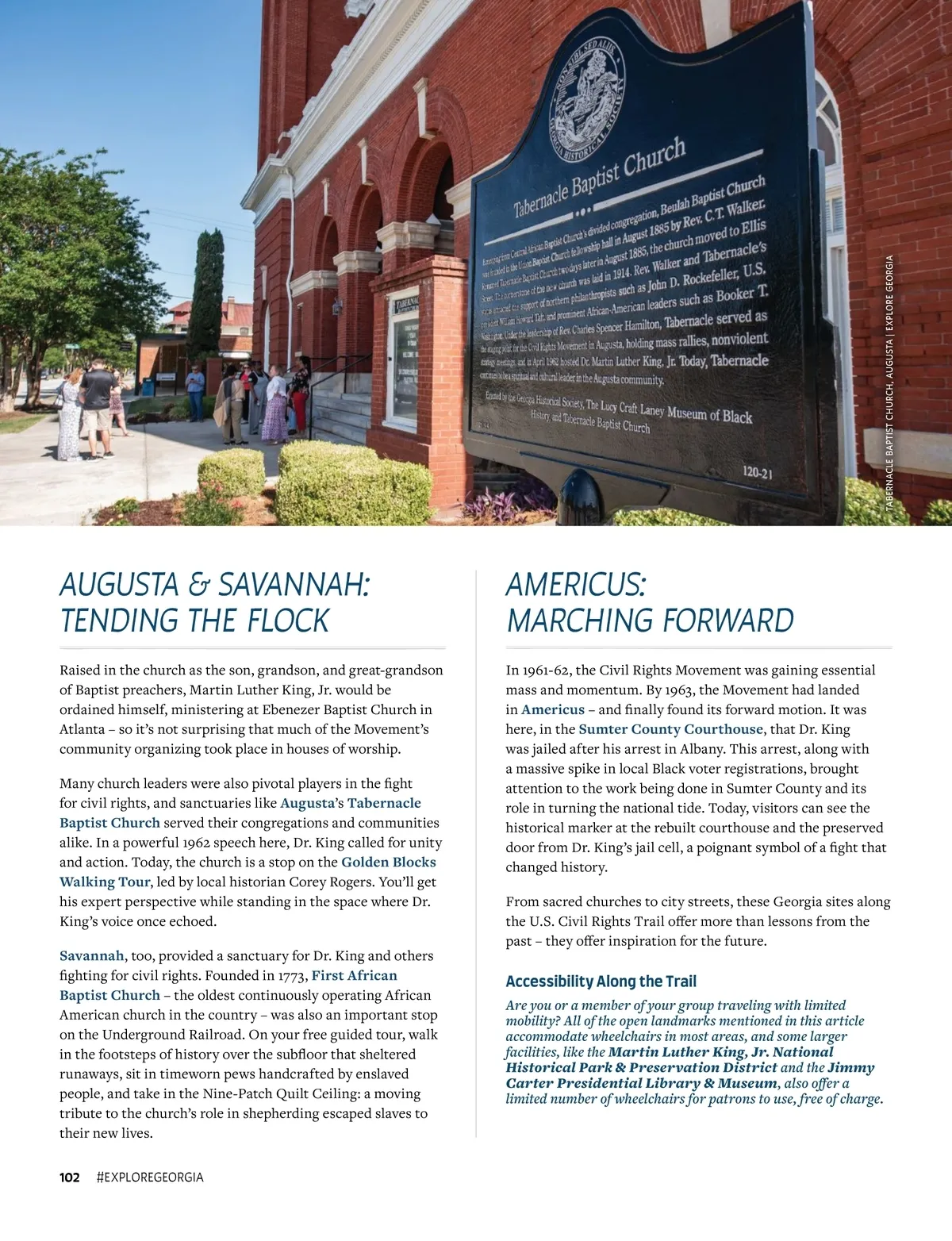
AUGUSTA & SAVANNAH: TENDING THE FLOCK Raised in the church as the son, grandson, and great-grandson of Baptist preachers, Martin Luther King, Jr. would be ordained himself, ministering at Ebenezer Baptist Church in Atlanta – so it’s not surprising that much of the Movement’s community organizing took place in houses of worship. Many church leaders were also pivotal players in the fight for civil rights, and sanctuaries like Augusta ’s Tabernacle Baptist Church served their congregations and communities alike. In a powerful 1962 speech here, Dr. King called for unity and action. Today, the church is a stop on the Golden Blocks Walking Tour , led by local historian Corey Rogers. You’ll get his expert perspective while standing in the space where Dr. King’s voice once echoed. Savannah , too, provided a sanctuary for Dr. King and others fighting for civil rights. Founded in 1773, First African Baptist Church – the oldest continuously operating African American church in the country – was also an important stop on the Underground Railroad. On your free guided tour, walk in the footsteps of history over the subfloor that sheltered runaways, sit in timeworn pews handcrafted by enslaved people, and take in the Nine-Patch Quilt Ceiling: a moving tribute to the church’s role in shepherding escaped slaves to their new lives. 102 #EXPLOREGEORGIA AMERICUS: MARCHING FORWARD In 1961-62, the Civil Rights Movement was gaining essential mass and momentum. By 1963, the Movement had landed in Americus – and finally found its forward motion. It was here, in the Sumter County Courthouse , that Dr. King was jailed after his arrest in Albany. This arrest, along with a massive spike in local Black voter registrations, brought attention to the work being done in Sumter County and its role in turning the national tide. Today, visitors can see the historical marker at the rebuilt courthouse and the preserved door from Dr. King’s jail cell, a poignant symbol of a fight that changed history. From sacred churches to city streets, these Georgia sites along the U.S. Civil Rights Trail offer more than lessons from the past – they offer inspiration for the future. Accessibility Along the Trail Are you or a member of your group traveling with limited mobility? All of the open landmarks mentioned in this article accommodate wheelchairs in most areas, and some larger facilities, like the Martin Luther King, Jr. National Historical Park & Preservation District and the Jimmy Carter Presidential Library & Museum , also offer a limited number of wheelchairs for patrons to use, free of charge. TABERNACLE BAPTIST CHURCH, AUGUSTA | EXPLORE GEORGIA
Official State Travel Guide 2026 Georgia Official State Travel Guide: Page 102