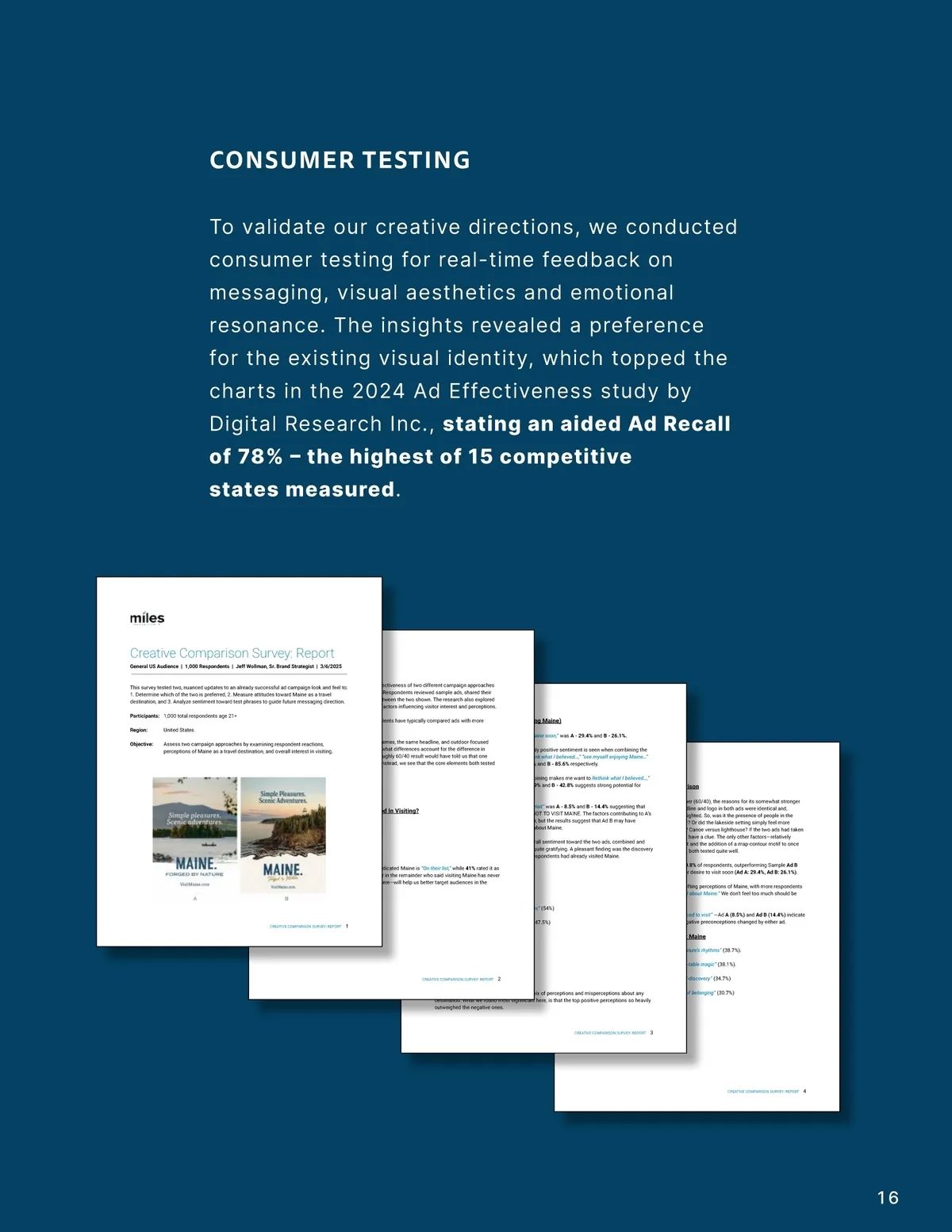
CONSUMER TESTING To validate our creative directions, we conducted consumer testing for real-time feedback on messaging, visual aesthetics and emotional resonance. The insights revealed a preference for the existing visual identity, which topped the charts in the 2024 Ad Effectiveness study by Digital Research Inc., stating an aided Ad Recall of 78% – the highest of 15 competitive states measured . Creative Comparison Survey: Report General US Audience | 1,000 Respondents | Jeff Wollman, Sr. Brand Strategist | 3/6/2025 Survey Overview This study was designed compare the effectiveness of two different campaign approaches This survey tested two, nuanced updates to an already successful ad campaign look and feel to to: for promoting Maine as a travel destination. Respondents reviewed sample ads, shared their 1. Determine which of the two is preferred, 2. Measure attitudes toward Maine as a travel and selected their preferred ad between the two shown. The research also explored destination, and 3. Analyze sentiment toward test phrases to guide reactions, future messaging direction. overall sentiment toward Maine, identifying factors in fl uencing visitor interest and perceptions. Participants: 1,000 total respondents age 21+ Region: Objective: United States Previous A/B studies performed for Miles’ clients have typically compared ads with more Response To Ad (re: Interest in Visiting Maine) distinct visual and messaging differences. ● LIKELY TO VISIT — Desire to “Visit Maine soon,” was A -29.4% and B -26.1%. Because reactions, both these ads featured outdoor themes, the same headline, and outdoor-focused Assess two campaign approaches by examining respondent subject matter, it is not possible to pinpoint what differences account for difference in ● the OVERALL POSITIVE — overwhelmingly positive sentiment is seen when combining the perceptions of Maine as a travel destination, and overall interest in visiting. ratings. Had they been more different, the roughly 60/40 result would have statements told us that “Visit one Maine soon,” “Rethink what I believed…,” “see myself enjoying Maine…” approach was clearly superior to the other. Instead, we see that the core elements both and “Want to tested learn more” at A -91.5% and B -85.6% respectively. quite positively. More discussion on this topic follows later. ● SOMEWHAT POSITIVE — when combining makes me want to Rethink what I believed…,” “see myself enjoying Maine…” A -39.9% and B -42.8% suggests strong potential for A/B Ad Comparison Effectiveness of The future visits. Even though Test Ad A emerged as the winner (60/40), the reasons for its somewhat stronger NEGATIVE — “Wouldn’t entice me to visit” was A -8.5% and B -14.4% suggesting that performance are not entirely clear. The headline and logo in both ads were identical and, neither ad overcame their intention NOT TO VISIT MAINE. The factors contributing to A’s visually, the subject matter was similarly weighted. So, was it the presence of people in the stronger performance remain unclear, but the results suggest that Ad B versus may have winning ad their absence in the other? Or did the lakeside setting simply feel more reinforced negative preconceptions about Maine. inviting than the rugged cliffside by the sea? Canoe versus lighthouse? If the two ads had taken Key Findings Have you Visited? / Are You Interested In Visiting? ● ● ● ● ● VISITED………………………….…… 29% NOT VISITED………………………… 24% ON MY LIST………………..……… 22% NOT NEAR TOP……………………. 15% NEVER OCCURRED TO ME… 10% ● signi fi cantly different approaches, we might have a clue. The only other factors—relatively What is most signi fi cant here is that the overall sentiment toward the two ads, combined and in tagline treatment and the addition of a map-contour motif to once minor—were differences averaged, is 90% positive —which we found quite gratifying. A pleasant fi nding the discovery versus the was other. With these factors in mind, both tested quite well. that a higher-than-expected percentage of respondents had already visited Maine. At face value, Test Ad A was preferred by 60.8% of respondents, outperforming Sample Ad B (39.2%), with both ads engendering a similar desire to visit soon (Ad A: 29.4%, Ad B: 26.1%) . Ad A also seemed a bit more effective in shifting perceptions of Maine, with more respondents stating it made them “rethink what I believed about Maine.” We don’t feel too much should be made of this. As to the question of participants “NOT enticed to visit” —Ad A (8.5%) and Ad B (14.4%) indicate that relatively few respondents had their negative preconceptions changed by either ad. Among those who haven’t yet visited, 59% indicated Maine is “On their list,” while 41% rated it as a lower travel priority. We chose not to factor in the remainder who said visiting Maine has never Perceptions of Maine occurred to them, as learning that—neutral here—will help us better target audiences in the future. Positive associations: “Lobsters, lighthouses, and blueberries” (54%) CREATIVE COMPARISON SURVEY: REPORT 1 “Scenic, with rugged natural beauty” (47.5%) “Full of New England charm” (46.6%) Negative associations: “Cold, remote, and sparse” (26.6%) CREATIVE COMPARISON SURVEY: REPORT 2 “Kinda boring and slow-paced” Sentiments Impacting Desire to Visit Maine ● ● ● “Find life’s meaningful moments in nature’s rhythms” (38.7%). “Maine means mouthwatering sea-to-table magic” (38.1%). “The set-yourself-free setting for self-discovery” (34.7%) (19%) ● “Maine about imbues visitors with a sense of belonging” (30.7%) As with any test cohort, there is typically a mix of perceptions and misperceptions any destination. What we found most signi fi cant here, is that the top positive perceptions so heavily outweighed the negative ones. CREATIVE COMPARISON SURVEY: REPORT 3 CREATIVE COMPARISON SURVEY: REPORT 4 16
MOT Annual Report & Plan 2024/2025 Annual Report & Plan: Page 16