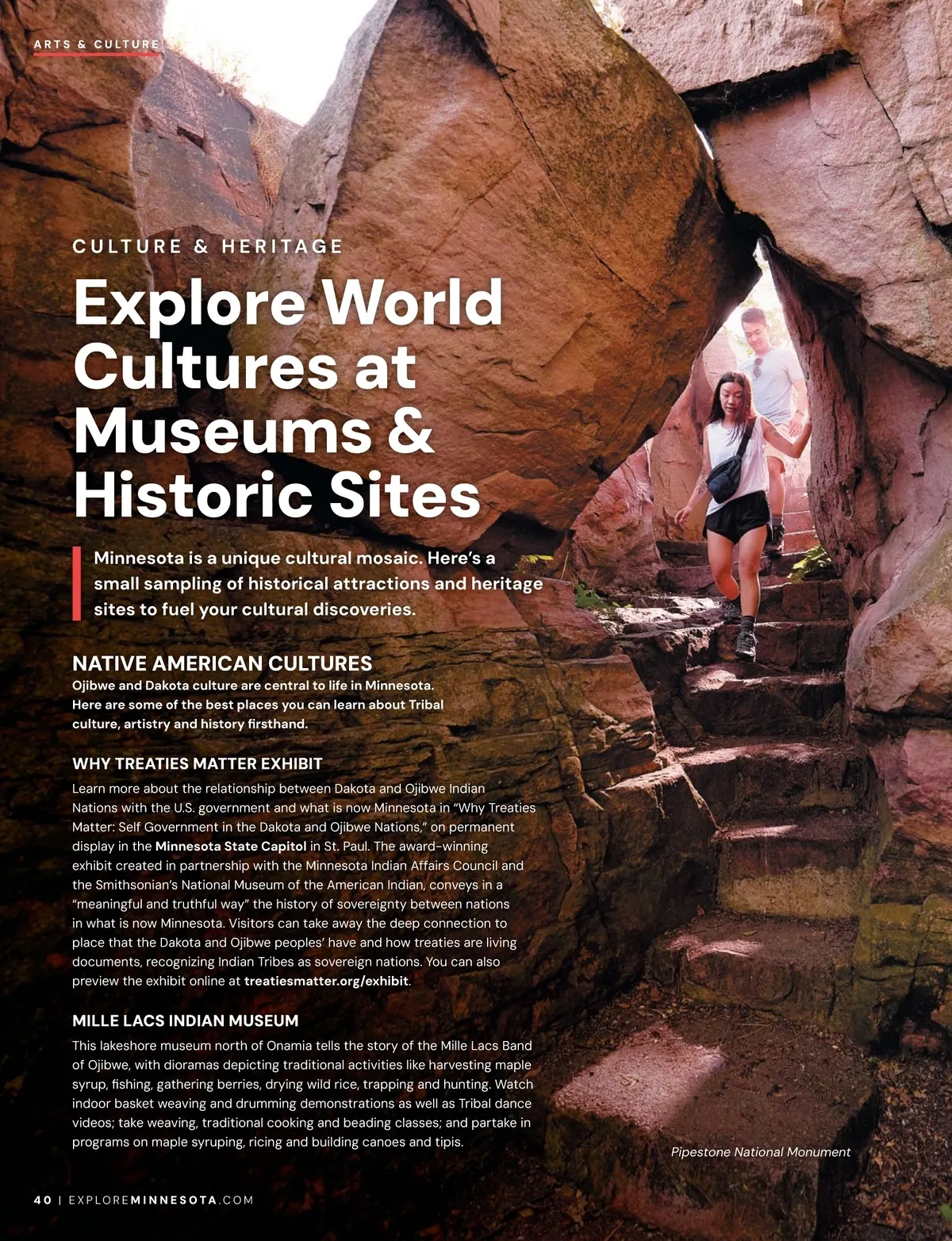
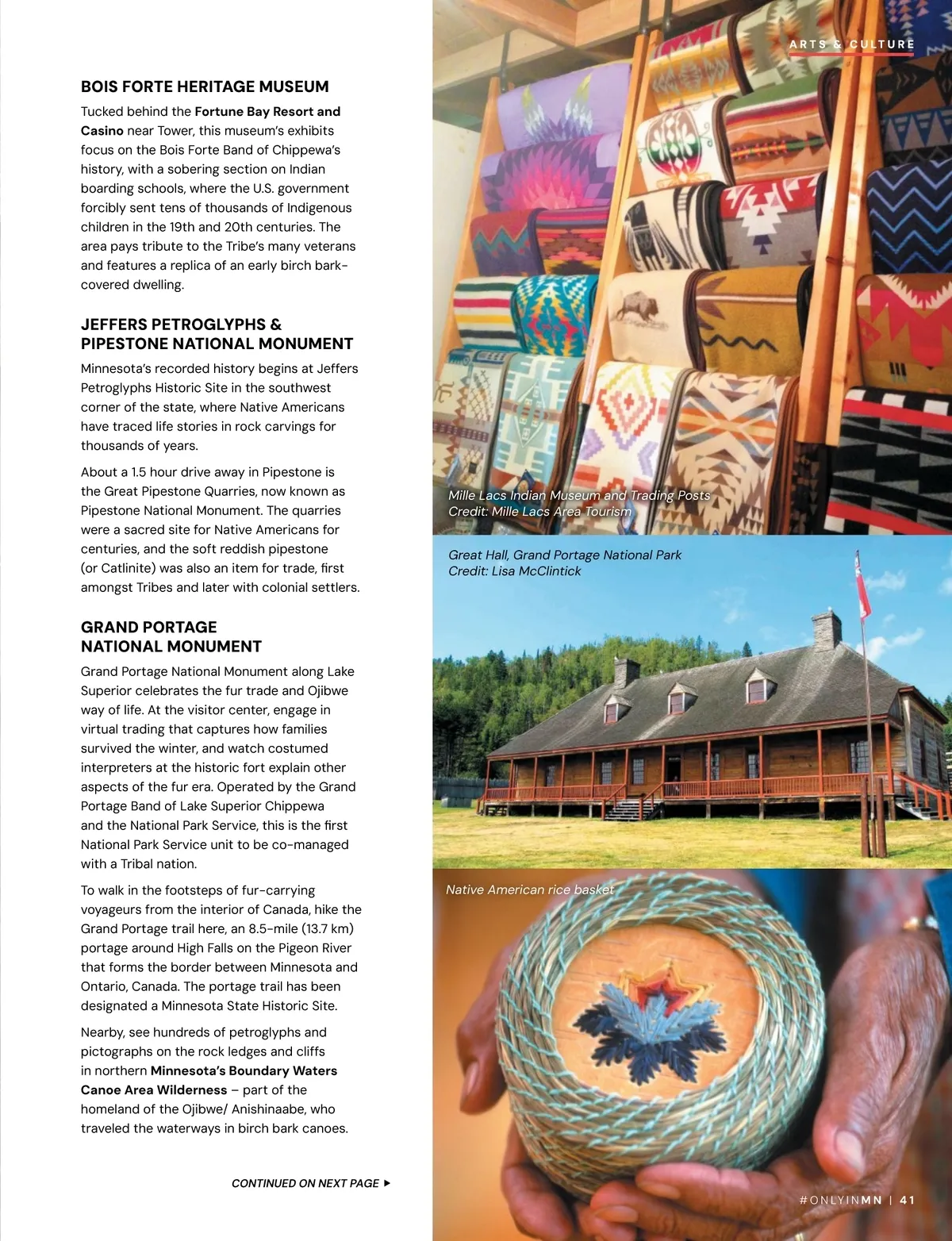
ARTS & CULTURE BOIS FORTE HERITAGE MUSEUM Tucked behind the Fortune Bay Resort and Casino near Tower, this museum’s exhibits focus on the Bois Forte Band of Chippewa’s history, with a sobering section on Indian boarding schools, where the U.S. government forcibly sent tens of thousands of Indigenous children in the 19th and 20th centuries. The area pays tribute to the Tribe’s many veterans and features a replica of an early birch bark-covered dwelling. JEFFERS PETROGLYPHS & PIPESTONE NATIONAL MONUMENT Minnesota’s recorded history begins at Jeffers Petroglyphs Historic Site in the southwest corner of the state, where Native Americans have traced life stories in rock carvings for thousands of years. About a 1.5 hour drive away in Pipestone is the Great Pipestone Quarries, now known as Pipestone National Monument. The quarries were a sacred site for Native Americans for centuries, and the soft reddish pipestone (or Catlinite) was also an item for trade, fi rst amongst Tribes and later with colonial settlers. Mille Lacs Indian Museum and Trading Posts Credit: Mille Lacs Area Tourism Great Hall, Grand Portage National Park Credit: Lisa McClintick GRAND PORTAGE NATIONAL MONUMENT Grand Portage National Monument along Lake Superior celebrates the fur trade and Ojibwe way of life. At the visitor center, engage in virtual trading that captures how families survived the winter, and watch costumed interpreters at the historic fort explain other aspects of the fur era. Operated by the Grand Portage Band of Lake Superior Chippewa and the National Park Service, this is the fi rst National Park Service unit to be co-managed with a Tribal nation. To walk in the footsteps of fur-carrying voyageurs from the interior of Canada, hike the Grand Portage trail here, an 8.5-mile (13.7 km) portage around High Falls on the Pigeon River that forms the border between Minnesota and Ontario, Canada. The portage trail has been designated a Minnesota State Historic Site. Nearby, see hundreds of petroglyphs and pictographs on the rock ledges and cliffs in northern Minnesota’s Boundary Waters Canoe Area Wilderness – part of the homeland of the Ojibwe/ Anishinaabe, who traveled the waterways in birch bark canoes. Native American rice basket CONTINUED ON NEXT PAGE #ONLYIN MN | 41
Explore Minnesota Travel Guide 2025 Explore Minnesota Travel Guide: Page 41