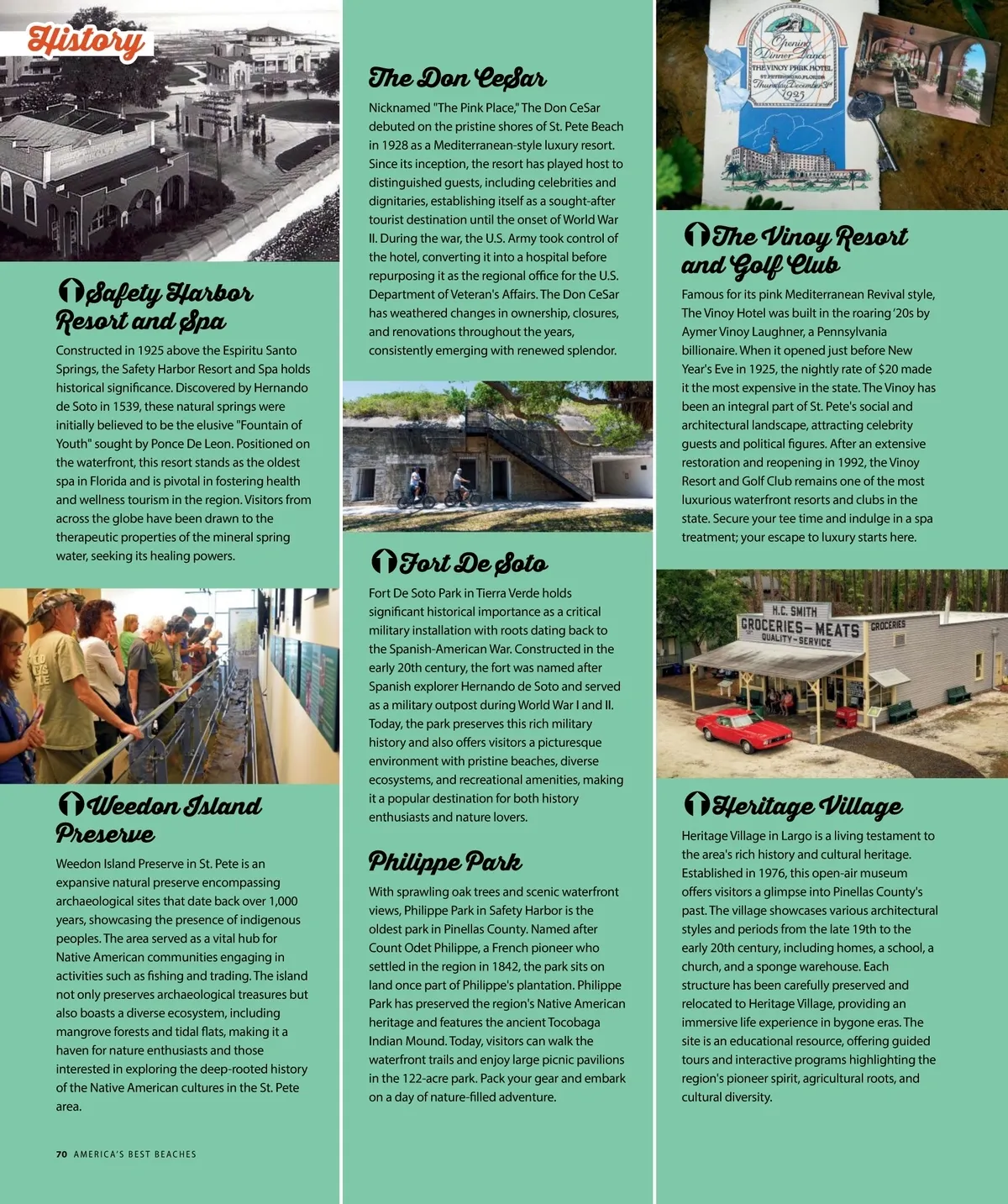
History The Don CeSar Nicknamed "The Pink Place," The Don CeSar debuted on the pristine shores of St. Pete Beach in 1928 as a Mediterranean-style luxury resort. Since its inception, the resort has played host to distinguished guests, including celebrities and dignitaries, establishing itself as a sought-after tourist destination until the onset of World War II. During the war, the U.S. Army took control of the hotel, converting it into a hospital before repurposing it as the regional office for the U.S. Department of Veteran's Affairs. The Don CeSar has weathered changes in ownership, closures, and renovations throughout the years, consistently emerging with renewed splendor. The Vinoy Resort and Golf Club Famous for its pink Mediterranean Revival style, The Vinoy Hotel was built in the roaring ‘20s by Aymer Vinoy Laughner, a Pennsylvania billionaire. When it opened just before New Year's Eve in 1925, the nightly rate of $20 made it the most expensive in the state. The Vinoy has been an integral part of St. Pete's social and architectural landscape, attracting celebrity guests and political figures. After an extensive restoration and reopening in 1992, the Vinoy Resort and Golf Club remains one of the most luxurious waterfront resorts and clubs in the state. Secure your tee time and indulge in a spa treatment; your escape to luxury starts here. Safety Harbor Resort and Spa Constructed in 1925 above the Espiritu Santo Springs, the Safety Harbor Resort and Spa holds historical significance. Discovered by Hernando de Soto in 1539, these natural springs were initially believed to be the elusive "Fountain of Youth" sought by Ponce De Leon. Positioned on the waterfront, this resort stands as the oldest spa in Florida and is pivotal in fostering health and wellness tourism in the region. Visitors from across the globe have been drawn to the therapeutic properties of the mineral spring water, seeking its healing powers. Fort De Soto Fort De Soto Park in Tierra Verde holds significant historical importance as a critical military installation with roots dating back to the Spanish-American War. Constructed in the early 20th century, the fort was named after Spanish explorer Hernando de Soto and served as a military outpost during World War I and II. Today, the park preserves this rich military history and also offers visitors a picturesque environment with pristine beaches, diverse ecosystems, and recreational amenities, making it a popular destination for both history enthusiasts and nature lovers. Weedon Island Preserve Weedon Island Preserve in St. Pete is an expansive natural preserve encompassing archaeological sites that date back over 1,000 years, showcasing the presence of indigenous peoples. The area served as a vital hub for Native American communities engaging in activities such as fishing and trading. The island not only preserves archaeological treasures but also boasts a diverse ecosystem, including mangrove forests and tidal flats, making it a haven for nature enthusiasts and those interested in exploring the deep-rooted history of the Native American cultures in the St. Pete area. Heritage Village Heritage Village in Largo is a living testament to the area's rich history and cultural heritage. Established in 1976, this open-air museum offers visitors a glimpse into Pinellas County's past. The village showcases various architectural styles and periods from the late 19th to the early 20th century, including homes, a school, a church, and a sponge warehouse. Each structure has been carefully preserved and relocated to Heritage Village, providing an immersive life experience in bygone eras. The site is an educational resource, offering guided tours and interactive programs highlighting the region's pioneer spirit, agricultural roots, and cultural diversity. Philippe Park With sprawling oak trees and scenic waterfront views, Philippe Park in Safety Harbor is the oldest park in Pinellas County. Named after Count Odet Philippe, a French pioneer who settled in the region in 1842, the park sits on land once part of Philippe's plantation. Philippe Park has preserved the region's Native American heritage and features the ancient Tocobaga Indian Mound. Today, visitors can walk the waterfront trails and enjoy large picnic pavilions in the 122-acre park. Pack your gear and embark on a day of nature-filled adventure. 70 AMERICA’S BEST BEACHES
Gulf To Bay St. Pete Clearwater FL Gulf To Bay 2024: Page 70