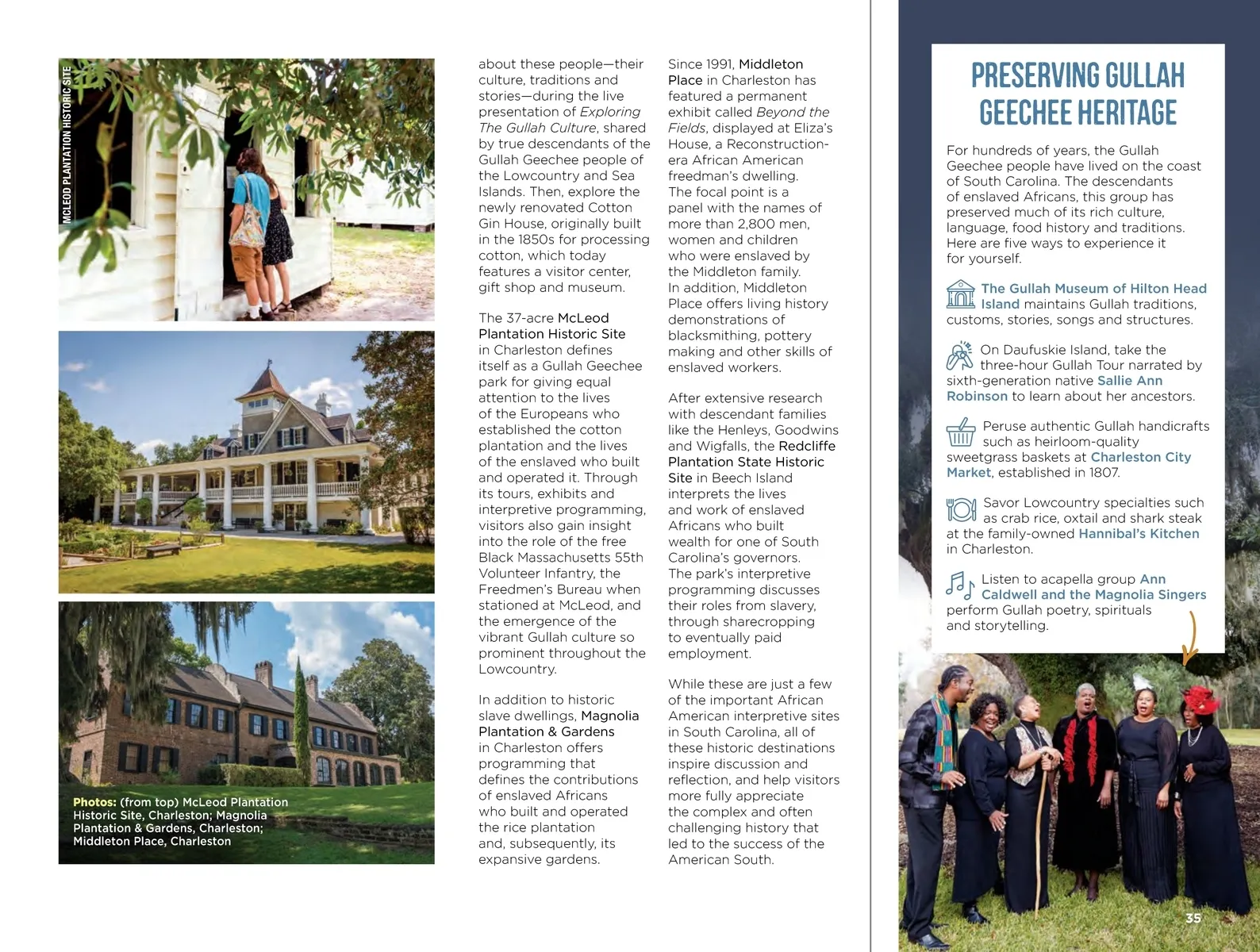
about these people—their culture, traditions and stories—during the live presentation of Exploring The Gullah Culture , shared by true descendants of the Gullah Geechee people of the Lowcountry and Sea Islands. Then, explore the newly renovated Cotton Gin House, originally built in the 1850s for processing cotton, which today features a visitor center, gift shop and museum. The 37-acre McLeod Plantation Historic Site in Charleston defines itself as a Gullah Geechee park for giving equal attention to the lives of the Europeans who established the cotton plantation and the lives of the enslaved who built and operated it. Through its tours, exhibits and interpretive programming, visitors also gain insight into the role of the free Black Massachusetts 55th Volunteer Infantry, the Freedmen’s Bureau when stationed at McLeod, and the emergence of the vibrant Gullah culture so prominent throughout the Lowcountry. In addition to historic slave dwellings, Magnolia Plantation & Gardens in Charleston offers programming that defines the contributions of enslaved Africans who built and operated the rice plantation and, subsequently, its expansive gardens. Since 1991, Middleton Place in Charleston has featured a permanent exhibit called Beyond the Fields , displayed at Eliza’s House, a Reconstruction-era African American freedman’s dwelling. The focal point is a panel with the names of more than 2,800 men, women and children who were enslaved by the Middleton family. In addition, Middleton Place offers living history demonstrations of blacksmithing, pottery making and other skills of enslaved workers. After extensive research with descendant families like the Henleys, Goodwins and Wigfalls, the Redcliffe Plantation State Historic Site in Beech Island interprets the lives and work of enslaved Africans who built wealth for one of South Carolina’s governors. The park’s interpretive programming discusses their roles from slavery, through sharecropping to eventually paid employment. While these are just a few of the important African American interpretive sites in South Carolina, all of these historic destinations inspire discussion and reflection, and help visitors more fully appreciate the complex and often challenging history that led to the success of the American South. MCLEOD PLANTATION HISTORIC SITE Preserving guLlah geechee heritage For hundreds of years, the Gullah Geechee people have lived on the coast of South Carolina. The descendants of enslaved Africans, this group has preserved much of its rich culture, language, food history and traditions. Here are five ways to experience it for yourself. The Gullah Museum of Hilton Head Island maintains Gullah traditions, customs, stories, songs and structures. On Daufuskie Island, take the three-hour Gullah Tour narrated by sixth-generation native Sallie Ann Robinson to learn about her ancestors. Peruse authentic Gullah handicrafts such as heirloom-quality sweetgrass baskets at Charleston City Market , established in 1807. Savor Lowcountry specialties such as crab rice, oxtail and shark steak at the family-owned Hannibal’s Kitchen in Charleston. Listen to acapella group Ann Caldwell and the Magnolia Singers perform Gullah poetry, spirituals and storytelling. Photos: (from top) McLeod Plantation Historic Site, Charleston; Magnolia Plantation & Gardens, Charleston; Middleton Place, Charleston 35
South Carolina Vacation Guide SC 2024: Page 35