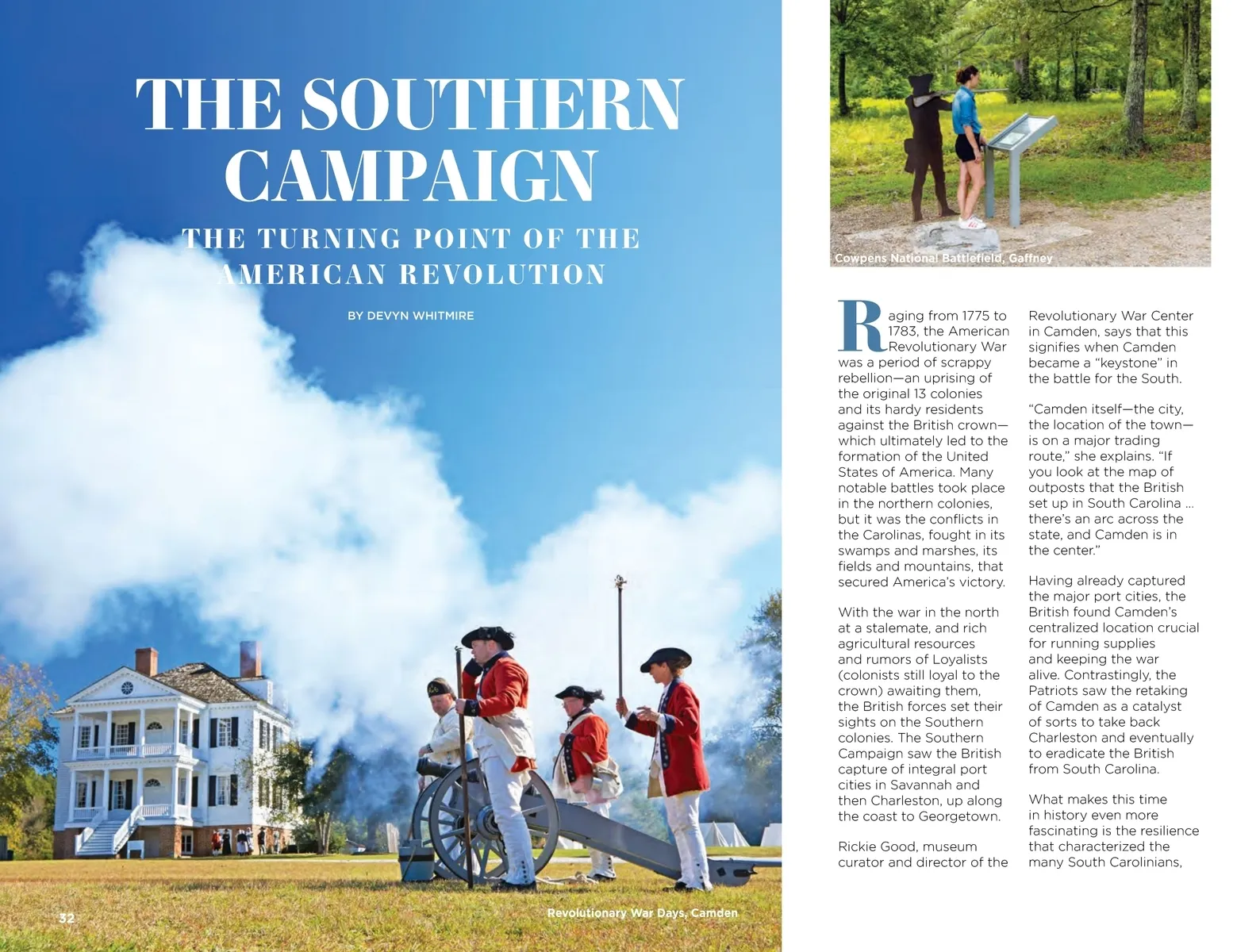
THE SOUTHERN CAMPAIGN THE TURNING POINT OF THE AMERICAN REVOLUTION BY DEVYN WHITMIRE Cowpens National Battlefield, Gaffney R aging from 1775 to 1783, the American Revolutionary War was a period of scrappy rebellion—an uprising of the original 13 colonies and its hardy residents against the British crown— which ultimately led to the formation of the United States of America. Many notable battles took place in the northern colonies, but it was the conflicts in the Carolinas, fought in its swamps and marshes, its fields and mountains, that secured America’s victory. With the war in the north at a stalemate, and rich agricultural resources and rumors of Loyalists (colonists still loyal to the crown) awaiting them, the British forces set their sights on the Southern colonies. The Southern Campaign saw the British capture of integral port cities in Savannah and then Charleston, up along the coast to Georgetown. Rickie Good, museum curator and director of the Revolutionary War Center in Camden, says that this signifies when Camden became a “keystone” in the battle for the South. “Camden itself—the city, the location of the town— is on a major trading route,” she explains. “If you look at the map of outposts that the British set up in South Carolina … there’s an arc across the state, and Camden is in the center.” Having already captured the major port cities, the British found Camden’s centralized location crucial for running supplies and keeping the war alive. Contrastingly, the Patriots saw the retaking of Camden as a catalyst of sorts to take back Charleston and eventually to eradicate the British from South Carolina. What makes this time in history even more fascinating is the resilience that characterized the many South Carolinians, 32 Revolutionary War Days, Camden
South Carolina Vacation Guide SC 2024: Page 32