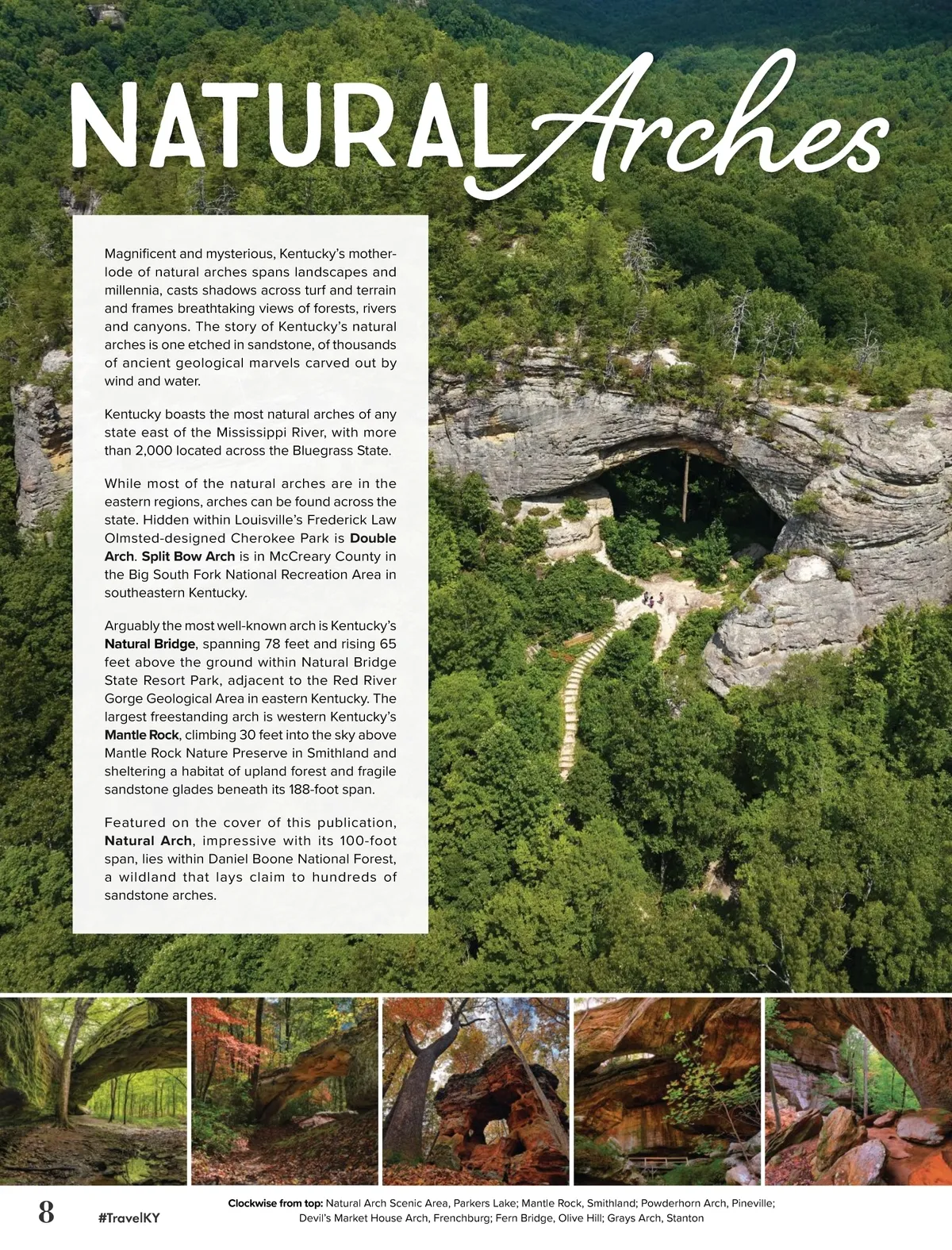
Magnificent and mysterious, Kentucky’s mother-lode of natural arches spans landscapes and millennia, casts shadows across turf and terrain and frames breathtaking views of forests, rivers and canyons. The story of Kentucky’s natural arches is one etched in sandstone, of thousands of ancient geological marvels carved out by wind and water. Kentucky boasts the most natural arches of any state east of the Mississippi River, with more than 2,000 located across the Bluegrass State. While most of the natural arches are in the eastern regions, arches can be found across the state. Hidden within Louisville’s Frederick Law Olmsted-designed Cherokee Park is Double Arch . Split Bow Arch is in McCreary County in the Big South Fork National Recreation Area in southeastern Kentucky. Arguably the most well-known arch is Kentucky’s Natural Bridge , spanning 78 feet and rising 65 feet above the ground within Natural Bridge State Resort Park, adjacent to the Red River Gorge Geological Area in eastern Kentucky. The largest freestanding arch is western Kentucky’s Mantle Rock , climbing 30 feet into the sky above Mantle Rock Nature Preserve in Smithland and sheltering a habitat of upland forest and fragile sandstone glades beneath its 188-foot span. Featured on the cover of this publication, Natural Arch , impressive with its 100-foot span, lies within Daniel Boone National Forest, a wildland that lays claim to hundreds of sandstone arches. 8 #TravelKY Clockwise from top: Natural Arch Scenic Area, Parkers Lake; Mantle Rock, Smithland; Powderhorn Arch, Pineville; Devil’s Market House Arch, Frenchburg; Fern Bridge, Olive Hill; Grays Arch, Stanton
The Official Kentucky Visitor's Guide The Official Kentucky Visitor's Guide 2024: Page 8