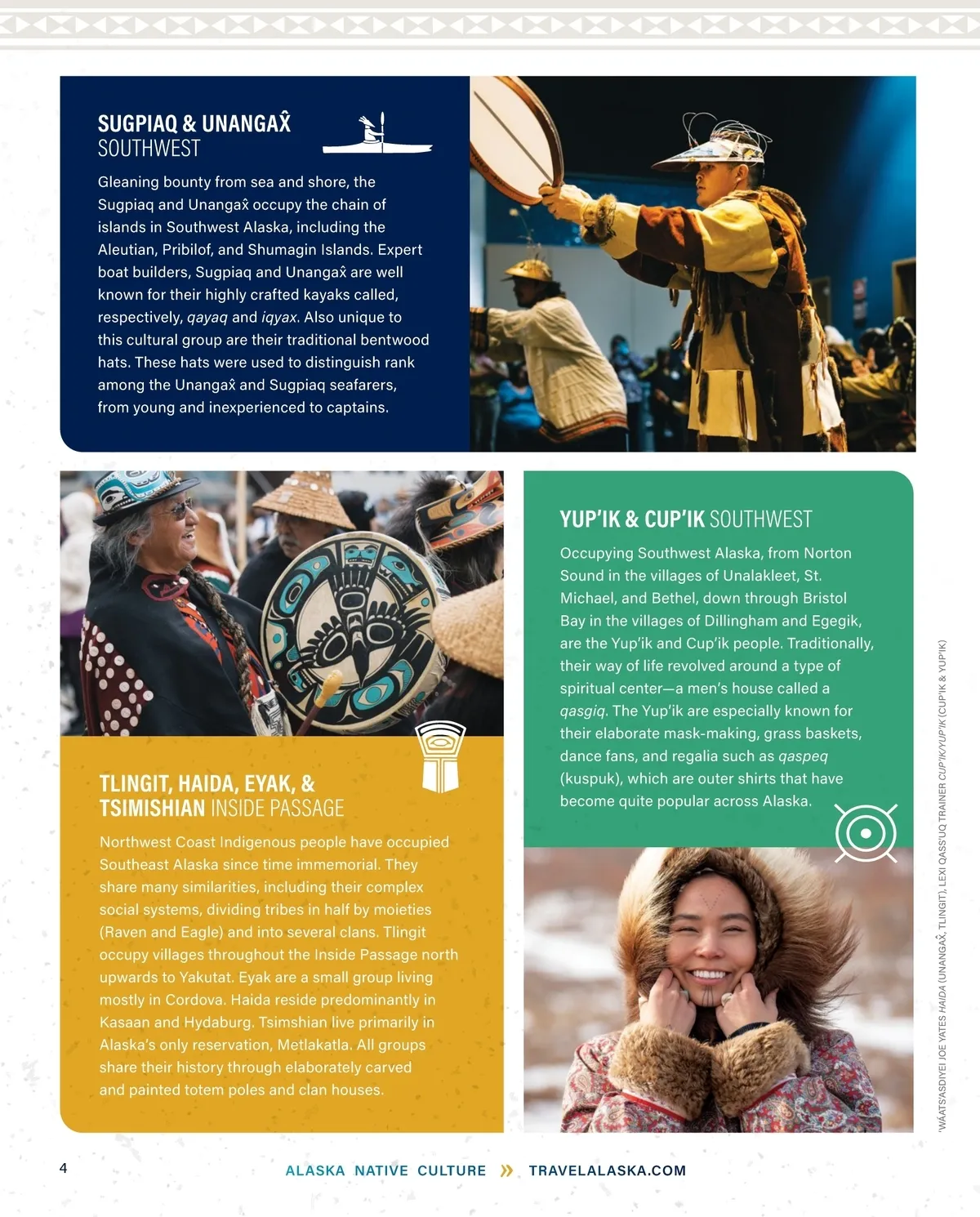
̂ SUGPIAQ & UNANGAX SOUTHWEST Gleaning bounty from sea and shore, the Sugpiaq and Unangax occupy the chain of islands in Southwest Alaska, including the Aleutian, Pribilof, and Shumagin Islands. Expert boat builders, Sugpiaq and Unangax are well known for their highly crafted kayaks called, respectively, qayaq and iqyax . Also unique to this cultural group are their traditional bentwood hats. These hats were used to distinguish rank among the Unangax and Sugpiaq seafarers, from young and inexperienced to captains. YUP’IK & CUP’IK SOUTHWEST Occupying Southwest Alaska, from Norton Sound in the villages of Unalakleet, St. Michael, and Bethel, down through Bristol Bay in the villages of Dillingham and Egegik, are the Yup’ik and Cup’ik people. Traditionally, their way of life revolved around a type of spiritual center—a men’s house called a qasgiq . The Yup’ik are especially known for their elaborate mask-making, grass baskets, dance fans, and regalia such as qaspeq (kuspuk), which are outer shirts that have become quite popular across Alaska. TLINGIT, HAIDA, EYAK, & TSIMISHIAN INSIDE PASSAGE Northwest Coast Indigenous people have occupied Southeast Alaska since time immemorial. They share many similarities, including their complex social systems, dividing tribes in half by moieties (Raven and Eagle) and into several clans. Tlingit occupy villages throughout the Inside Passage north upwards to Yakutat. Eyak are a small group living mostly in Cordova. Haida reside predominantly in Kasaan and Hydaburg. Tsimshian live primarily in Alaska’s only reservation, Metlakatla. All groups share their history through elaborately carved and painted totem poles and clan houses. 4 ALASKA NATIVE CULTURE TRAVELALASKA.COM ‘WÁATS’ASDIYEI JOE YATES HAIDA (UNANGAX, TLINGIT), LEXI QASS’UQ TRAINER CUP’IK/YUP’IK (CUP’IK & YUP’IK)
Alaska Native Culture 2024: Page 4