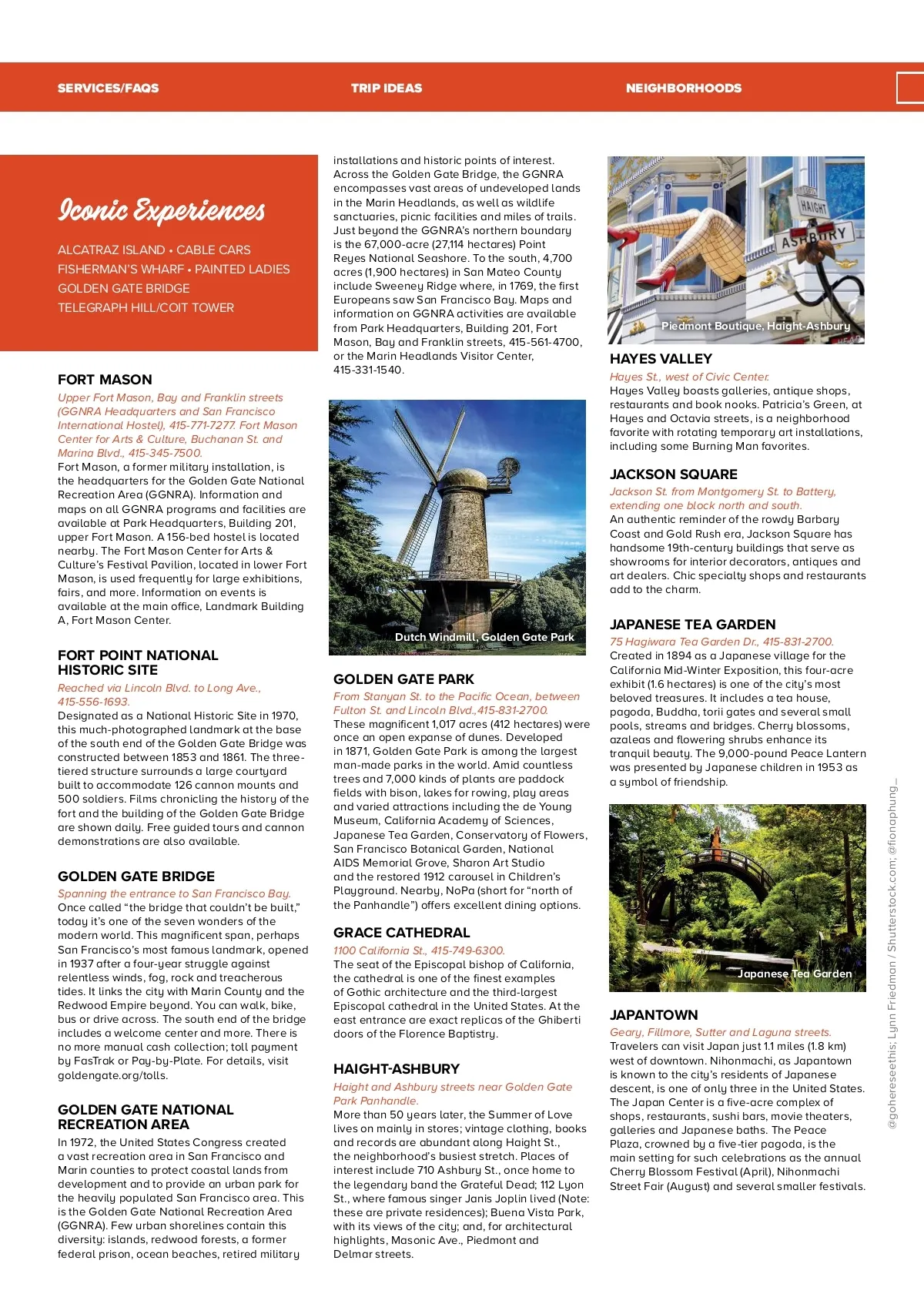
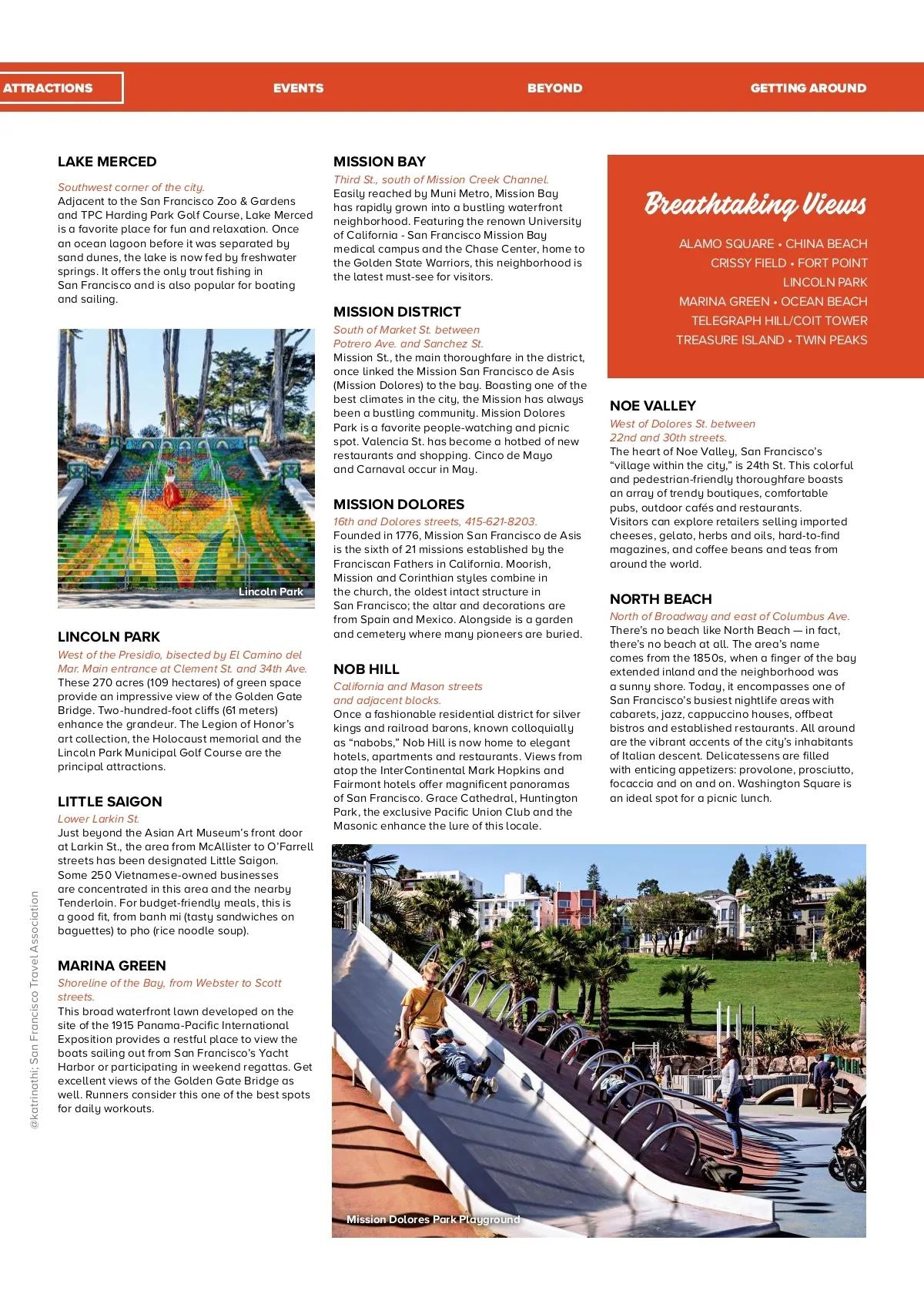
SERVICES/FAQS TRIP IDEAS NEIGHBORHOODS Iconic Experiences ALCATRAZ ISLAND • CABLE CARS FISHERMAN’S WHARF • PAINTED LADIES GOLDEN GATE BRIDGE TELEGRAPH HILL/COIT TOWER FORT MASON installations and historic points of interest. Across the Golden Gate Bridge, the GGNRA encompasses vast areas of undeveloped lands in the Marin Headlands, as well as wildlife sanctuaries, picnic facilities and miles of trails. Just beyond the GGNRA’s northern boundary is the 67,000-acre (27,114 hectares) Point Reyes National Seashore. To the south, 4,700 acres (1,900 hectares) in San Mateo County include Sweeney Ridge where, in 1769, the first Europeans saw San Francisco Bay. Maps and information on GGNRA activities are available from Park Headquarters, Building 201, Fort Mason, Bay and Franklin streets, 415-561-4700, or the Marin Headlands Visitor Center, 415-331-1540. Piedmont Boutique, Haight-Ashbury HAYES VALLEY Upper Fort Mason, Bay and Franklin streets (GGNRA Headquarters and San Francisco International Hostel), 415-771-7277. Fort Mason Center for Arts & Culture, Buchanan St. and Marina Blvd., 415-345-7500. Fort Mason, a former military installation, is the headquarters for the Golden Gate National Recreation Area (GGNRA). Information and maps on all GGNRA programs and facilities are available at Park Headquarters, Building 201, upper Fort Mason. A 156-bed hostel is located nearby. The Fort Mason Center for Arts & Culture’s Festival Pavilion, located in lower Fort Mason, is used frequently for large exhibitions, fairs, and more. Information on events is available at the main office, Landmark Building A, Fort Mason Center. Hayes St., west of Civic Center. Hayes Valley boasts galleries, antique shops, restaurants and book nooks. Patricia’s Green, at Hayes and Octavia streets, is a neighborhood favorite with rotating temporary art installations, including some Burning Man favorites. JACKSON SQUARE Jackson St. from Montgomery St. to Battery, extending one block north and south. An authentic reminder of the rowdy Barbary Coast and Gold Rush era, Jackson Square has handsome 19th-century buildings that serve as showrooms for interior decorators, antiques and art dealers. Chic specialty shops and restaurants add to the charm. FORT POINT NATIONAL HISTORIC SITE Dutch Windmill, Golden Gate Park JAPANESE TEA GARDEN GOLDEN GATE BRIDGE Spanning the entrance to San Francisco Bay. Once called “the bridge that couldn’t be built,” today it’s one of the seven wonders of the modern world. This magnificent span, perhaps San Francisco’s most famous landmark, opened in 1937 after a four-year struggle against relentless winds, fog, rock and treacherous tides. It links the city with Marin County and the Redwood Empire beyond. You can walk, bike, bus or drive across. The south end of the bridge includes a welcome center and more. There is no more manual cash collection; toll payment by FasTrak or Pay-by-Plate. For details, visit goldengate.org/tolls. GRACE CATHEDRAL 1100 California St., 415-749-6300. The seat of the Episcopal bishop of California, the cathedral is one of the finest examples of Gothic architecture and the third-largest Episcopal cathedral in the United States. At the east entrance are exact replicas of the Ghiberti doors of the Florence Baptistry. Japanese Tea Garden JAPANTOWN HAIGHT-ASHBURY GOLDEN GATE NATIONAL RECREATION AREA In 1972, the United States Congress created a vast recreation area in San Francisco and Marin counties to protect coastal lands from development and to provide an urban park for the heavily populated San Francisco area. This is the Golden Gate National Recreation Area (GGNRA). Few urban shorelines contain this diversity: islands, redwood forests, a former federal prison, ocean beaches, retired military Haight and Ashbury streets near Golden Gate Park Panhandle. More than 50 years later, the Summer of Love lives on mainly in stores; vintage clothing, books and records are abundant along Haight St., the neighborhood’s busiest stretch. Places of interest include 710 Ashbury St., once home to the legendary band the Grateful Dead; 112 Lyon St., where famous singer Janis Joplin lived (Note: these are private residences); Buena Vista Park, with its views of the city; and, for architectural highlights, Masonic Ave., Piedmont and Delmar streets. Geary, Fillmore, Sutter and Laguna streets. Travelers can visit Japan just 1.1 miles (1.8 km) west of downtown. Nihonmachi, as Japantown is known to the city’s residents of Japanese descent, is one of only three in the United States. The Japan Center is a five-acre complex of shops, restaurants, sushi bars, movie theaters, galleries and Japanese baths. The Peace Plaza, crowned by a five-tier pagoda, is the main setting for such celebrations as the annual Cherry Blossom Festival (April), Nihonmachi Street Fair (August) and several smaller festivals. @gohereseethis; Lynn Friedman / Shutterstock.com; @fionaphung_ Reached via Lincoln Blvd. to Long Ave., 415-556-1693. Designated as a National Historic Site in 1970, this much-photographed landmark at the base of the south end of the Golden Gate Bridge was constructed between 1853 and 1861. The three-tiered structure surrounds a large courtyard built to accommodate 126 cannon mounts and 500 soldiers. Films chronicling the history of the fort and the building of the Golden Gate Bridge are shown daily. Free guided tours and cannon demonstrations are also available. GOLDEN GATE PARK From Stanyan St. to the Pacific Ocean, between Fulton St. and Lincoln Blvd.,415-831-2700. These magnificent 1,017 acres (412 hectares) were once an open expanse of dunes. Developed in 1871, Golden Gate Park is among the largest man-made parks in the world. Amid countless trees and 7,000 kinds of plants are paddock fields with bison, lakes for rowing, play areas and varied attractions including the de Young Museum, California Academy of Sciences, Japanese Tea Garden, Conservatory of Flowers, San Francisco Botanical Garden, National AIDS Memorial Grove, Sharon Art Studio and the restored 1912 carousel in Children’s Playground. Nearby, NoPa (short for “north of the Panhandle”) offers excellent dining options. 75 Hagiwara Tea Garden Dr., 415-831-2700. Created in 1894 as a Japanese village for the California Mid-Winter Exposition, this four-acre exhibit (1.6 hectares) is one of the city’s most beloved treasures. It includes a tea house, pagoda, Buddha, torii gates and several small pools, streams and bridges. Cherry blossoms, azaleas and flowering shrubs enhance its tranquil beauty. The 9,000-pound Peace Lantern was presented by Japanese children in 1953 as a symbol of friendship.
San Francisco Travel Planner's Guide 2023 TPG: Page 16