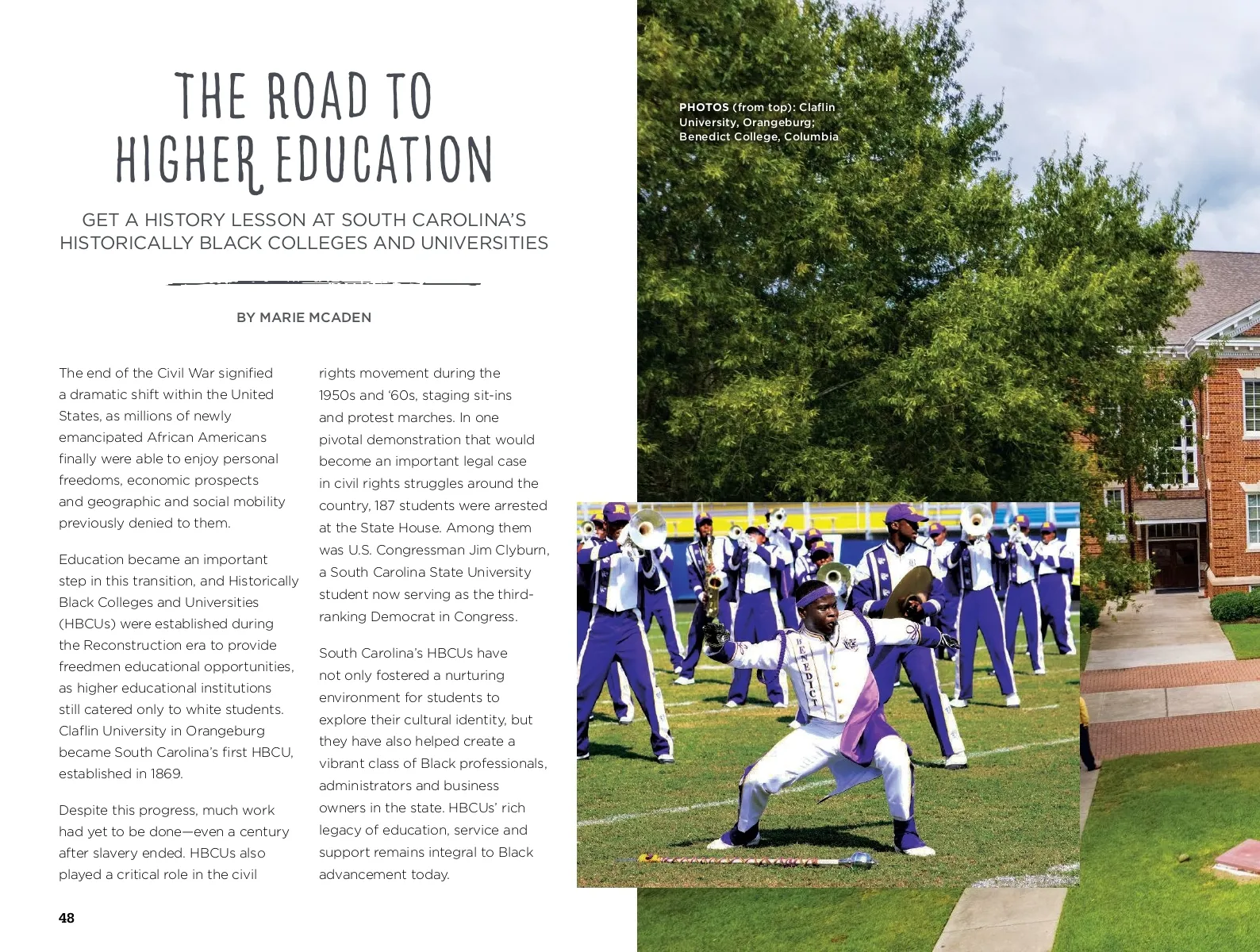
The Road to Higher Education GET A HISTORY LESSON AT SOUTH CAROLINA’S HISTORICALLY BLACK COLLEGES AND UNIVERSITIES BY MARIE MCADEN The end of the Civil War signified a dramatic shift within the United States, as millions of newly emancipated African Americans finally were able to enjoy personal freedoms, economic prospects and geographic and social mobility previously denied to them. Education became an important step in this transition, and Historically Black Colleges and Universities (HBCUs) were established during the Reconstruction era to provide freedmen educational opportunities, as higher educational institutions still catered only to white students. Claflin University in Orangeburg became South Carolina’s first HBCU, established in 1869. Despite this progress, much work had yet to be done—even a century after slavery ended. HBCUs also played a critical role in the civil rights movement during the 1950s and ‘60s, staging sit-ins and protest marches. In one pivotal demonstration that would become an important legal case in civil rights struggles around the country, 187 students were arrested at the State House. Among them was U.S. Congressman Jim Clyburn, a South Carolina State University student now serving as the third-ranking Democrat in Congress. South Carolina’s HBCUs have not only fostered a nurturing environment for students to explore their cultural identity, but they have also helped create a vibrant class of Black professionals, administrators and business owners in the state. HBCUs’ rich legacy of education, service and support remains integral to Black advancement today. PHOTOS (from top): Claflin University, Orangeburg; Benedict College, Columbia 48
South Carolina Vacation Guide SC2022: Page 48