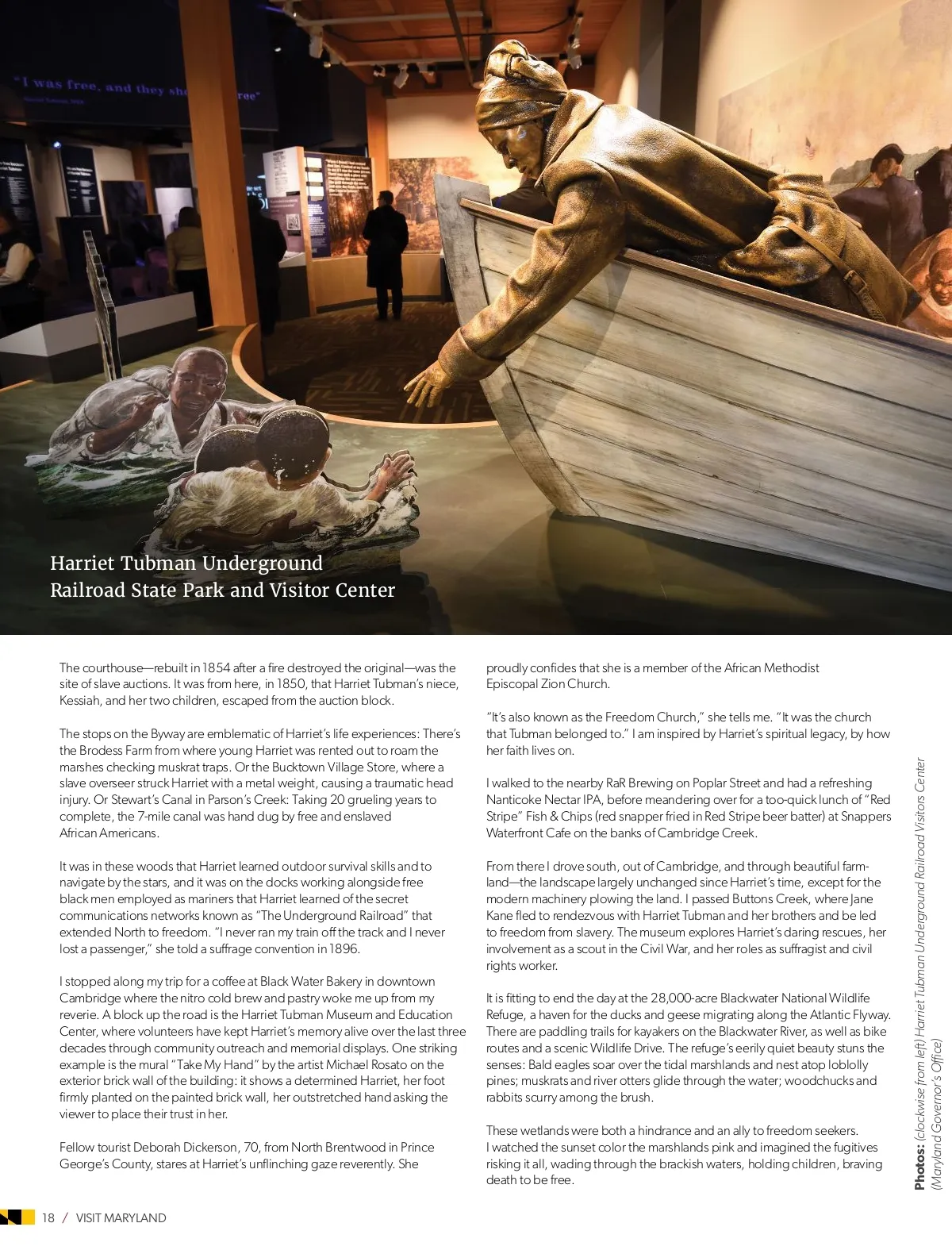
Harriet Tubman Underground Railroad State Park and Visitor Center The courthouse—rebuilt in 1854 after a fire destroyed the original—was the site of slave auctions. It was from here, in 1850, that Harriet Tubman’s niece, Kessiah, and her two children, escaped from the auction block. The stops on the Byway are emblematic of Harriet’s life experiences: There’s the Brodess Farm from where young Harriet was rented out to roam the marshes checking muskrat traps. Or the Bucktown Village Store, where a slave overseer struck Harriet with a metal weight, causing a traumatic head injury. Or Stewart’s Canal in Parson’s Creek: Taking 20 grueling years to complete, the 7-mile canal was hand dug by free and enslaved African Americans. It was in these woods that Harriet learned outdoor survival skills and to navigate by the stars, and it was on the docks working alongside free black men employed as mariners that Harriet learned of the secret communications networks known as “The Underground Railroad” that extended North to freedom. “I never ran my train off the track and I never lost a passenger,” she told a suffrage convention in 1896. I stopped along my trip for a coffee at Black Water Bakery in downtown Cambridge where the nitro cold brew and pastry woke me up from my reverie. A block up the road is the Harriet Tubman Museum and Education Center, where volunteers have kept Harriet’s memory alive over the last three decades through community outreach and memorial displays. One striking example is the mural “Take My Hand” by the artist Michael Rosato on the exterior brick wall of the building: it shows a determined Harriet, her foot firmly planted on the painted brick wall, her outstretched hand asking the viewer to place their trust in her. Fellow tourist Deborah Dickerson, 70, from North Brentwood in Prince George’s County, stares at Harriet’s unflinching gaze reverently. She proudly confides that she is a member of the African Methodist Episcopal Zion Church. “It’s also known as the Freedom Church,” she tells me. “It was the church that Tubman belonged to.” I am inspired by Harriet’s spiritual legacy, by how her faith lives on. I walked to the nearby RaR Brewing on Poplar Street and had a refreshing Nanticoke Nectar IPA, before meandering over for a too-quick lunch of “Red Stripe” Fish & Chips (red snapper fried in Red Stripe beer batter) at Snappers Waterfront Cafe on the banks of Cambridge Creek. From there I drove south, out of Cambridge, and through beautiful farm-land—the landscape largely unchanged since Harriet’s time, except for the modern machinery plowing the land. I passed Buttons Creek, where Jane Kane fled to rendezvous with Harriet Tubman and her brothers and be led to freedom from slavery. The museum explores Harriet’s daring rescues, her involvement as a scout in the Civil War, and her roles as suffragist and civil rights worker. It is fitting to end the day at the 28,000-acre Blackwater National Wildlife Refuge, a haven for the ducks and geese migrating along the Atlantic Flyway. There are paddling trails for kayakers on the Blackwater River, as well as bike routes and a scenic Wildlife Drive. The refuge’s eerily quiet beauty stuns the senses: Bald eagles soar over the tidal marshlands and nest atop loblolly pines; muskrats and river otters glide through the water; woodchucks and rabbits scurry among the brush. These wetlands were both a hindrance and an ally to freedom seekers. I watched the sunset color the marshlands pink and imagined the fugitives risking it all, wading through the brackish waters, holding children, braving death to be free. Photos: (clockwise from left) Harriet Tubman Underground Railroad Visitors Center (Maryland Governor’s Office) 18 / VISIT MARYLAND
Maryland Official Visitors Guide 2022 Maryland Maryland Official Visitors Guide: Page 18