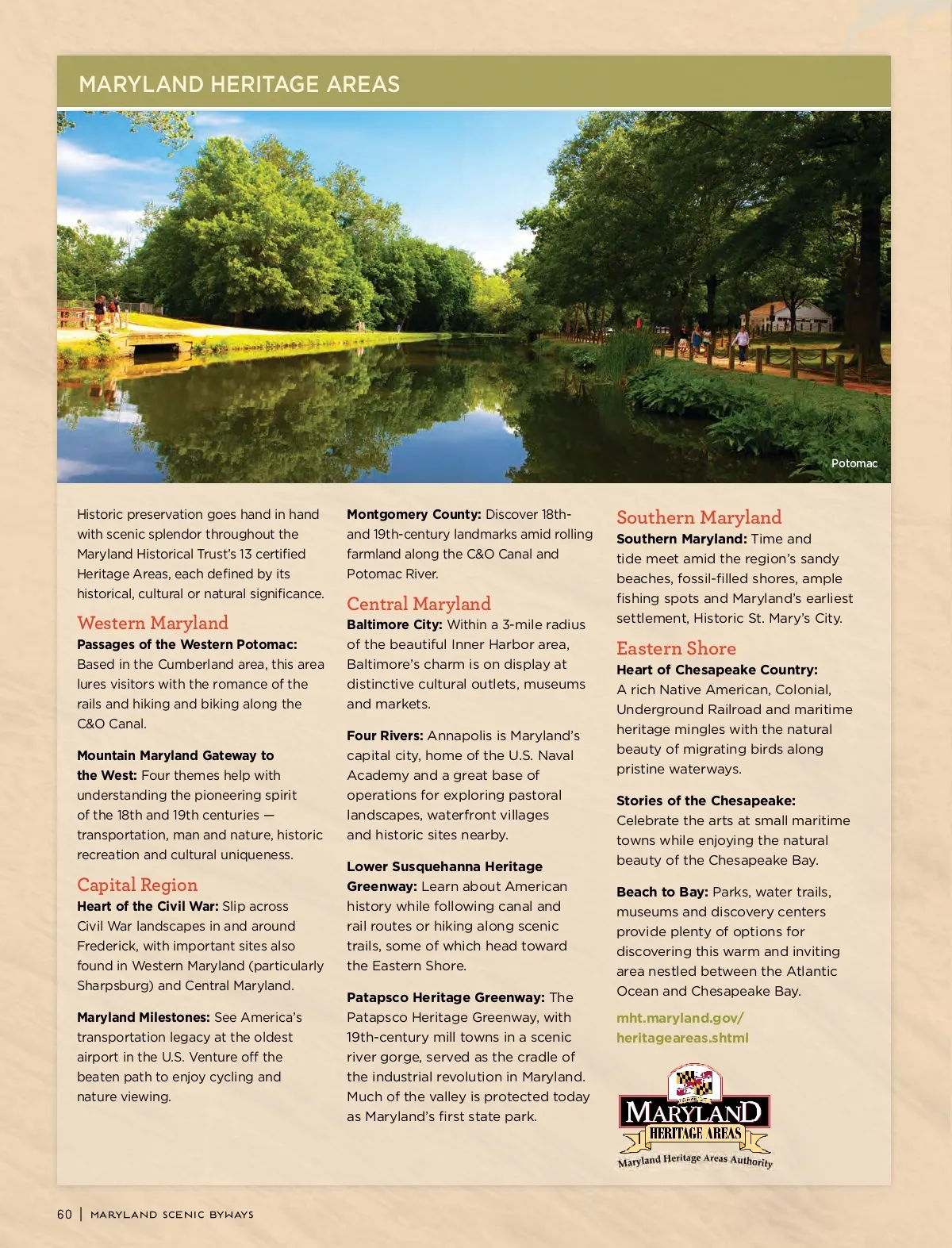
MARYLAND HISTORIC DISTRICTS Annapolis MARYLAND CIVIL WAR TRAILS Nearly every county in Maryland is home to one or more historic preservation commissions, providing advocacy and program support for historic districts stretching from Frostburg to Snow Hill. www.mahdc.org Sharpsburg MARYLAND WINE TRAILS Five Civil War driving tours (each incorporating a variety of recreation diversions) take you beyond the battlefi elds of Antietam, South Mountain and Monocacy to trace troop movements during the Gettysburg campaign and the pursuit of John Wilkes Booth after the assassination of President Lincoln. Antietam Campaign: Follow the September 1862 march of Gen. Robert E. Lee’s Rebel forces, proceeding through South Mountain and ending in Sharpsburg, site of the war’s bloodiest single-day battle. Attack on Washington: Follow the route of Confederate Gen. Jubal A. Early’s July 1864 invasion of Maryland and attack on Washington, D.C., an unsuccessful attempt to release Confederate prisoners, and the last major Confederate invasion of the North. Baltimore Region: Maryland’s largest city was not only popular for its navigable harbor, four railroads and proximity to Washington, D.C., but was also the site of the Civil War’s fi rst bloodshed as Confederate sympathizers rioted in 1861. John Wilkes Booth: Chasing Lincoln’s Assassin: After assassinating President Lincoln in 1865, John Wilkes Booth fl ed south before being cornered and killed in Virginia. Several sites just below Washington, D.C., and throughout Southern Maryland are linked to Booth’s escape. Gettysburg Campaign: Explore destinations where, in 1863, both Union and Confederate soldiers stopped — and sometimes skirmished — on their way to and from one of the most important battles of the war. www.civilwartrails.org 1-877-333-4455 | www.visitmaryland.org | 61 The state’s burgeoning wine scene has much to o er visitors who might like to tilt their glass while admiring the bucolic beauty of local vineyards. Maryland’s trails follow the journey “from grape to bottle” for more than 400 di erent wines. Western Maryland Though not an o cial wine trail, the Mountain Wine Region features a pair of popular Maryland wineries — one near Deep Creek Lake and the other in the foothills of the Alleghany Mountains. Capital Region More than half of Maryland’s wine production comes from vineyards found along the Frederick Wine Trail, the central focus of which is a cluster of four wineries resting on the outskirts of Mount Airy. Two Maryland wineries are also part of the D.C. Metro Wine Region, located just north of our nation’s capital. thrive. Along the way are numerous historic towns, state parks and Thoroughbred horse farms. Several Piedmont wineries are also part of a Gunpowder Wine Trail. A Carroll Wine Trail links three wineries located down the road from the state’s oldest wine festival, held each September at the Carroll County Farm Museum. Southern Maryland Southern hospitality blends with pastoral splendor along a Patuxent Wine Trail that includes seven wineries bounded by the Chesapeake Bay and the Patuxent and Potomac rivers. Central Maryland Across the countryside that lies beyond Baltimore’s northern border, a Piedmont Wine Trail visits the land where Maryland wine began and more than a half-dozen nationally recognized wineries continue to Eastern Shore The sandy soil on the Chesapeake Bay’s Eastern Shore has given life to 12 Maryland wineries within a short drive of beaches, boutiques and superb seafood dining. www.marylandwine.com
MD Scenic Byways Digital Guide: Page 61