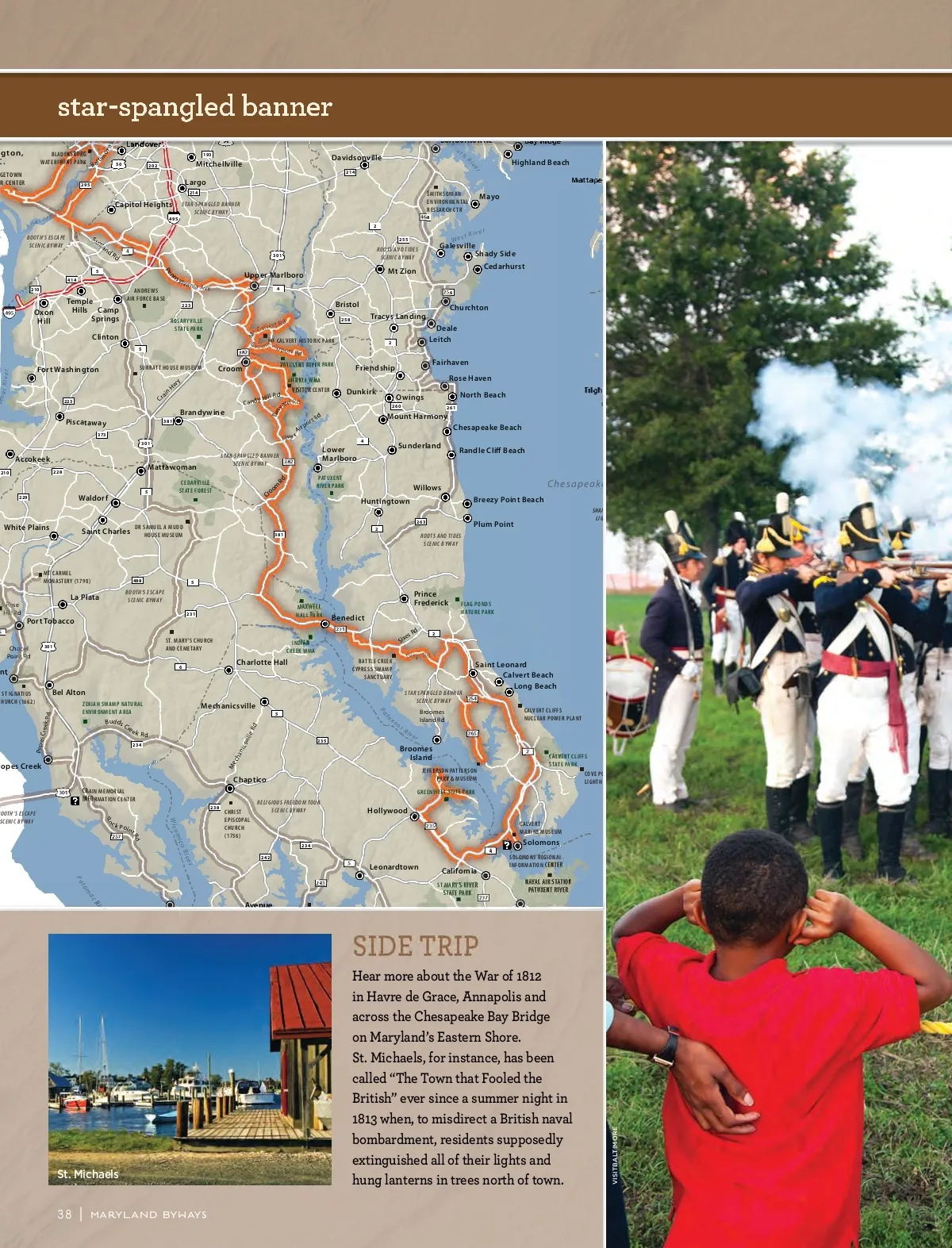
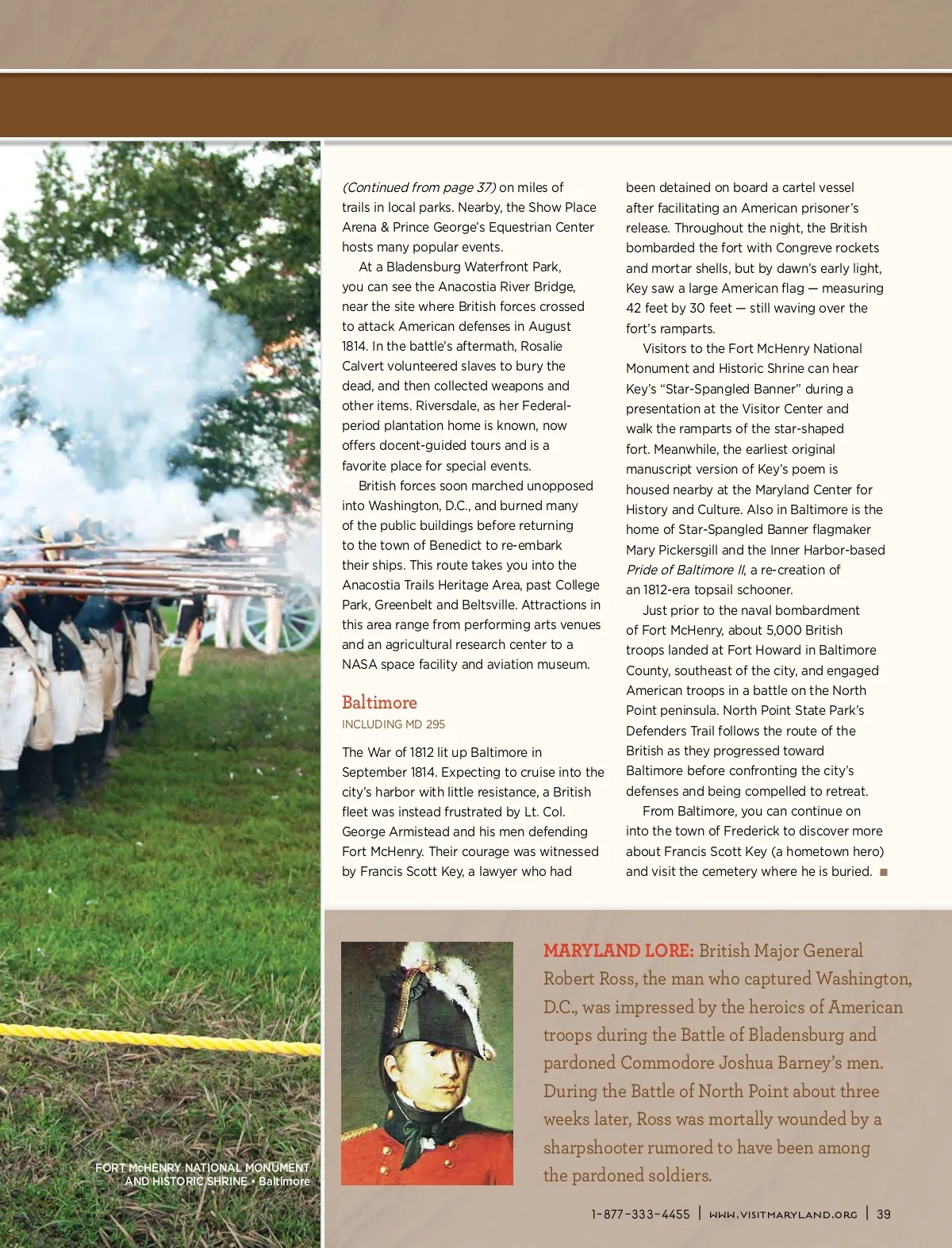
(Continued from page 37) on miles of trails in local parks. Nearby, the Show Place Arena & Prince George’s Equestrian Center hosts many popular events. At a Bladensburg Waterfront Park, you can see the Anacostia River Bridge, near the site where British forces crossed to attack American defenses in August 1814. In the battle’s aftermath, Rosalie Calvert volunteered slaves to bury the dead, and then collected weapons and other items. Riversdale, as her Federal-period plantation home is known, now o ers docent-guided tours and is a favorite place for special events. British forces soon marched unopposed into Washington, D.C., and burned many of the public buildings before returning to the town of Benedict to re-embark their ships. This route takes you into the Anacostia Trails Heritage Area, past College Park, Greenbelt and Beltsville. Attractions in this area range from performing arts venues and an agricultural research center to a NASA space facility and aviation museum. been detained on board a cartel vessel after facilitating an American prisoner’s release. Throughout the night, the British bombarded the fort with Congreve rockets and mortar shells, but by dawn’s early light, Key saw a large American fl ag — measuring 42 feet by 30 feet — still waving over the fort’s ramparts. Visitors to the Fort McHenry National Monument and Historic Shrine can hear Key’s “Star-Spangled Banner” during a presentation at the Visitor Center and walk the ramparts of the star-shaped fort. Meanwhile, the earliest original manuscript version of Key’s poem is housed nearby at the Maryland Center for History and Culture. Also in Baltimore is the home of Star-Spangled Banner fl agmaker Mary Pickersgill and the Inner Harbor-based Pride of Baltimore II, a re-creation of an 1812-era topsail schooner. Just prior to the naval bombardment of Fort McHenry, about 5,000 British troops landed at Fort Howard in Baltimore County, southeast of the city, and engaged American troops in a battle on the North Point peninsula. North Point State Park’s Defenders Trail follows the route of the British as they progressed toward Baltimore before confronting the city’s defenses and being compelled to retreat. From Baltimore, you can continue on into the town of Frederick to discover more about Francis Scott Key (a hometown hero) and visit the cemetery where he is buried. ■ Baltimore INCLUDING MD 295 The War of 1812 lit up Baltimore in September 1814. Expecting to cruise into the city’s harbor with little resistance, a British fl eet was instead frustrated by Lt. Col. George Armistead and his men defending Fort McHenry. Their courage was witnessed by Francis Scott Key, a lawyer who had FORT McHENRY NATIONAL MONUMENT AND HISTORIC SHRINE • Baltimore MARYLAND LORE: British Major General Robert Ross, the man who captured Washington, D.C., was impressed by the heroics of American troops during the Battle of Bladensburg and pardoned Commodore Joshua Barney’s men. During the Battle of North Point about three weeks later, Ross was mortally wounded by a sharpshooter rumored to have been among the pardoned soldiers. 1-877-333-4455 | www.visitmaryland.org | 39
MD Scenic Byways Digital Guide: Page 39