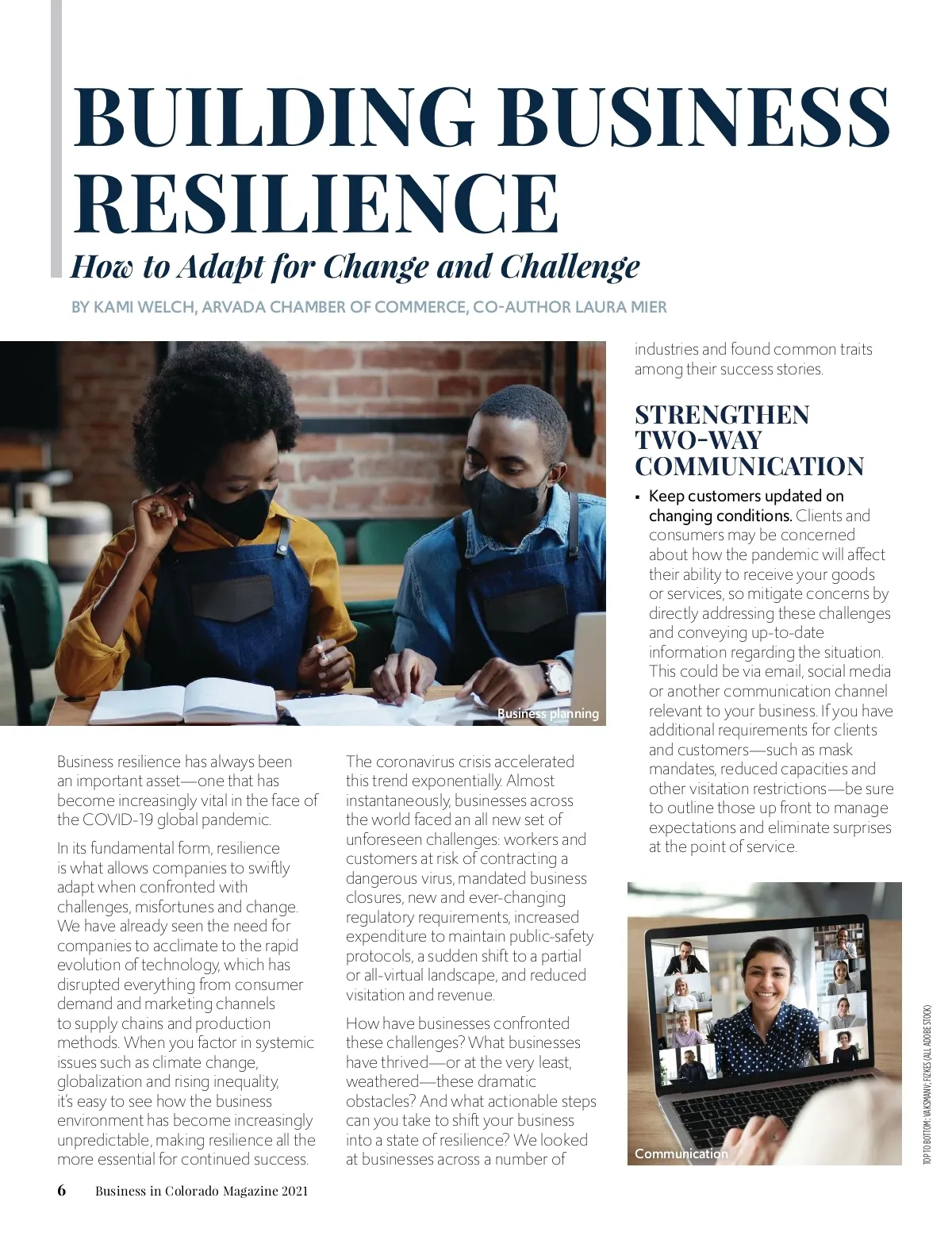
How to Adapt for Change and Challenge BUILDING BUSINESS RESILIENCE industries and found common traits among their success stories. BY KAMI WELCH, ARVADA CHAMBER OF COMMERCE, CO-AUTHOR LAURA MIER STRENGTHEN TWO-WAY COMMUNICATION • Keep customers updated on changing conditions. Clients and consumers may be concerned about how the pandemic will affect their ability to receive your goods or services, so mitigate concerns by directly addressing these challenges and conveying up-to-date information regarding the situation. This could be via email, social media or another communication channel relevant to your business. If you have additional requirements for clients and customers—such as mask mandates, reduced capacities and other visitation restrictions—be sure to outline those up front to manage expectations and eliminate surprises at the point of service. Business planning Business resilience has always been an important asset—one that has become increasingly vital in the face of the COVID-19 global pandemic. In its fundamental form, resilience is what allows companies to swiftly adapt when confronted with challenges, misfortunes and change. We have already seen the need for companies to acclimate to the rapid evolution of technology, which has disrupted everything from consumer demand and marketing channels to supply chains and production methods. When you factor in systemic issues such as climate change, globalization and rising inequality, it’s easy to see how the business environment has become increasingly unpredictable, making resilience all the more essential for continued success. 6 Business in Colorado Magazine 2021 How have businesses confronted these challenges? What businesses have thrived—or at the very least, weathered—these dramatic obstacles? And what actionable steps can you take to shift your business into a state of resilience? We looked at businesses across a number of Communication TOP TO BOTTOM: VAKSMANV; FIZKES (ALL ADOBE STOCK) The coronavirus crisis accelerated this trend exponentially. Almost instantaneously, businesses across the world faced an all new set of unforeseen challenges: workers and customers at risk of contracting a dangerous virus, mandated business closures, new and ever-changing regulatory requirements, increased expenditure to maintain public-safety protocols, a sudden shift to a partial or all-virtual landscape, and reduced visitation and revenue.
Business in Colorado 2021 Business in Colorado: Page 6