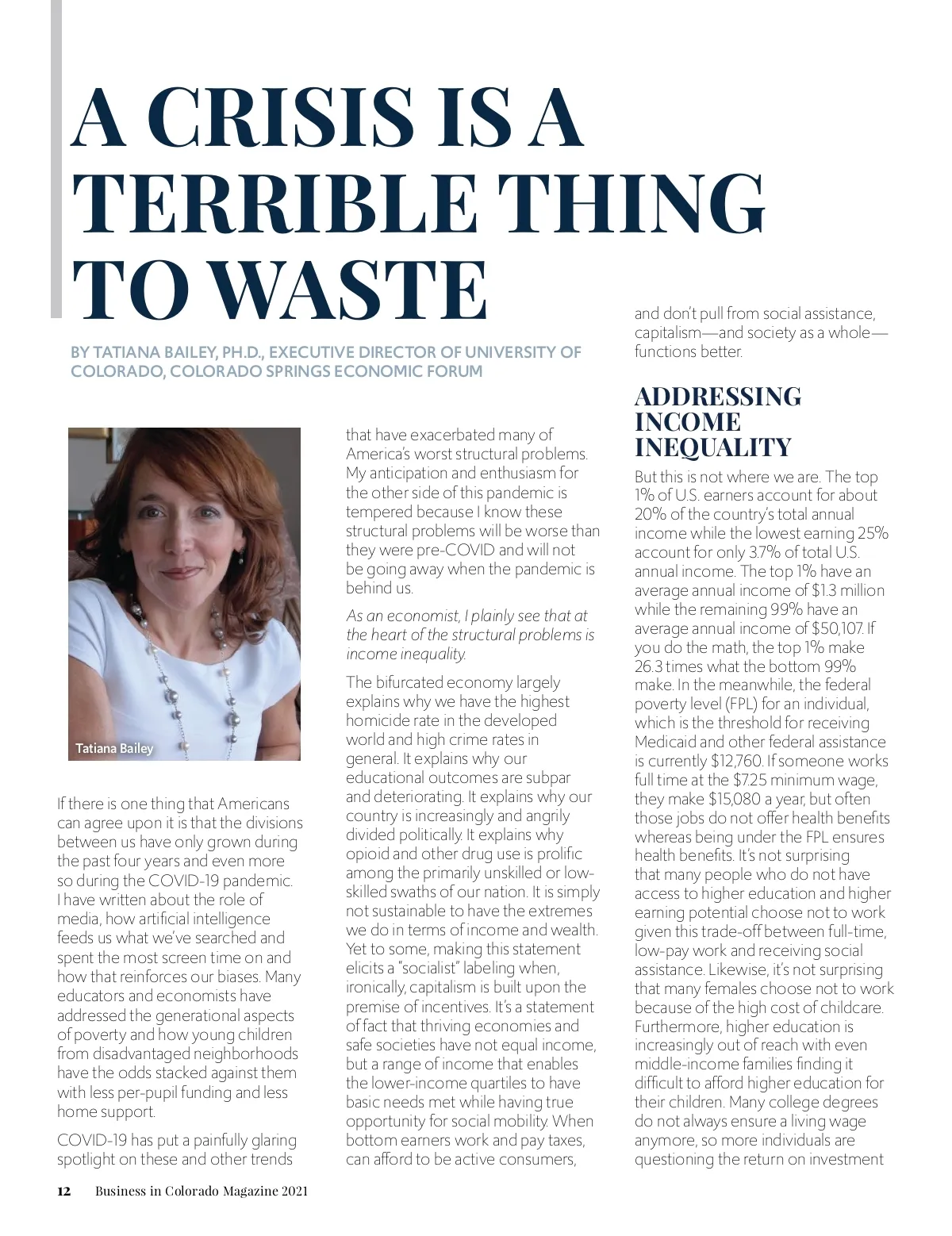
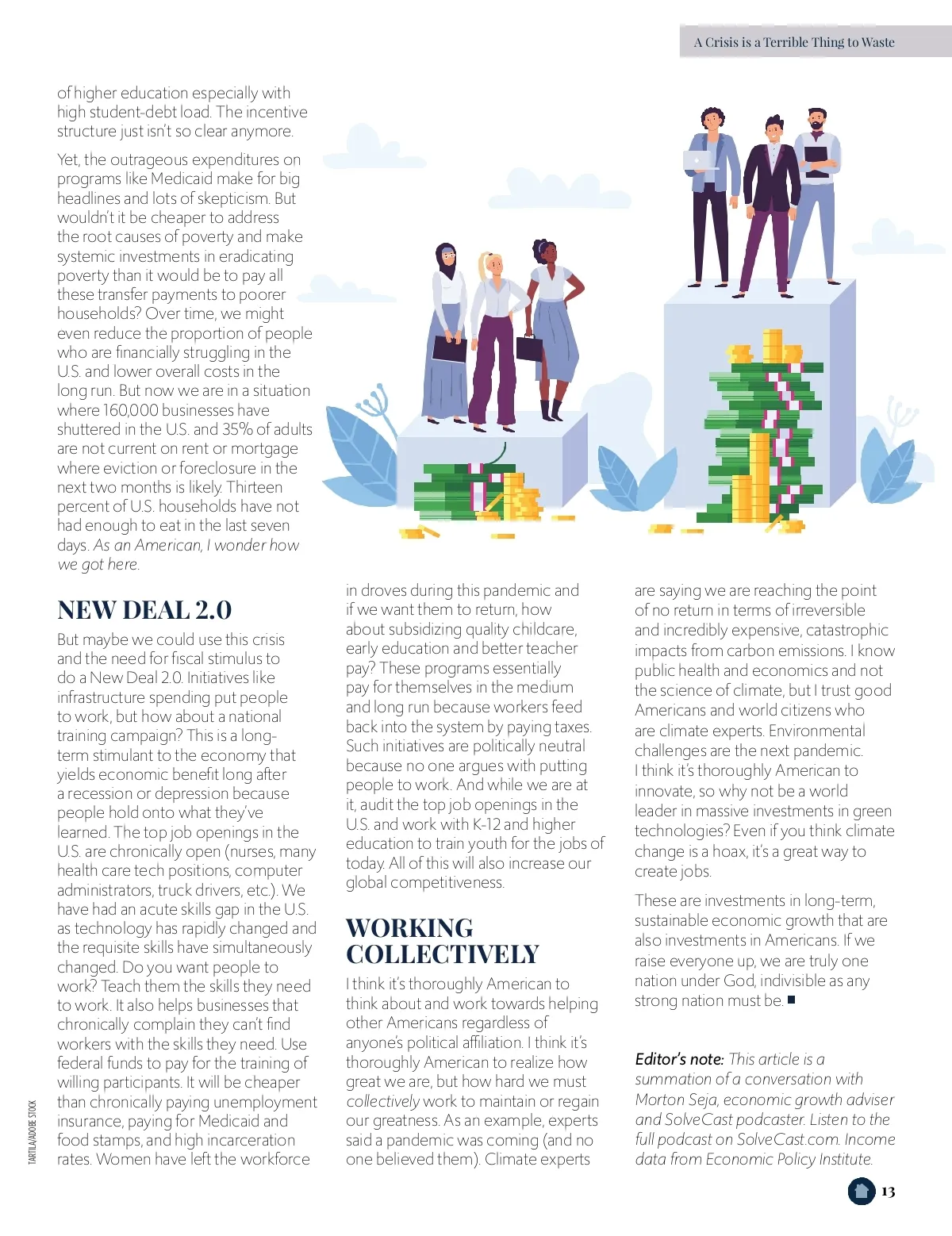
A CRISIS IS A TERRIBLE THING TO WASTE BY TATIANA BAILEY, PH.D., EXECUTIVE DIRECTOR OF UNIVERSITY OF COLORADO, COLORADO SPRINGS ECONOMIC FORUM that have exacerbated many of America’s worst structural problems. My anticipation and enthusiasm for the other side of this pandemic is tempered because I know these structural problems will be worse than they were pre-COVID and will not be going away when the pandemic is behind us. As an economist, I plainly see that at the heart of the structural problems is income inequality. The bifurcated economy largely explains why we have the highest homicide rate in the developed world and high crime rates in general. It explains why our educational outcomes are subpar and deteriorating. It explains why our country is increasingly and angrily divided politically. It explains why opioid and other drug use is prolific among the primarily unskilled or low-skilled swaths of our nation. It is simply not sustainable to have the extremes we do in terms of income and wealth. Yet to some, making this statement elicits a “socialist” labeling when, ironically, capitalism is built upon the premise of incentives. It’s a statement of fact that thriving economies and safe societies have not equal income, but a range of income that enables the lower-income quartiles to have basic needs met while having true opportunity for social mobility. When bottom earners work and pay taxes, can afford to be active consumers, and don’t pull from social assistance, capitalism—and society as a whole— functions better. ADDRESSING INCOME INEQUALITY But this is not where we are. The top 1% of U.S. earners account for about 20% of the country’s total annual income while the lowest earning 25% account for only 3.7% of total U.S. annual income. The top 1% have an average annual income of $1.3 million while the remaining 99% have an average annual income of $50,107. If you do the math, the top 1% make 26.3 times what the bottom 99% make. In the meanwhile, the federal poverty level (FPL) for an individual, which is the threshold for receiving Medicaid and other federal assistance is currently $12,760. If someone works full time at the $7.25 minimum wage, they make $15,080 a year, but often those jobs do not offer health benefits whereas being under the FPL ensures health benefits. It’s not surprising that many people who do not have access to higher education and higher earning potential choose not to work given this trade-off between full-time, low-pay work and receiving social assistance. Likewise, it’s not surprising that many females choose not to work because of the high cost of childcare. Furthermore, higher education is increasingly out of reach with even middle-income families finding it difficult to afford higher education for their children. Many college degrees do not always ensure a living wage anymore, so more individuals are questioning the return on investment Tatiana Bailey If there is one thing that Americans can agree upon it is that the divisions between us have only grown during the past four years and even more so during the COVID-19 pandemic. I have written about the role of media, how artificial intelligence feeds us what we’ve searched and spent the most screen time on and how that reinforces our biases. Many educators and economists have addressed the generational aspects of poverty and how young children from disadvantaged neighborhoods have the odds stacked against them with less per-pupil funding and less home support. COVID-19 has put a painfully glaring spotlight on these and other trends 12 Business in Colorado Magazine 2021
Business in Colorado 2021 Business in Colorado: Page 12