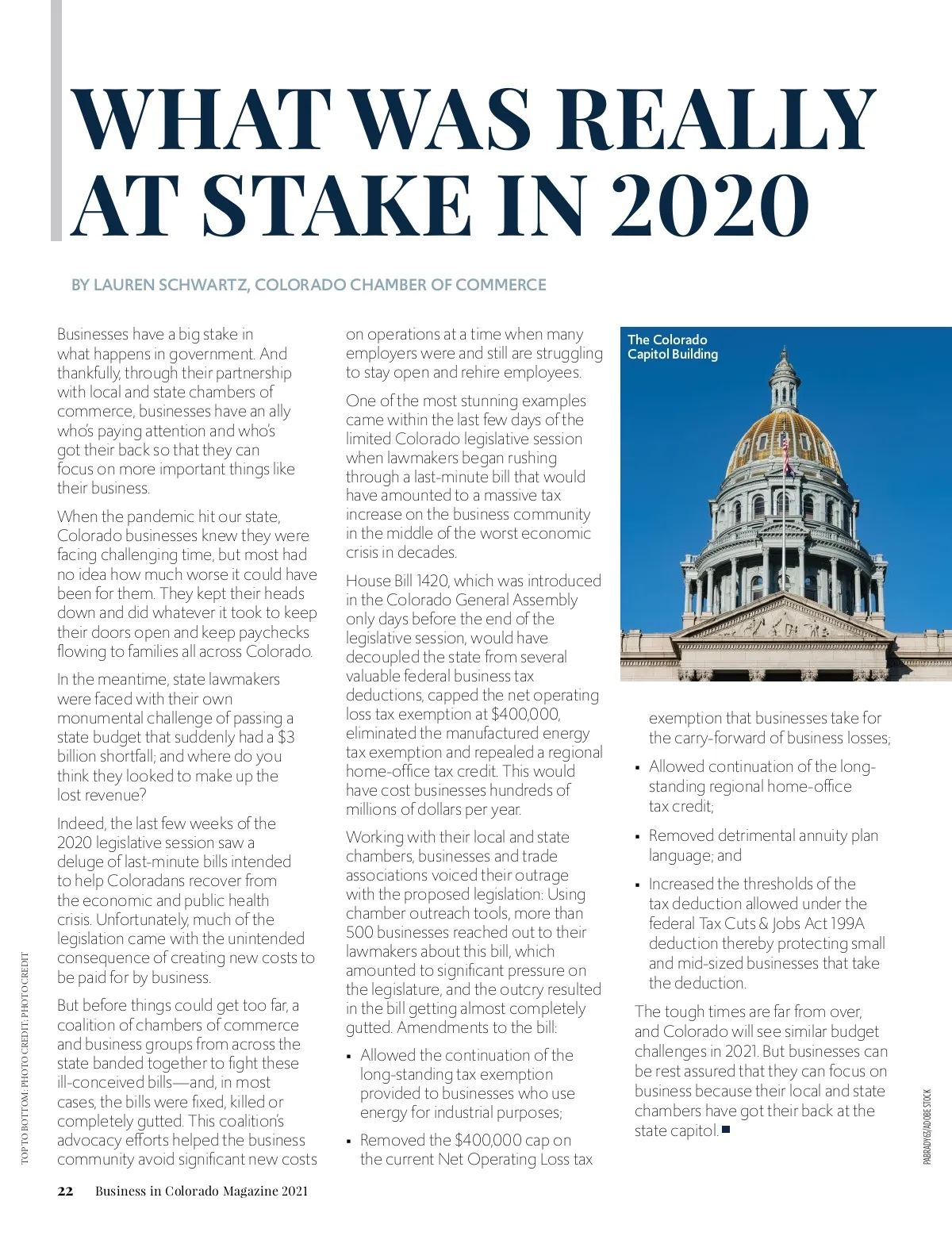
WHAT WAS REALLY AT STAKE IN 2020 BY LAUREN SCHWARTZ, COLORADO CHAMBER OF COMMERCE Businesses have a big stake in what happens in government. And thankfully, through their partnership with local and state chambers of commerce, businesses have an ally who’s paying attention and who’s got their back so that they can focus on more important things like their business. When the pandemic hit our state, Colorado businesses knew they were facing challenging time, but most had no idea how much worse it could have been for them. They kept their heads down and did whatever it took to keep their doors open and keep paychecks flowing to families all across Colorado. In the meantime, state lawmakers were faced with their own monumental challenge of passing a state budget that suddenly had a $3 billion shortfall; and where do you think they looked to make up the lost revenue? Indeed, the last few weeks of the 2020 legislative session saw a deluge of last-minute bills intended to help Coloradans recover from the economic and public health crisis. Unfortunately, much of the legislation came with the unintended consequence of creating new costs to be paid for by business. But before things could get too far, a coalition of chambers of commerce and business groups from across the state banded together to fight these ill-conceived bills—and, in most cases, the bills were fixed, killed or completely gutted. This coalition’s advocacy efforts helped the business community avoid significant new costs 22 Business in Colorado Magazine 2021 on operations at a time when many employers were and still are struggling to stay open and rehire employees. One of the most stunning examples came within the last few days of the limited Colorado legislative session when lawmakers began rushing through a last-minute bill that would have amounted to a massive tax increase on the business community in the middle of the worst economic crisis in decades. House Bill 1420, which was introduced in the Colorado General Assembly only days before the end of the legislative session, would have decoupled the state from several valuable federal business tax deductions, capped the net operating loss tax exemption at $400,000, eliminated the manufactured energy tax exemption and repealed a regional home-office tax credit. This would have cost businesses hundreds of millions of dollars per year. Working with their local and state chambers, businesses and trade associations voiced their outrage with the proposed legislation: Using chamber outreach tools, more than 500 businesses reached out to their lawmakers about this bill, which amounted to significant pressure on the legislature, and the outcry resulted in the bill getting almost completely gutted. Amendments to the bill: • Allowed the continuation of the long-standing tax exemption provided to businesses who use energy for industrial purposes; • Removed the $400,000 cap on the current Net Operating Loss tax The Colorado Capitol Building exemption that businesses take for the carry-forward of business losses; • Allowed continuation of the long-standing regional home-office tax credit; • Removed detrimental annuity plan language; and • Increased the thresholds of the tax deduction allowed under the federal Tax Cuts & Jobs Act 199A deduction thereby protecting small and mid-sized businesses that take the deduction. The tough times are far from over, and Colorado will see similar budget challenges in 2021. But businesses can be rest assured that they can focus on business because their local and state chambers have got their back at the state capitol. TOP TO BOTTOM: PHOTO CREDIT; PHOTO CREDIT PABRADY63/ADOBE STOCK
Business in Colorado 2021 Business in Colorado: Page 22