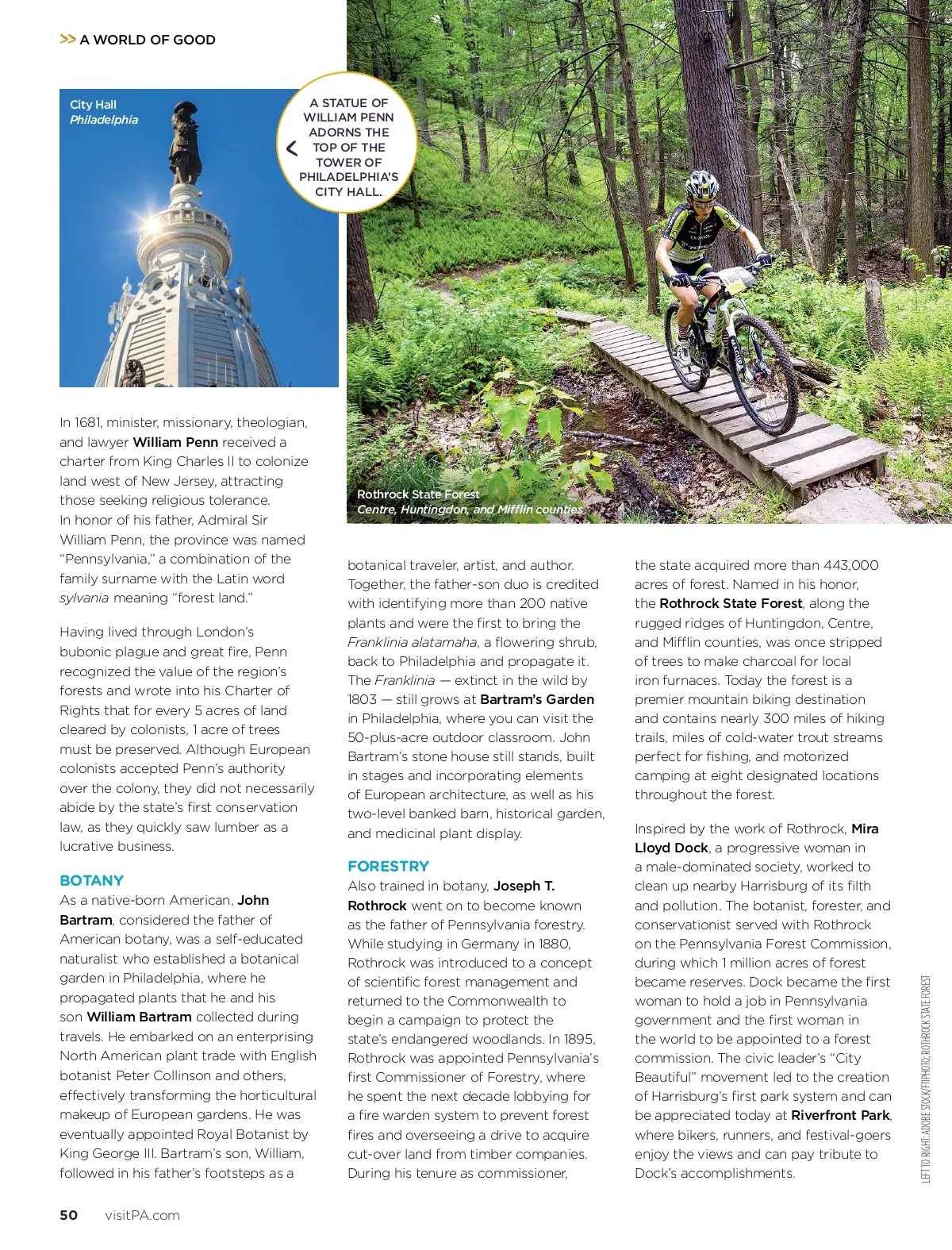
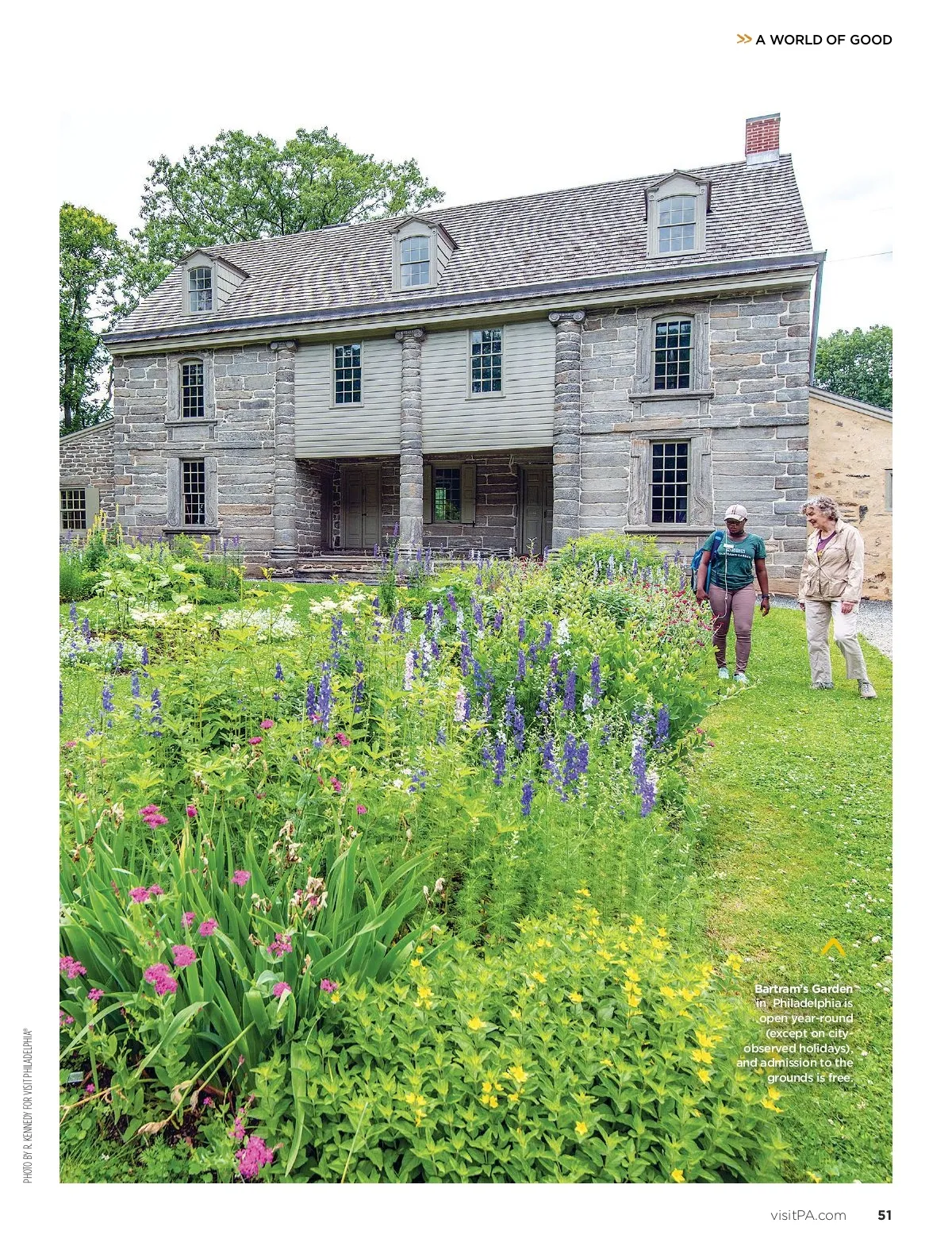
>> A WORLD OF GOOD City Hall Philadelphia A STATUE OF WILLIAM PENN ADORNS THE TOP OF THE TOWER OF PHILADELPHIA’S CITY HALL. In 1681, minister, missionary, theologian, and lawyer William Penn received a charter from King Charles II to colonize land west of New Jersey, attracting those seeking religious tolerance. In honor of his father, Admiral Sir William Penn, the province was named “Pennsylvania,” a combination of the family surname with the Latin word sylvania meaning “forest land.” Having lived through London’s bubonic plague and great fire, Penn recognized the value of the region’s forests and wrote into his Charter of Rights that for every 5 acres of land cleared by colonists, 1 acre of trees must be preserved. Although European colonists accepted Penn’s authority over the colony, they did not necessarily abide by the state’s first conservation law, as they quickly saw lumber as a lucrative business. Rothrock State Forest Centre, Huntingdon, and Mifflin counties botanical traveler, artist, and author. Together, the father-son duo is credited with identifying more than 200 native plants and were the first to bring the Franklinia alatamaha , a flowering shrub, back to Philadelphia and propagate it. The Franklinia — extinct in the wild by 1803 — still grows at Bartram’s Garden in Philadelphia, where you can visit the 50-plus-acre outdoor classroom. John Bartram’s stone house still stands, built in stages and incorporating elements of European architecture, as well as his two-level banked barn, historical garden, and medicinal plant display. the state acquired more than 443,000 acres of forest. Named in his honor, the Rothrock State Forest , along the rugged ridges of Huntingdon, Centre, and Mifflin counties, was once stripped of trees to make charcoal for local iron furnaces. Today the forest is a premier mountain biking destination and contains nearly 300 miles of hiking trails, miles of cold-water trout streams perfect for fishing, and motorized camping at eight designated locations throughout the forest. Inspired by the work of Rothrock, Mira Lloyd Dock , a progressive woman in a male-dominated society, worked to clean up nearby Harrisburg of its filth and pollution. The botanist, forester, and conservationist served with Rothrock on the Pennsylvania Forest Commission, during which 1 million acres of forest became reserves. Dock became the first woman to hold a job in Pennsylvania government and the first woman in the world to be appointed to a forest commission. The civic leader’s “City Beautiful” movement led to the creation of Harrisburg’s first park system and can be appreciated today at Riverfront Park , where bikers, runners, and festival-goers enjoy the views and can pay tribute to Dock’s accomplishments. BOTANY As a native-born American, John Bartram , considered the father of American botany, was a self-educated naturalist who established a botanical garden in Philadelphia, where he propagated plants that he and his son William Bartram collected during travels. He embarked on an enterprising North American plant trade with English botanist Peter Collinson and others, effectively transforming the horticultural makeup of European gardens. He was eventually appointed Royal Botanist by King George III. Bartram’s son, William, followed in his father’s footsteps as a 50 visitPA.com FORESTRY Also trained in botany, Joseph T. Rothrock went on to become known as the father of Pennsylvania forestry. While studying in Germany in 1880, Rothrock was introduced to a concept of scientific forest management and returned to the Commonwealth to begin a campaign to protect the state’s endangered woodlands. In 1895, Rothrock was appointed Pennsylvania’s first Commissioner of Forestry, where he spent the next decade lobbying for a fire warden system to prevent forest fires and overseeing a drive to acquire cut-over land from timber companies. During his tenure as commissioner, LEFT TO RIGHT: ADOBE STOCK/F11PHOTO; ROTHROCK STATE FOREST
Pennsylvania Happy Traveler Guide 2020: Page 50