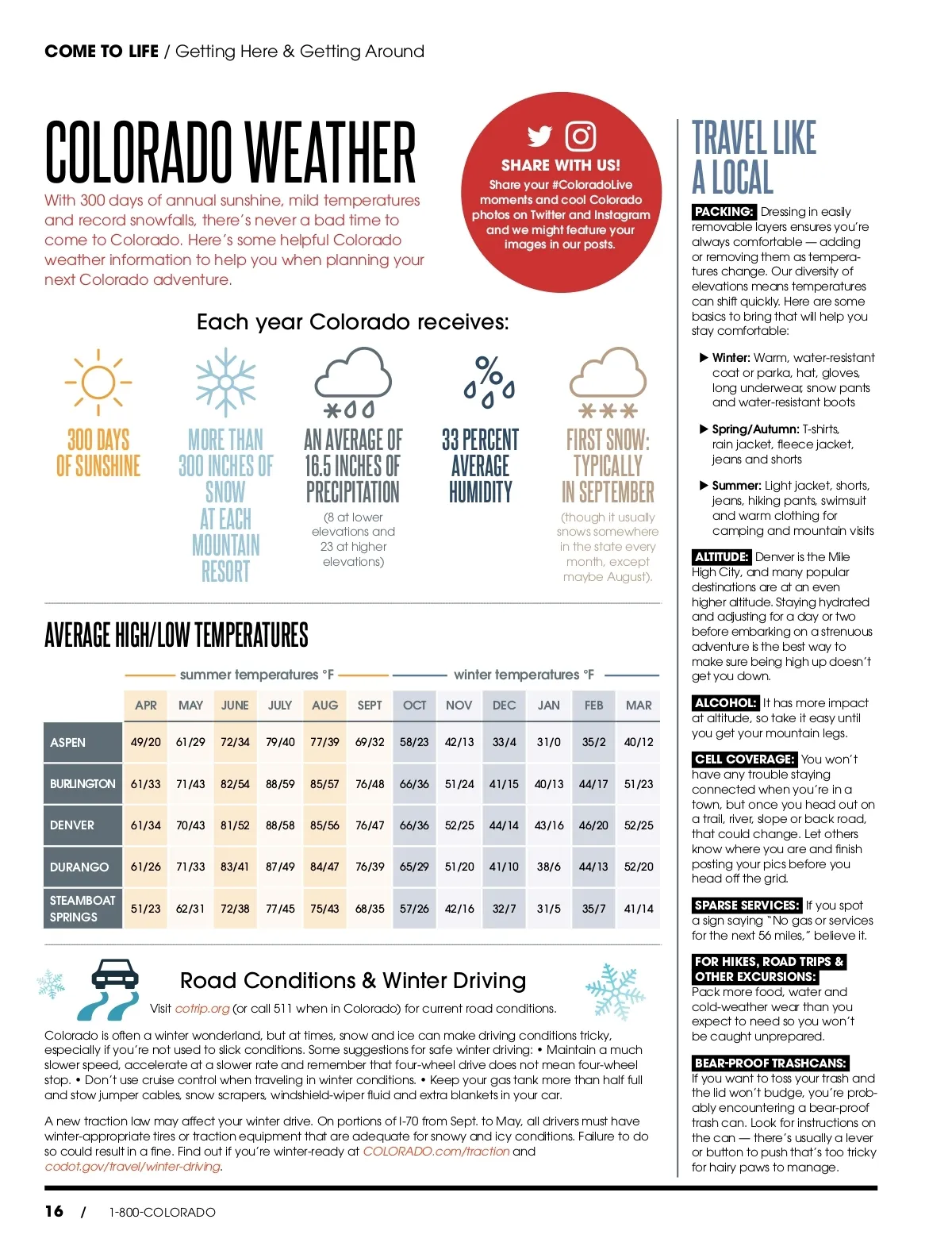
COME TO LIFE / Getting Here & Getting Around COLORADO WEATHER SHARE WITH US! Share your #ColoradoLive moments and cool Colorado photos on Twitter and Instagram and we might feature your images in our posts. With 300 days of annual sunshine, mild temperatures and record snowfalls, there’s never a bad time to come to Colorado. Here’s some helpful Colorado weather information to help you when planning your next Colorado adventure. TRAVEL LIKE A LOCAL PACKING: Dressing in easily removable layers ensures you’re always comfortable — adding or removing them as tempera-tures change. Our diversity of elevations means temperatures can shift quickly. Here are some basics to bring that will help you stay comfortable: Winter: Warm, water-resistant coat or parka, hat, gloves, long underwear, snow pants and water-resistant boots Each year Colorado receives: % 300 DAYS OF SUNSHINE MORE THAN 300 INCHES OF SNOW AT EACH MOUNTAIN RESORT AN AVERAGE OF 16.5 INCHES OF PRECIPITATION (8 at lower elevations and 23 at higher elevations) 33 PERCENT AVERAGE HUMIDITY FIRST SNOW: TYPICALLY IN SEPTEMBER (though it usually snows somewhere in the state every month, except maybe August). Spring/Autumn: T-shirts, rain jacket, fleece jacket, jeans and shorts Summer: Light jacket, shorts, jeans, hiking pants, swimsuit and warm clothing for camping and mountain visits ALTITUDE: Denver is the Mile High City, and many popular destinations are at an even higher altitude. Staying hydrated and adjusting for a day or two before embarking on a strenuous adventure is the best way to make sure being high up doesn’t get you down. ALCOHOL: It has more impact at altitude, so take it easy until you get your mountain legs. CELL COVERAGE: You won’t have any trouble staying connected when you’re in a town, but once you head out on a trail, river, slope or back road, that could change. Let others know where you are and finish posting your pics before you head off the grid. SPARSE SERVICES: If you spot a sign saying “No gas or services for the next 56 miles,” believe it. FOR HIKES, ROAD TRIPS & OTHER EXCURSIONS: Pack more food, water and cold-weather wear than you expect to need so you won’t be caught unprepared. BEAR-PROOF TRASHCANS: If you want to toss your trash and the lid won’t budge, you’re prob-ably encountering a bear-proof trash can. Look for instructions on the can — there’s usually a lever or button to push that’s too tricky for hairy paws to manage. AVERAGE HIGH/LOW TEMPERATURES summer temperatures °F APR ASPEN BURLINGTON DENVER DURANGO STEAMBOAT SPRINGS 49/20 winter temperatures °F SEPT 69/32 MAY 61/29 JUNE 72/34 JULY 79/40 AUG 77/39 OCT 58/23 NOV 42/13 DEC 33/4 JAN 31/0 FEB 35/2 MAR 40/12 61/33 71/43 82/54 88/59 85/57 76/48 66/36 51/24 41/15 40/13 44/17 51/23 61/34 70/43 81/52 88/58 85/56 76/47 66/36 52/25 44/14 43/16 46/20 52/25 61/26 71/33 83/41 87/49 84/47 76/39 65/29 51/20 41/10 38/6 44/13 52/20 51/23 62/31 72/38 77/45 75/43 68/35 57/26 42/16 32/7 31/5 35/7 41/14 Road Conditions & Winter Driving Visit cotrip.org (or call 511 when in Colorado) for current road conditions. Colorado is often a winter wonderland, but at times, snow and ice can make driving conditions tricky, especially if you’re not used to slick conditions. Some suggestions for safe winter driving: • Maintain a much slower speed, accelerate at a slower rate and remember that four-wheel drive does not mean four-wheel stop. • Don’t use cruise control when traveling in winter conditions. • Keep your gas tank more than half full and stow jumper cables, snow scrapers, windshield-wiper fluid and extra blankets in your car. A new traction law may affect your winter drive. On portions of I-70 from Sept. to May, all drivers must have winter-appropriate tires or traction equipment that are adequate for snowy and icy conditions. Failure to do so could result in a fine. Find out if you’re winter-ready at COLORADO.com/traction and codot.gov/travel/winter-driving . 16 / 1-800-COLORADO
Colorado Official State Vacation Guide 2020: Page 16