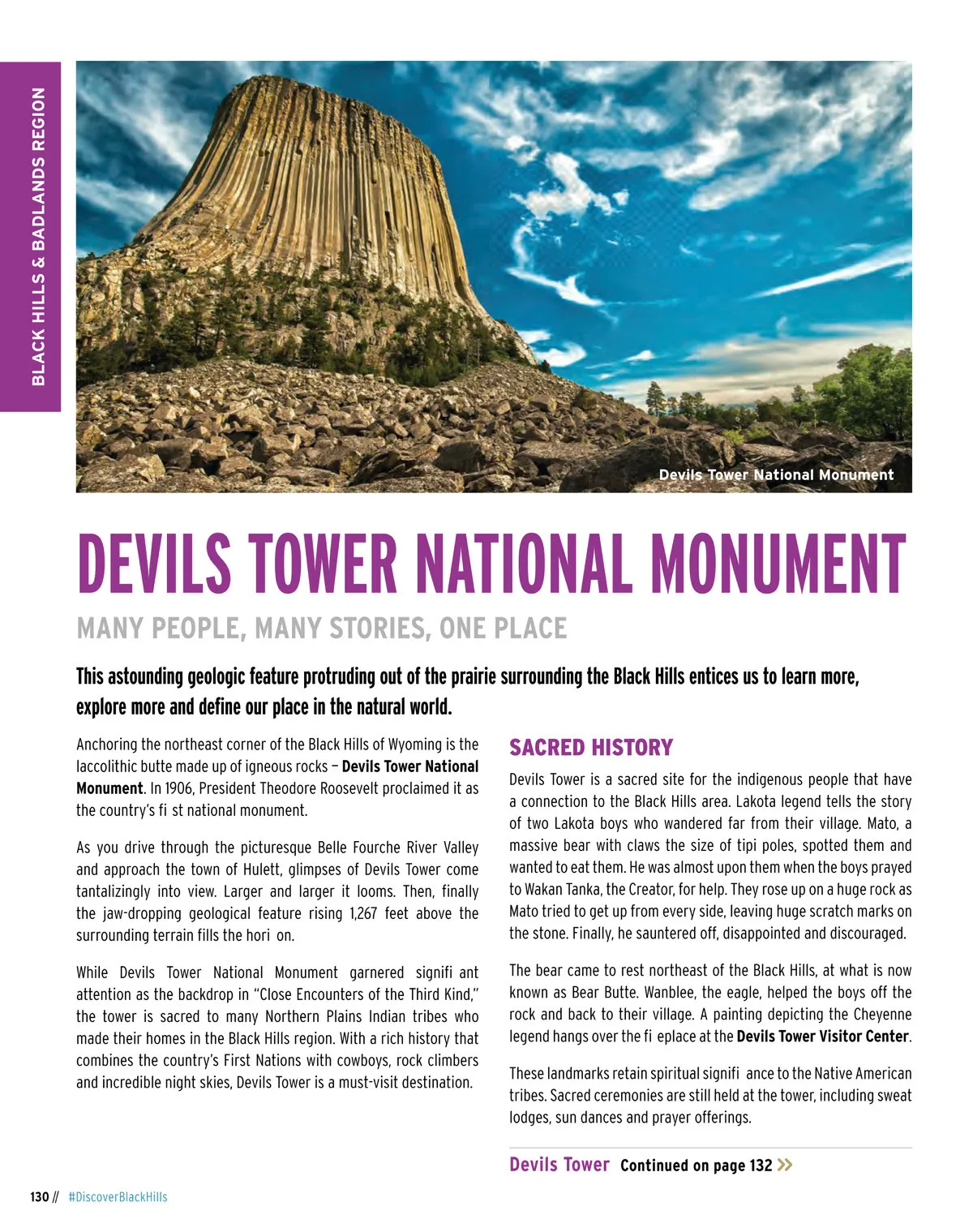
BLACK HILLS & BADLANDS REGION Devils Tower National Monument DEVILS TOWER NATIONAL MONUMENT MANY PEOPLE, MANY STORIES, ONE PLACE This astounding geologic feature protruding out of the prairie surrounding the Black Hills entices us to learn more, explore more and define our place in the natural world. Anchoring the northeast corner of the Black Hills of Wyoming is the laccolithic butte made up of igneous rocks — Devils Tower National Monument . In 1906, President Theodore Roosevelt proclaimed it as the country’s fi st national monument. As you drive through the picturesque Belle Fourche River Valley and approach the town of Hulett, glimpses of Devils Tower come tantalizingly into view. Larger and larger it looms. Then, finally the jaw-dropping geological feature rising 1,267 feet above the surrounding terrain fills the hori on. While Devils Tower National Monument garnered signifi ant attention as the backdrop in “Close Encounters of the Third Kind,” the tower is sacred to many Northern Plains Indian tribes who made their homes in the Black Hills region. With a rich history that combines the country’s First Nations with cowboys, rock climbers and incredible night skies, Devils Tower is a must-visit destination. SACRED HISTORY Devils Tower is a sacred site for the indigenous people that have a connection to the Black Hills area. Lakota legend tells the story of two Lakota boys who wandered far from their village. Mato, a massive bear with claws the size of tipi poles, spotted them and wanted to eat them. He was almost upon them when the boys prayed to Wakan Tanka, the Creator, for help. They rose up on a huge rock as Mato tried to get up from every side, leaving huge scratch marks on the stone. Finally, he sauntered off, disappointed and discouraged. The bear came to rest northeast of the Black Hills, at what is now known as Bear Butte. Wanblee, the eagle, helped the boys off the rock and back to their village. A painting depicting the Cheyenne legend hangs over the fi eplace at the Devils Tower Visitor Center . These landmarks retain spiritual signifi ance to the Native American tribes. Sacred ceremonies are still held at the tower, including sweat lodges, sun dances and prayer offerings. Devils Tower Continued on page 132 130 // #DiscoverBlackHills
South Dakota Vacation Guide South Dakota Vacation Guide 2019: Page 130