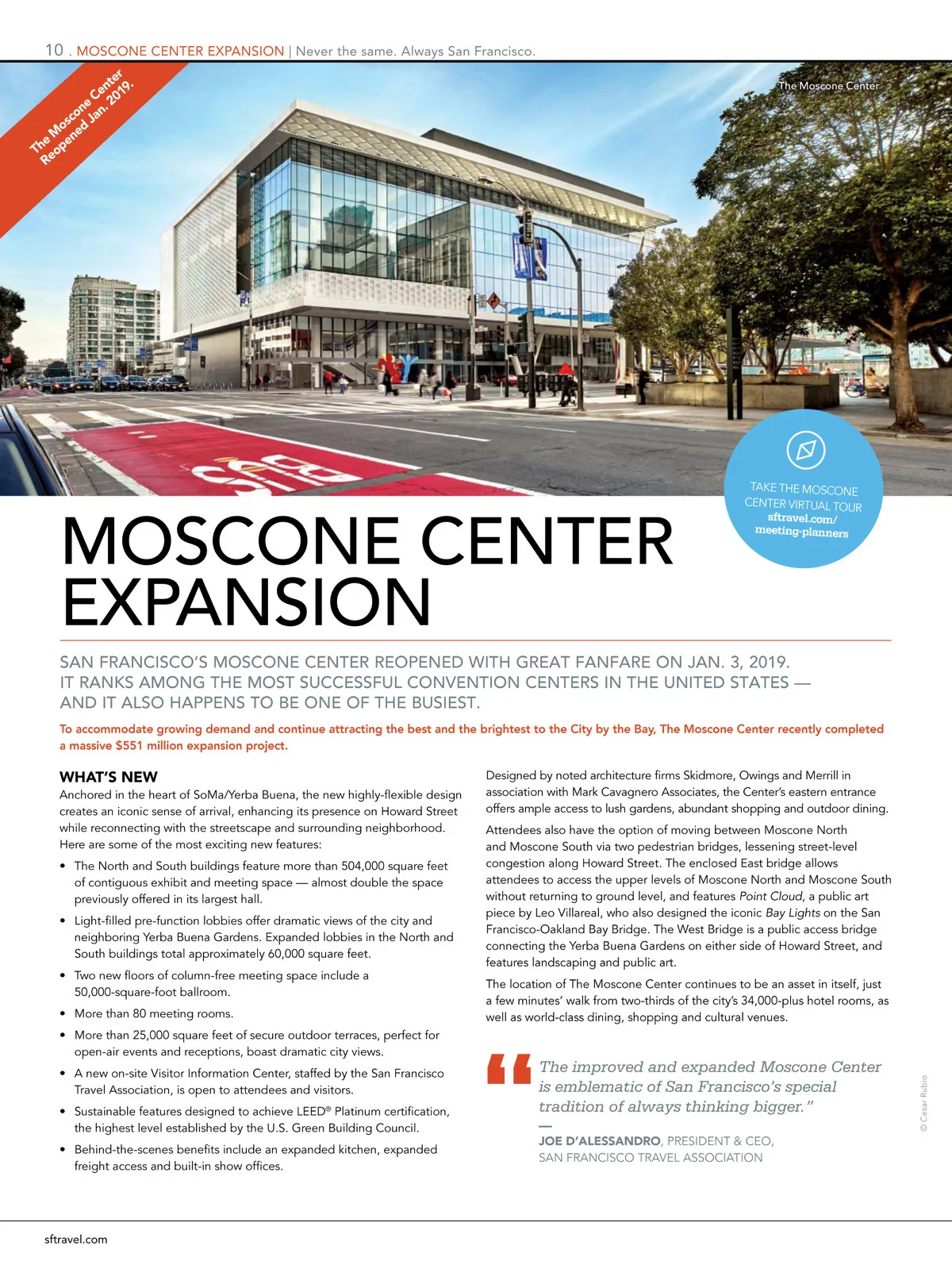
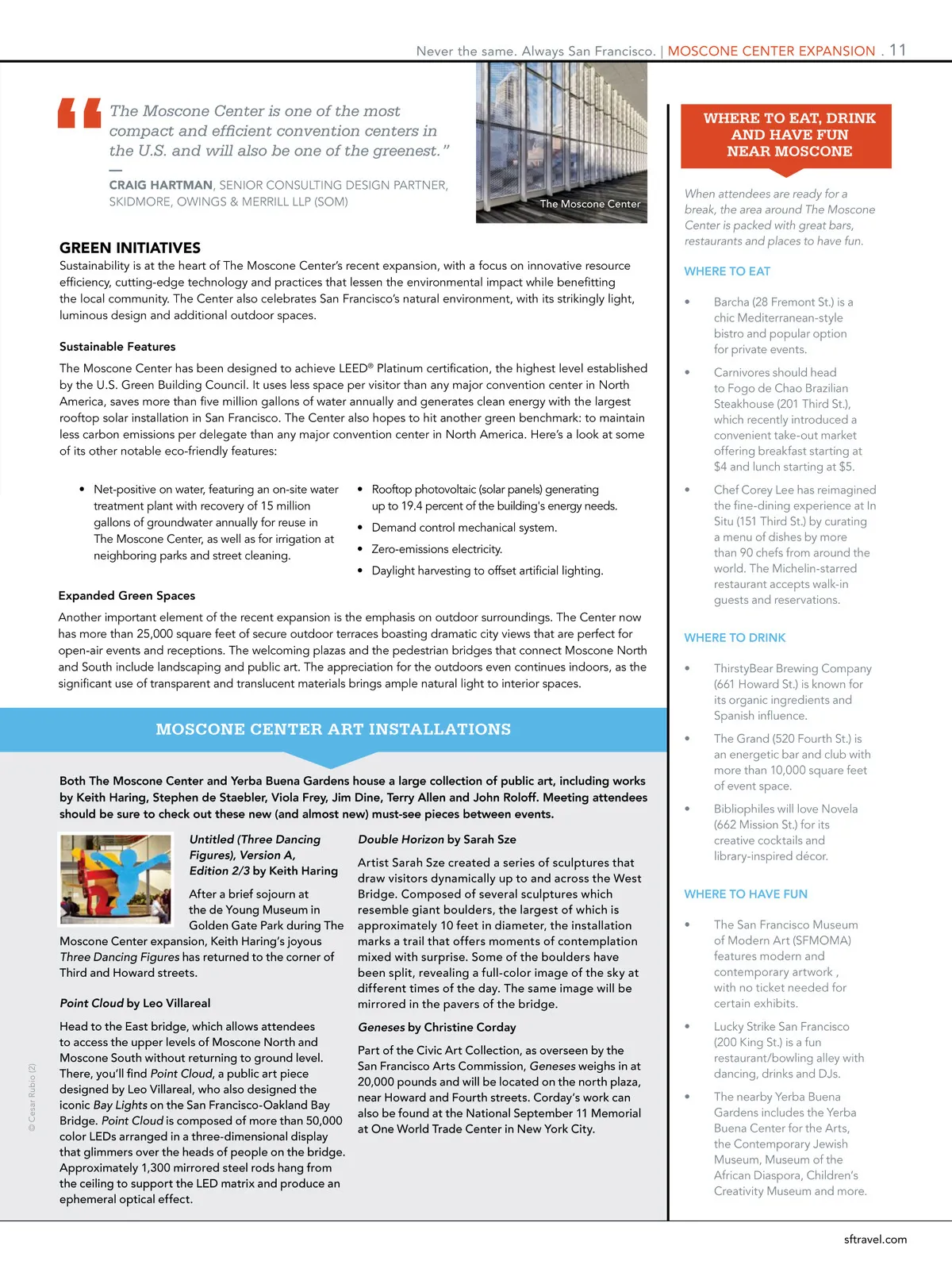
Never the same. Always San Francisco. | MOSCONE CENTER EXPANSION . 11 The Moscone Center is one of the most compact and efficient convention centers in the U.S. and will also be one of the greenest.” CRAIG HARTMAN , SENIOR CONSULTING DESIGN PARTNER, SKIDMORE, OWINGS & MERRILL LLP (SOM) The Moscone Center WHERE TO EAT, DRINK AND HAVE FUN NEAR MOSCONE When attendees are ready for a break, the area around The Moscone Center is packed with great bars, restaurants and places to have fun. WHERE TO EAT • Barcha (28 Fremont St.) is a chic Mediterranean-style bistro and popular option for private events. Carnivores should head to Fogo de Chao Brazilian Steakhouse (201 Third St.), which recently introduced a convenient take-out market offering breakfast starting at $4 and lunch starting at $5. Chef Corey Lee has reimagined the fine-dining experience at In Situ (151 Third St.) by curating a menu of dishes by more than 90 chefs from around the world. The Michelin-starred restaurant accepts walk-in guests and reservations. GREEN INITIATIVES Sustainability is at the heart of The Moscone Center’s recent expansion, with a focus on innovative resource efficiency, cutting-edge technology and practices that lessen the environmental impact while benefitting the local community. The Center also celebrates San Francisco’s natural environment, with its strikingly light, luminous design and additional outdoor spaces. Sustainable Features The Moscone Center has been designed to achieve LEED ® Platinum certification, the highest level established by the U.S. Green Building Council. It uses less space per visitor than any major convention center in North America, saves more than five million gallons of water annually and generates clean energy with the largest rooftop solar installation in San Francisco. The Center also hopes to hit another green benchmark: to maintain less carbon emissions per delegate than any major convention center in North America. Here’s a look at some of its other notable eco-friendly features: • Net-positive on water, featuring an on-site water treatment plant with recovery of 15 million gallons of groundwater annually for reuse in The Moscone Center, as well as for irrigation at neighboring parks and street cleaning. Expanded Green Spaces Another important element of the recent expansion is the emphasis on outdoor surroundings. The Center now has more than 25,000 square feet of secure outdoor terraces boasting dramatic city views that are perfect for open-air events and receptions. The welcoming plazas and the pedestrian bridges that connect Moscone North and South include landscaping and public art. The appreciation for the outdoors even continues indoors, as the significant use of transparent and translucent materials brings ample natural light to interior spaces. • Rooftop photovoltaic (solar panels) generating up to 19.4 percent of the building's energy needs. • Demand control mechanical system. • Zero-emissions electricity. • Daylight harvesting to offset artificial lighting. • • WHERE TO DRINK • ThirstyBear Brewing Company (661 Howard St.) is known for its organic ingredients and Spanish influence. The Grand (520 Fourth St.) is an energetic bar and club with more than 10,000 square feet of event space. Bibliophiles will love Novela (662 Mission St.) for its creative cocktails and library-inspired décor. MOSCONE CENTER ART INSTALLATIONS Both The Moscone Center and Yerba Buena Gardens house a large collection of public art, including works by Keith Haring, Stephen de Staebler, Viola Frey, Jim Dine, Terry Allen and John Roloff. Meeting attendees should be sure to check out these new (and almost new) must-see pieces between events. Untitled (Three Dancing Figures), Version A, Edition 2/3 by Keith Haring After a brief sojourn at the de Young Museum in Golden Gate Park during The Moscone Center expansion, Keith Haring’s joyous Three Dancing Figures has returned to the corner of Third and Howard streets. Point Cloud by Leo Villareal Head to the East bridge, which allows attendees to access the upper levels of Moscone North and Moscone South without returning to ground level. There, you’ll find Point Cloud , a public art piece designed by Leo Villareal, who also designed the iconic Bay Lights on the San Francisco-Oakland Bay Bridge. Point Cloud is composed of more than 50,000 color LEDs arranged in a three-dimensional display that glimmers over the heads of people on the bridge. Approximately 1,300 mirrored steel rods hang from the ceiling to support the LED matrix and produce an ephemeral optical effect. Double Horizon by Sarah Sze Artist Sarah Sze created a series of sculptures that draw visitors dynamically up to and across the West Bridge. Composed of several sculptures which resemble giant boulders, the largest of which is approximately 10 feet in diameter, the installation marks a trail that offers moments of contemplation mixed with surprise. Some of the boulders have been split, revealing a full-color image of the sky at different times of the day. The same image will be mirrored in the pavers of the bridge. Geneses by Christine Corday Part of the Civic Art Collection, as overseen by the San Francisco Arts Commission, Geneses weighs in at 20,000 pounds and will be located on the north plaza, near Howard and Fourth streets. Corday’s work can also be found at the National September 11 Memorial at One World Trade Center in New York City. • • WHERE TO HAVE FUN • The San Francisco Museum of Modern Art (SFMOMA) features modern and contemporary artwork , with no ticket needed for certain exhibits. Lucky Strike San Francisco (200 King St.) is a fun restaurant/bowling alley with dancing, drinks and DJs. The nearby Yerba Buena Gardens includes the Yerba Buena Center for the Arts, the Contemporary Jewish Museum, Museum of the African Diaspora, Children’s Creativity Museum and more. • © Cesar Rubio (2) • sftravel.com
San Francisco Meeting Planner's Guide 2019 MPG: Page 11