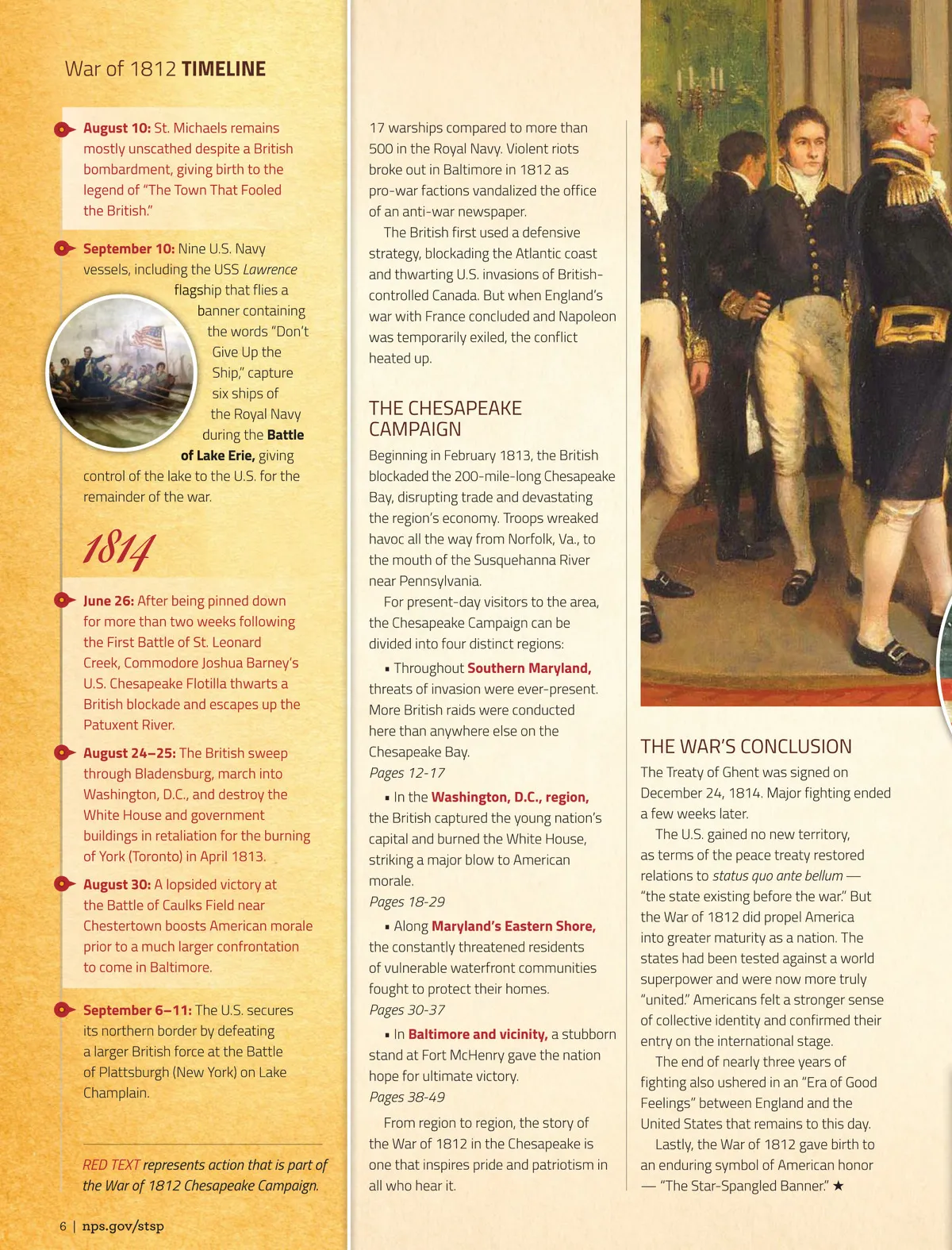
War of 1812 TIMELINE August 10: St. Michaels remains mostly unscathed despite a British bombardment, giving birth to the legend of “The Town That Fooled the British.” September 10: Nine U.S. Navy vessels, including the USS Lawrence flagship that flies a banner containing the words “Don’t Give Up the Ship,” capture six ships of the Royal Navy during the Battle of Lake Erie, giving control of the lake to the U.S. for the remainder of the war. 17 warships compared to more than 500 in the Royal Navy. Violent riots broke out in Baltimore in 1812 as pro-war factions vandalized the office of an anti-war newspaper. The British first used a defensive strategy, blockading the Atlantic coast and thwarting U.S. invasions of British-controlled Canada. But when England’s war with France concluded and Napoleon was temporarily exiled, the conflict heated up. THE CHESAPEAKE CAMPAIGN Beginning in February 1813, the British blockaded the 200-mile-long Chesapeake Bay, disrupting trade and devastating the region’s economy. Troops wreaked havoc all the way from Norfolk, Va., to the mouth of the Susquehanna River near Pennsylvania. For present-day visitors to the area, the Chesapeake Campaign can be divided into four distinct regions: 1814 June 26: After being pinned down for more than two weeks following the First Battle of St. Leonard Creek, Commodore Joshua Barney’s U.S. Chesapeake Flotilla thwarts a British blockade and escapes up the Patuxent River. August 24–25: The British sweep through Bladensburg, march into Washington, D.C., and destroy the White House and government buildings in retaliation for the burning of York (Toronto) in April 1813. August 30: A lopsided victory at the Battle of Caulks Field near Chestertown boosts American morale prior to a much larger confrontation to come in Baltimore. September 6–11: The U.S. secures its northern border by defeating a larger British force at the Battle of Plattsburgh (New York) on Lake Champlain. • Throughout Southern Maryland, threats of invasion were ever-present. More British raids were conducted here than anywhere else on the Chesapeake Bay. Pages 12-17 • In the Washington, D.C., region, the British captured the young nation’s capital and burned the White House, striking a major blow to American morale. Pages 18-29 • Along Maryland’s Eastern Shore, the constantly threatened residents of vulnerable waterfront communities fought to protect their homes. Pages 30-37 • In Baltimore and vicinity, a stubborn stand at Fort McHenry gave the nation hope for ultimate victory. Pages 38-49 From region to region, the story of the War of 1812 in the Chesapeake is one that inspires pride and patriotism in all who hear it. THE WAR’S CONCLUSION The Treaty of Ghent was signed on December 24, 1814. Major fighting ended a few weeks later. The U.S. gained no new territory, as terms of the peace treaty restored relations to status quo ante bellum — “the state existing before the war.” But the War of 1812 did propel America into greater maturity as a nation. The states had been tested against a world superpower and were now more truly “united.” Americans felt a stronger sense of collective identity and confirmed their entry on the international stage. The end of nearly three years of fighting also ushered in an “Era of Good Feelings” between England and the United States that remains to this day. Lastly, the War of 1812 gave birth to an enduring symbol of American honor — “The Star-Spangled Banner.” + RED TEXT represents action that is part of the War of 1812 Chesapeake Campaign. 6 | snps.gov/stsp nps.gov/stsp
Star-Spangled Banner Star-Spangled Banner 2018: Page 6