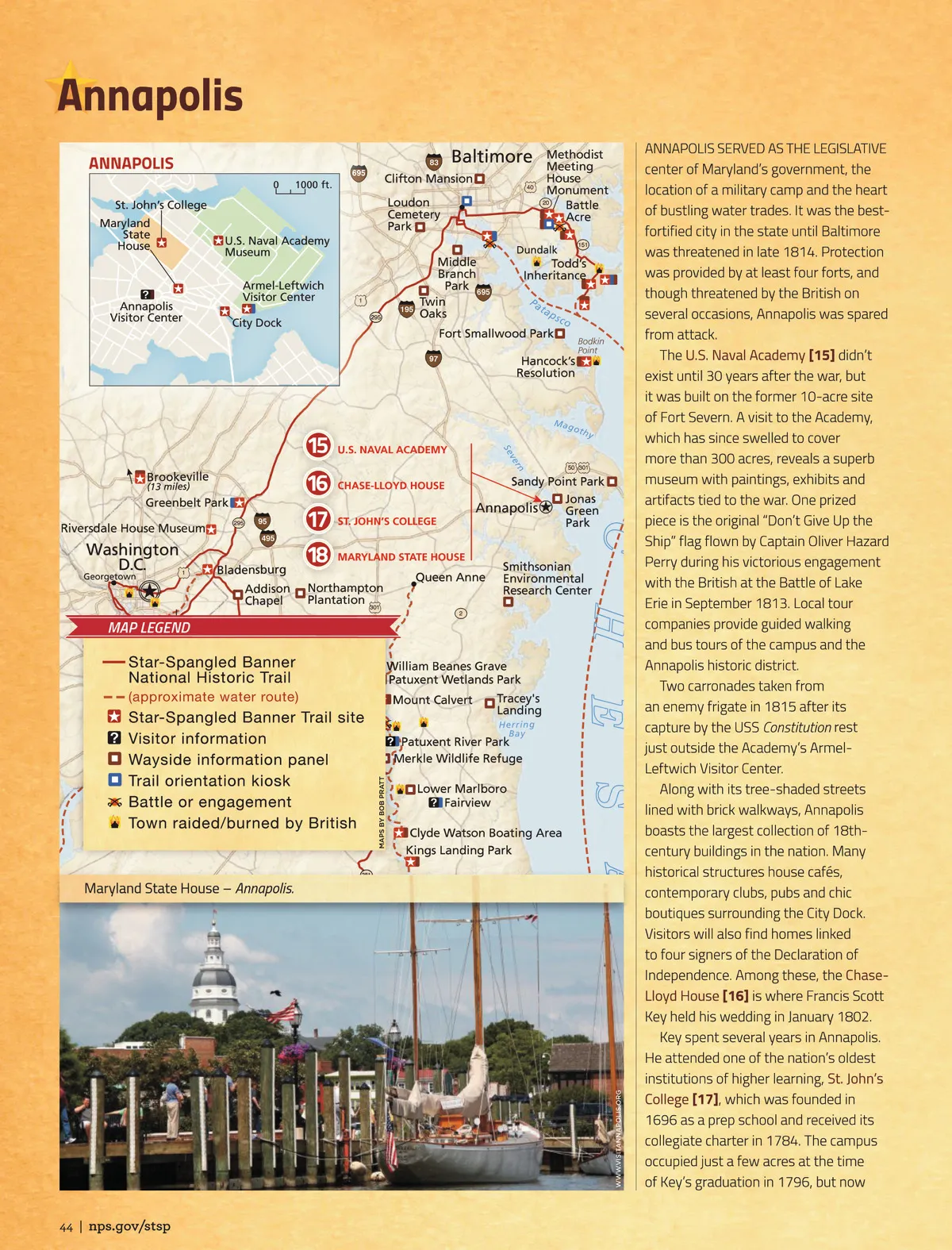
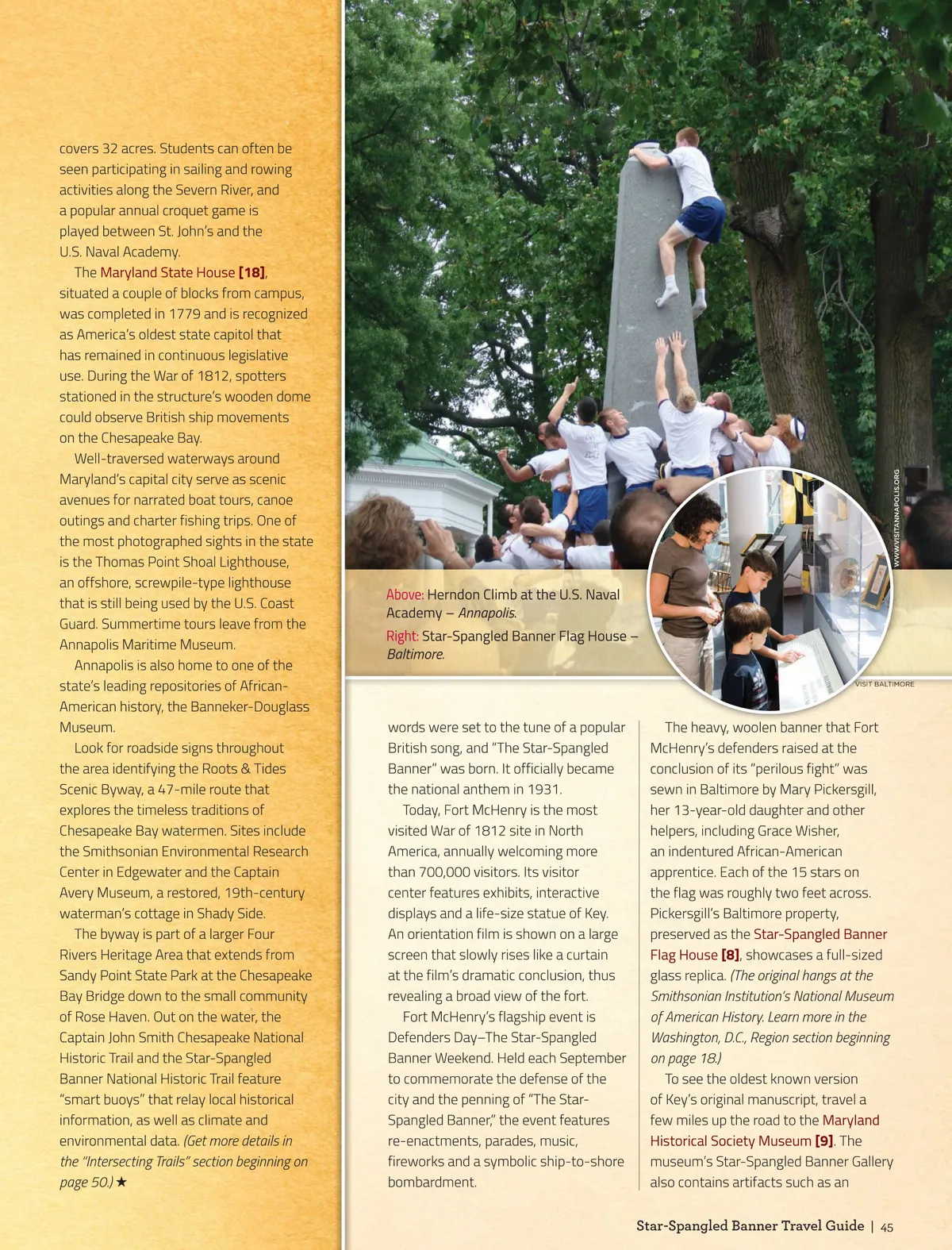
covers 32 acres. Students can often be seen participating in sailing and rowing activities along the Severn River, and a popular annual croquet game is played between St. John’s and the U.S. Naval Academy. The Maryland State House [18] , situated a couple of blocks from campus, was completed in 1779 and is recognized as America’s oldest state capitol that has remained in continuous legislative use. During the War of 1812, spotters stationed in the structure’s wooden dome could observe British ship movements on the Chesapeake Bay. Well-traversed waterways around Maryland’s capital city serve as scenic avenues for narrated boat tours, canoe outings and charter fishing trips. One of the most photographed sights in the state is the Thomas Point Shoal Lighthouse, an offshore, screwpile-type lighthouse that is still being used by the U.S. Coast Guard. Summertime tours leave from the Annapolis Maritime Museum. Annapolis is also home to one of the state’s leading repositories of African-American history, the Banneker-Douglass Museum. Look for roadside signs throughout the area identifying the Roots & Tides Scenic Byway, a 47-mile route that explores the timeless traditions of Chesapeake Bay watermen. Sites include the Smithsonian Environmental Research Center in Edgewater and the Captain Avery Museum, a restored, 19th-century waterman’s cottage in Shady Side. The byway is part of a larger Four Rivers Heritage Area that extends from Sandy Point State Park at the Chesapeake Bay Bridge down to the small community of Rose Haven. Out on the water, the Captain John Smith Chesapeake National Historic Trail and the Star-Spangled Banner National Historic Trail feature “smart buoys” that relay local historical information, as well as climate and environmental data. (Get more details in the “Intersecting Trails” section beginning on page 50.) + Above: Herndon Climb at the U.S. Naval Academy – Annapolis. Right: Star-Spangled Banner Flag House – Baltimore. VISIT BALTIMORE words were set to the tune of a popular British song, and “The Star-Spangled Banner” was born. It officially became the national anthem in 1931. Today, Fort McHenry is the most visited War of 1812 site in North America, annually welcoming more than 700,000 visitors. Its visitor center features exhibits, interactive displays and a life-size statue of Key. An orientation film is shown on a large screen that slowly rises like a curtain at the film’s dramatic conclusion, thus revealing a broad view of the fort. Fort McHenry’s flagship event is Defenders Day–The Star-Spangled Banner Weekend. Held each September to commemorate the defense of the city and the penning of “The Star-Spangled Banner,” the event features re-enactments, parades, music, fireworks and a symbolic ship-to-shore bombardment. The heavy, woolen banner that Fort McHenry’s defenders raised at the conclusion of its “perilous fight” was sewn in Baltimore by Mary Pickersgill, her 13-year-old daughter and other helpers, including Grace Wisher, an indentured African-American apprentice. Each of the 15 stars on the flag was roughly two feet across. Pickersgill’s Baltimore property, preserved as the Star-Spangled Banner Flag House [8] , showcases a full-sized glass replica. (The original hangs at the Smithsonian Institution’s National Museum of American History. Learn more in the Washington, D.C., Region section beginning on page 18.) To see the oldest known version of Key’s original manuscript, travel a few miles up the road to the Maryland Historical Society Museum [9] . The museum’s Star-Spangled Banner Gallery also contains artifacts such as an Star-Spangled Banner Travel Guide | 45 WWW.VISITANNAPOLIS.ORG
Star-Spangled Banner Star-Spangled Banner 2018: Page 45