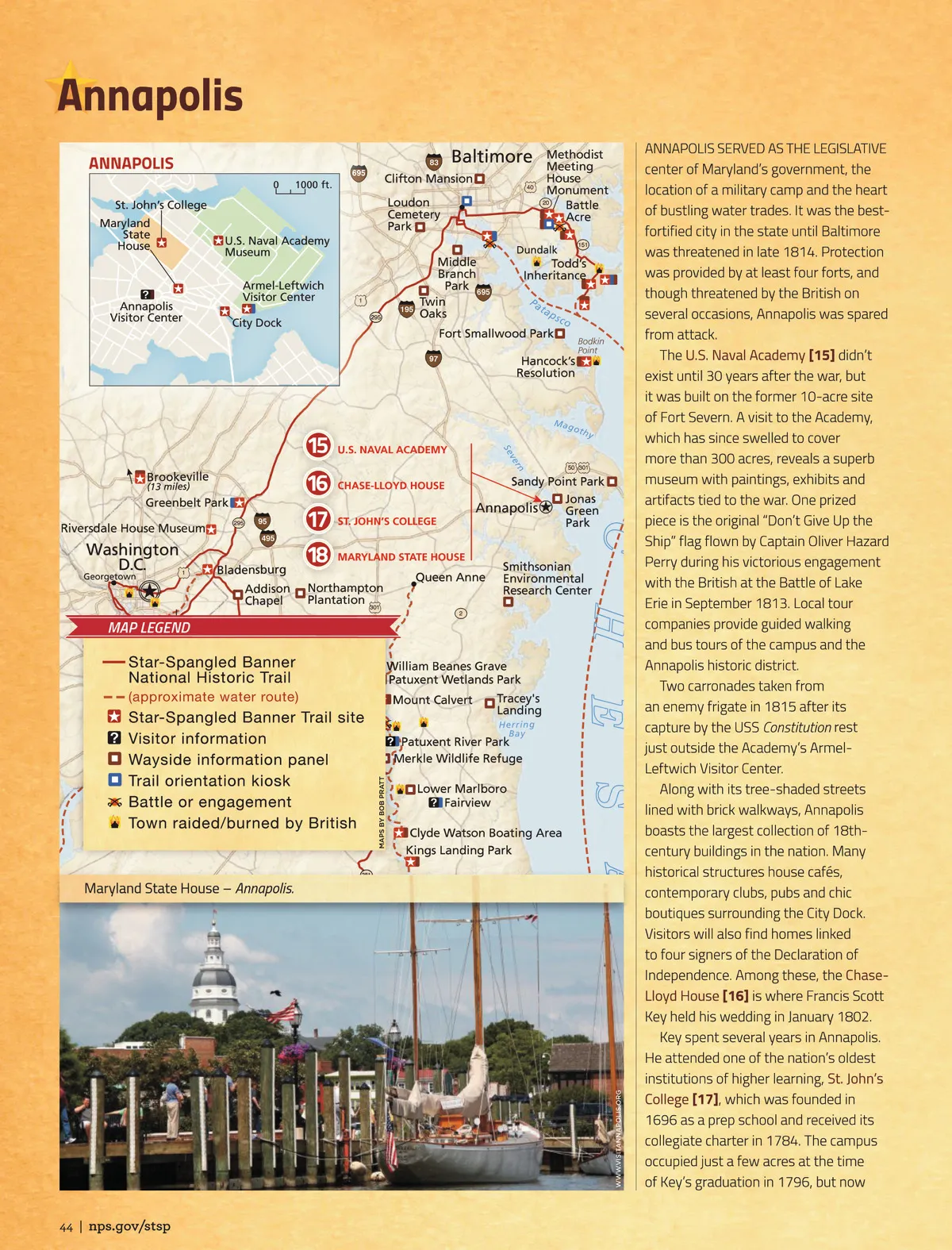
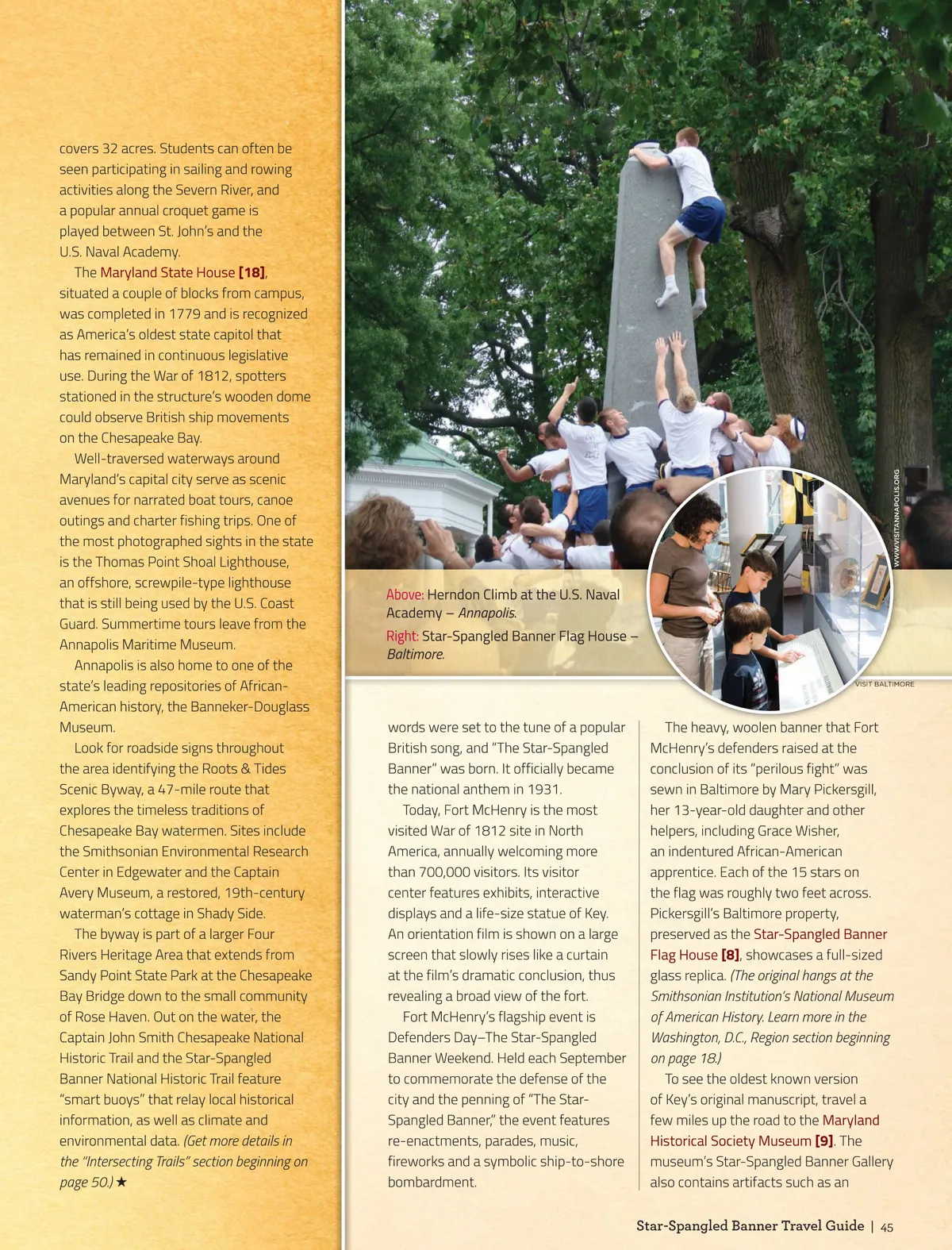
Annapolis ANNAPOLIS 0 1000 ft. 70 40 83 695 Baltimore Clifton Mansion Loudon Cemetery Park St. John’s College Maryland State House . 40 Methodist Meeting House Monument 20 Battle Acre 151 U.S. Naval Academy Museum Armel-Leftwich Visitor Center City Dock 95 Dundalk ? Annapolis Visitor Center 1 195 295 Middle Branch Park 695 Twin Oaks Todd’s Inheritance Pa ta ps co Bodkin Point Fort Smallwood Park 97 Hancock’s Resolution Mag 15 Brookeville (13 miles) oth y U.S. NAVAL ACADEMY CHASE-LLOYD HOUSE ST. JOHN’S COLLEGE MARYLAND STATE HOUSE 50 301 16 295 Greenbelt Park Riversdale House Museum 95 17 18 Sandy Point Park Jonas Annapolis Green Park 495 Georgetown Washington D.C. . 1 Bladensburg Addison Chapel 4 Northampton Plantation 301 Darnall’s Chance . Queen Anne 2 Smithsonian Environmental Research Center MAP LEGEND 395 295 Star-Spangled Banner National Historic Trail Oxon Cove Park Barney Circle Trinity Church 4 1 ? MAPS BY BOB PRATT Wayside information panel Washington Park Trail Fort orientation kiosk Nottingham Battle or engagement Town raided/burned by British Upper (approximate water route) Marlboro 382 Melwood Pond Park Star-Spangled Banner Trail site Croom Visitor information St. Thomas Church Dr. William Beanes Grave Patuxent Wetlands Park Mount Calvert Tracey's Landing Herring Bay ? Patuxent River Park Merkle Wildlife Refuge Lower Marlboro ? Fairview Clyde Watson Boating Area Kings Landing Park 382 381 Maryland State House – Annapolis. ANNAPOLIS SERVED AS THE LEGISLATIVE center of Maryland’s government, the location of a military camp and the heart of bustling water trades. It was the best-fortified city in the state until Baltimore was threatened in late 1814. Protection was provided by at least four forts, and though threatened by the British on several occasions, Annapolis was spared from attack. The U.S. Naval Academy [15] didn’t exist until 30 years after the war, but it was built on the former 10-acre site of Fort Severn. A visit to the Academy, which has since swelled to cover more than 300 acres, reveals a superb museum with paintings, exhibits and artifacts tied to the war. One prized piece is the original “Don’t Give Up the Ship” flag flown by Captain Oliver Hazard Perry during his victorious engagement with the British at the Battle of Lake Erie in September 1813. Local tour companies provide guided walking and bus tours of the campus and the Annapolis historic district. Two carronades taken from an enemy frigate in 1815 after its capture by the USS Constitution rest just outside the Academy’s Armel-Leftwich Visitor Center. Along with its tree-shaded streets lined with brick walkways, Annapolis boasts the largest collection of 18th-century buildings in the nation. Many historical structures house cafés, contemporary clubs, pubs and chic boutiques surrounding the City Dock. Visitors will also find homes linked to four signers of the Declaration of Independence. Among these, the Chase-Lloyd House [16] is where Francis Scott Key held his wedding in January 1802. Key spent several years in Annapolis. He attended one of the nation’s oldest institutions of higher learning, St. John’s College [17] , which was founded in 1696 as a prep school and received its collegiate charter in 1784. The campus occupied just a few acres at the time of Key’s graduation in 1796, but now 44 | snps.gov/stsp nps.gov/stsp WWW.VISITANNAPOLIS.ORG Se ve rn
Star-Spangled Banner Star-Spangled Banner 2018: Page 44