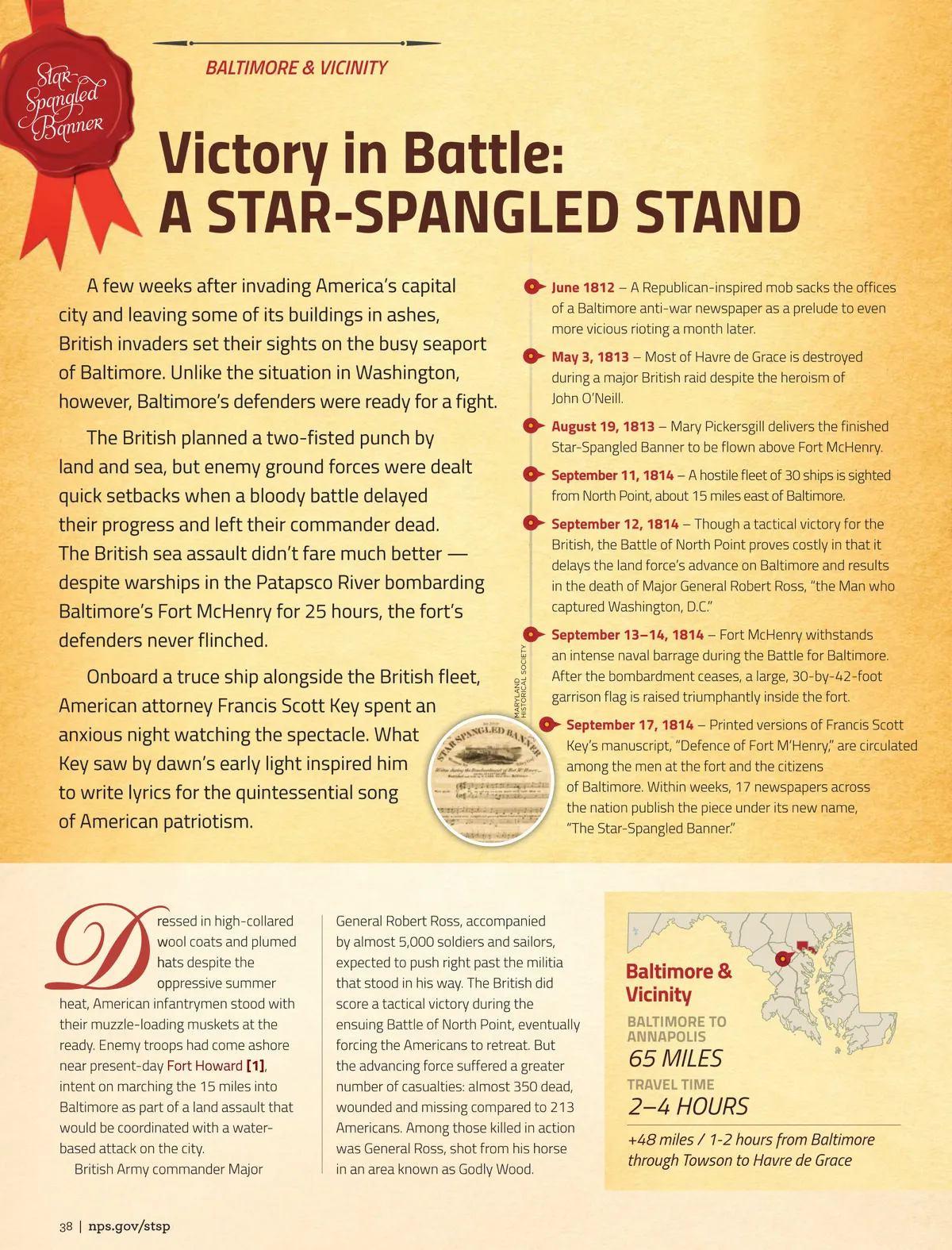
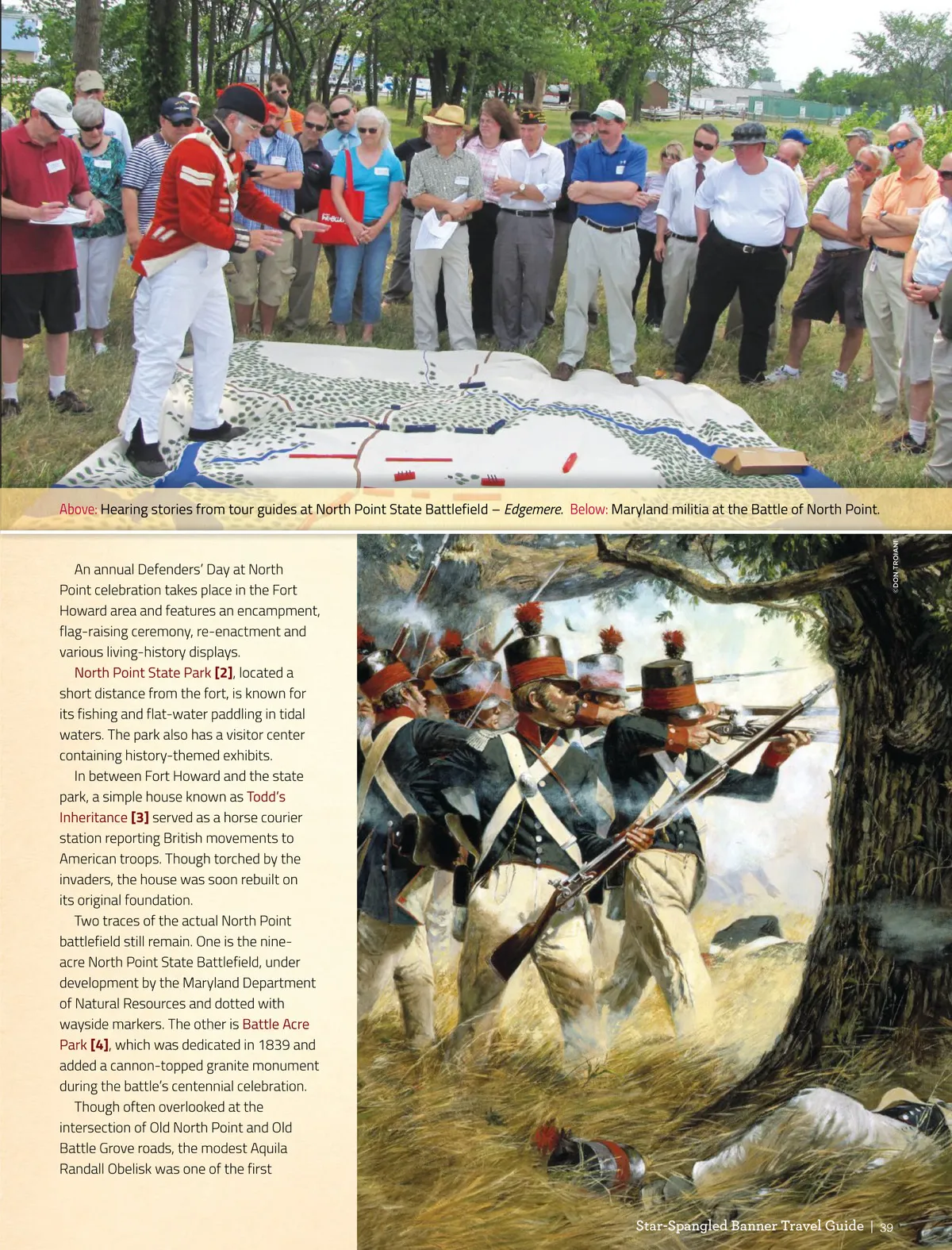
Star-Spangled Banner BALTIMORE & VICINITY Victory in Battle: A STAR-SPANGLED STAND June 1812 – A Republican-inspired mob sacks the offices of a Baltimore anti-war newspaper as a prelude to even more vicious rioting a month later. May 3, 1813 – Most of Havre de Grace is destroyed during a major British raid despite the heroism of John O’Neill. August 19, 1813 – Mary Pickersgill delivers the finished Star-Spangled Banner to be flown above Fort McHenry. September 11, 1814 – A hostile fleet of 30 ships is sighted from North Point, about 15 miles east of Baltimore. September 12, 1814 – Though a tactical victory for the British, the Battle of North Point proves costly in that it delays the land force’s advance on Baltimore and results in the death of Major General Robert Ross, “the Man who captured Washington, D.C.” MARYLAND HISTORICAL SOCIETY A few weeks after invading America’s capital city and leaving some of its buildings in ashes, British invaders set their sights on the busy seaport of Baltimore. Unlike the situation in Washington, however, Baltimore’s defenders were ready for a fight. The British planned a two-fisted punch by land and sea, but enemy ground forces were dealt quick setbacks when a bloody battle delayed their progress and left their commander dead. The British sea assault didn’t fare much better — despite warships in the Patapsco River bombarding Baltimore’s Fort McHenry for 25 hours, the fort’s defenders never flinched. Onboard a truce ship alongside the British fleet, American attorney Francis Scott Key spent an anxious night watching the spectacle. What Key saw by dawn’s early light inspired him to write lyrics for the quintessential song of American patriotism. September 13–14, 1814 – Fort McHenry withstands an intense naval barrage during the Battle for Baltimore. After the bombardment ceases, a large, 30-by-42-foot garrison flag is raised triumphantly inside the fort. September 17, 1814 – Printed versions of Francis Scott Key’s manuscript, “Defence of Fort M’Henry,” are circulated among the men at the fort and the citizens of Baltimore. Within weeks, 17 newspapers across the nation publish the piece under its new name, “The Star-Spangled Banner.” ressed in high-collared wool coats and plumed hats despite the oppressive summer heat, American infantrymen stood with their muzzle-loading muskets at the ready. Enemy troops had come ashore near present-day Fort Howard [1] , intent on marching the 15 miles into Baltimore as part of a land assault that would be coordinated with a water-based attack on the city. British Army commander Major General Robert Ross, accompanied by almost 5,000 soldiers and sailors, expected to push right past the militia that stood in his way. The British did score a tactical victory during the ensuing Battle of North Point, eventually forcing the Americans to retreat. But the advancing force suffered a greater number of casualties: almost 350 dead, wounded and missing compared to 213 Americans. Among those killed in action was General Ross, shot from his horse in an area known as Godly Wood. Baltimore & Vicinity BALTIMORE TO ANNAPOLIS 65 MILES TRAVEL TIME 2–4 HOURS +48 miles / 1-2 hours from Baltimore through Towson to Havre de Grace 38 | snps.gov/stsp nps.gov/stsp
Star-Spangled Banner Star-Spangled Banner 2018: Page 38