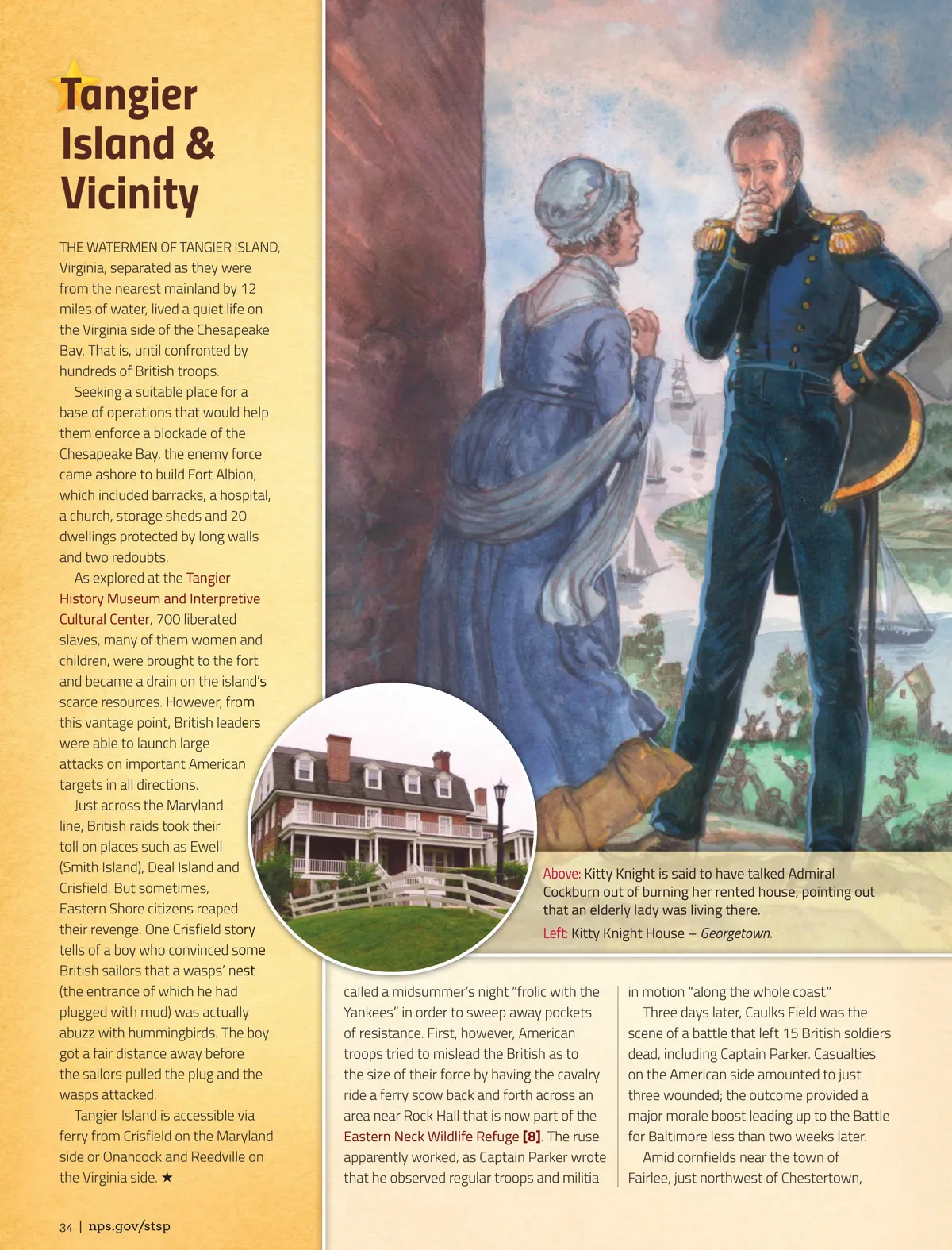
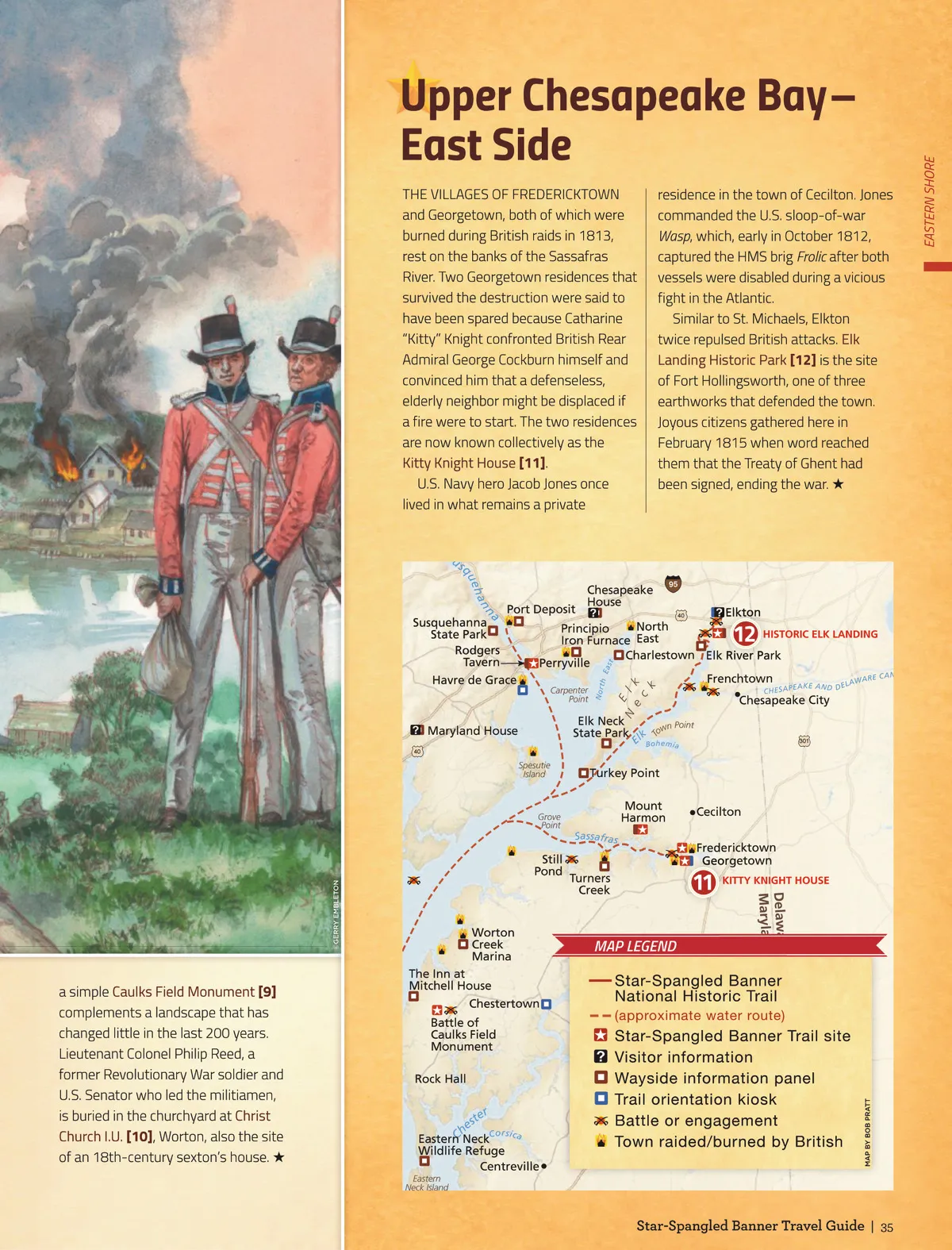
Tangier Island & Vicinity THE WATERMEN OF TANGIER ISLAND, Virginia, separated as they were from the nearest mainland by 12 miles of water, lived a quiet life on the Virginia side of the Chesapeake Bay. That is, until confronted by hundreds of British troops. Seeking a suitable place for a base of operations that would help them enforce a blockade of the Chesapeake Bay, the enemy force came ashore to build Fort Albion, which included barracks, a hospital, a church, storage sheds and 20 dwellings protected by long walls and two redoubts. As explored at the Tangier History Museum and Interpretive Cultural Center , 700 liberated slaves, many of them women and children, were brought to the fort and became a drain on the island’s scarce resources. However, from this vantage point, British leaders were able to launch large attacks on important American targets in all directions. Just across the Maryland line, British raids took their toll on places such as Ewell (Smith Island), Deal Island and Crisfield. But sometimes, Eastern Shore citizens reaped their revenge. One Crisfield story tells of a boy who convinced some British sailors that a wasps’ nest (the entrance of which he had plugged with mud) was actually abuzz with hummingbirds. The boy got a fair distance away before the sailors pulled the plug and the wasps attacked. Tangier Island is accessible via ferry from Crisfield on the Maryland side or Onancock and Reedville on the Virginia side. + 34 | snps.gov/stsp nps.gov/stsp Above: Kitty Knight is said to have talked Admiral Cockburn out of burning her rented house, pointing out that an elderly lady was living there. Left: Kitty Knight House – Georgetown . called a midsummer’s night “frolic with the Yankees” in order to sweep away pockets of resistance. First, however, American troops tried to mislead the British as to the size of their force by having the cavalry ride a ferry scow back and forth across an area near Rock Hall that is now part of the Eastern Neck Wildlife Refuge [8] . The ruse apparently worked, as Captain Parker wrote that he observed regular troops and militia in motion “along the whole coast.” Three days later, Caulks Field was the scene of a battle that left 15 British soldiers dead, including Captain Parker. Casualties on the American side amounted to just three wounded; the outcome provided a major morale boost leading up to the Battle for Baltimore less than two weeks later. Amid cornfields near the town of Fairlee, just northwest of Chestertown,
Star-Spangled Banner Star-Spangled Banner 2018: Page 34