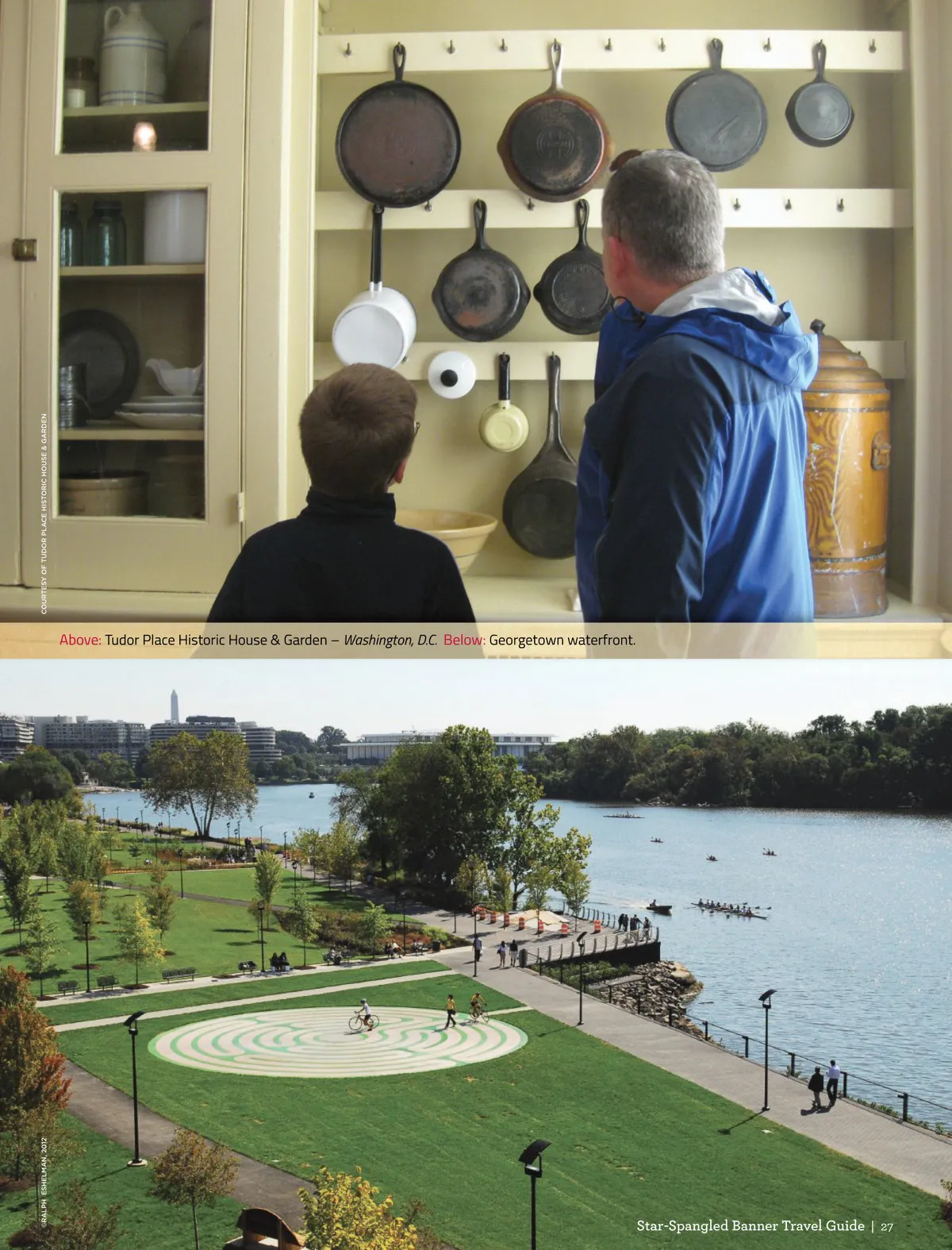
northeast of the Capitol, is one of only a few private structures that the British burned. Built in 1800, the house was targeted after an American sniper shot at General Robert Ross from one of its windows. It later served as the headquarters of the National Woman’s Party and today includes exhibits on women’s suffrage and the equal rights movement. The White House [11] , which had only been occupied for a mere 14 years, was left a roofless shell by the British. But President Madison’s wife, Dolley, saved the Gilbert Stuart portrait of George Washington that now hangs in the East Room. The U.S. Treasury Building, located near the White House, was also burned. The Octagon House [12] , which served as a temporary executive residence for President Madison after the White House was destroyed, is where the Treaty of Ghent was ratified, officially ending the war. The Smithsonian Institution’s National Museum of American History [13] holds one of the most cherished First Lady Dolley Madison, below and right, is credited with saving a White House portrait of President George Washington. symbols of the War of 1812 — the huge garrison flag that flew defiantly over Fort McHenry as the British departed Baltimore. (Read more about the Battle for Baltimore beginning on page 38.) The tattered banner is dramatically displayed behind a floor-to-ceiling glass wall within a climate-controlled gallery that re-creates “dawn’s early light.” A museum at the headquarters of the National Society United States Daughters of 1812 contains more information about the war. Meanwhile, walking tours of the Congressional Cemetery reveal the burial sites of such notables as Attorney General William Pinkney, Commodore Joseph Smoot and Major General Jacob Brown, as well as a public vault where Dolley Madison was temporarily interred. The Washington Navy Yard in southeast D.C. was set on fire by its defenders rather than have it fall into British hands. Located on site is the National Museum of the U.S. Navy [14] , which features such items as artifacts from Commodore Joshua Barney’s U.S. Chesapeake Flotilla. In the opposite corner of the nation’s capital, historic Georgetown is an international community of embassies, upscale shops and eclectic eateries. Here, Martha Washington’s granddaughter, Martha Peter, watched from her bedroom window at Tudor Place [15] as the nation’s capital burned. Today, the residence and its nearly six-acre garden are open to the public, as is the Dumbarton House, to which Dolley Madison fled as the British advanced. Francis Scott Key, the writer of “The Star-Spangled Banner,” is honored with a memorial park located next to the bridge that also bears his name. The former location of Key’s residence when he lived on M Street is noted within the park. Following the British occupation of Washington, President Madison and members of his cabinet sought refuge 26 | nps.gov/stsp ©GERRY EMBLETON WHITE HOUSE HISTORICAL ASSOCIATION/WHITE HOUSE COLLECTION
Star-Spangled Banner Star-Spangled Banner 2018: Page 26