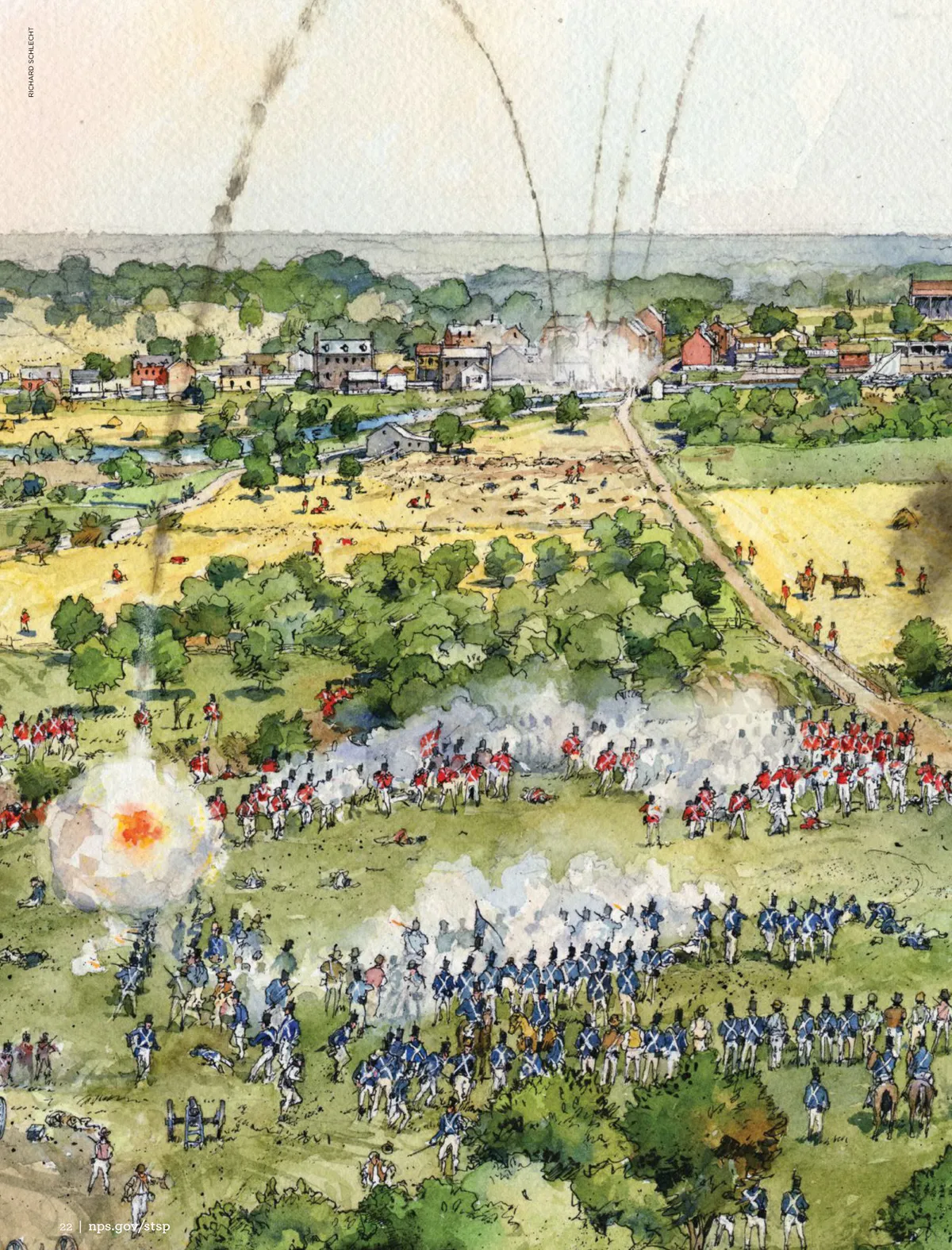
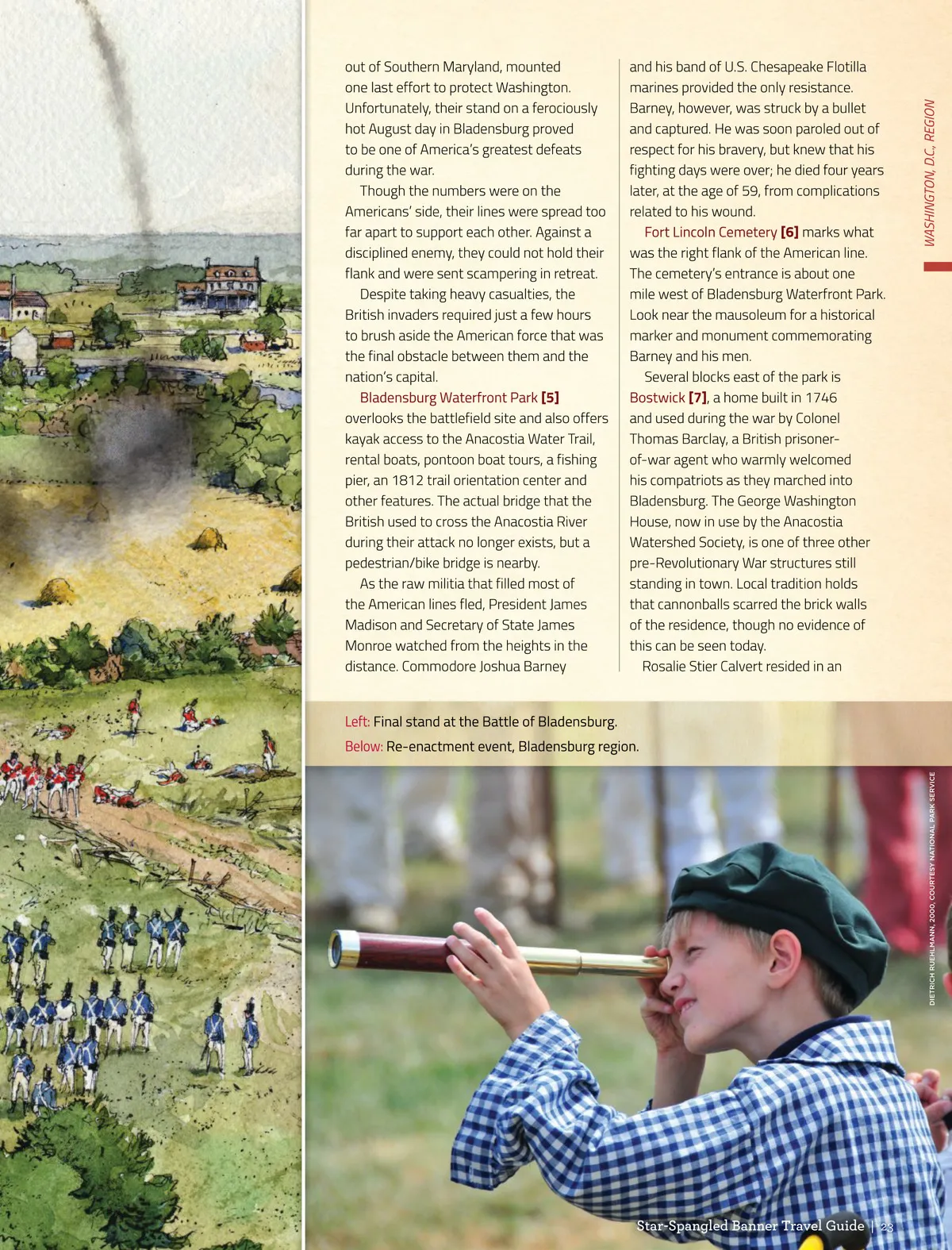
out of Southern Maryland, mounted one last effort to protect Washington. Unfortunately, their stand on a ferociously hot August day in Bladensburg proved to be one of America’s greatest defeats during the war. Though the numbers were on the Americans’ side, their lines were spread too far apart to support each other. Against a disciplined enemy, they could not hold their flank and were sent scampering in retreat. Despite taking heavy casualties, the British invaders required just a few hours to brush aside the American force that was the final obstacle between them and the nation’s capital. Bladensburg Waterfront Park [5] overlooks the battlefield site and also offers kayak access to the Anacostia Water Trail, rental boats, pontoon boat tours, a fishing pier, an 1812 trail orientation center and other features. The actual bridge that the British used to cross the Anacostia River during their attack no longer exists, but a pedestrian/bike bridge is nearby. As the raw militia that filled most of the American lines fled, President James Madison and Secretary of State James Monroe watched from the heights in the distance. Commodore Joshua Barney and his band of U.S. Chesapeake Flotilla marines provided the only resistance. Barney, however, was struck by a bullet and captured. He was soon paroled out of respect for his bravery, but knew that his fighting days were over; he died four years later, at the age of 59, from complications related to his wound. Fort Lincoln Cemetery [6] marks what was the right flank of the American line. The cemetery’s entrance is about one mile west of Bladensburg Waterfront Park. Look near the mausoleum for a historical marker and monument commemorating Barney and his men. Several blocks east of the park is Bostwick [7] , a home built in 1746 and used during the war by Colonel Thomas Barclay, a British prisoner-of-war agent who warmly welcomed his compatriots as they marched into Bladensburg. The George Washington House, now in use by the Anacostia Watershed Society, is one of three other pre-Revolutionary War structures still standing in town. Local tradition holds that cannonballs scarred the brick walls of the residence, though no evidence of this can be seen today. Rosalie Stier Calvert resided in an Left: Final stand at the Battle of Bladensburg. Below: Re-enactment event, Bladensburg region. DIETRICH RUEHLMANN, 2000, COURTESY NATIONAL PARK SERVICE Star-Spangled Banner Travel Guide | 23 WASHINGTON, D.C., REGION
Star-Spangled Banner Star-Spangled Banner 2018: Page 23