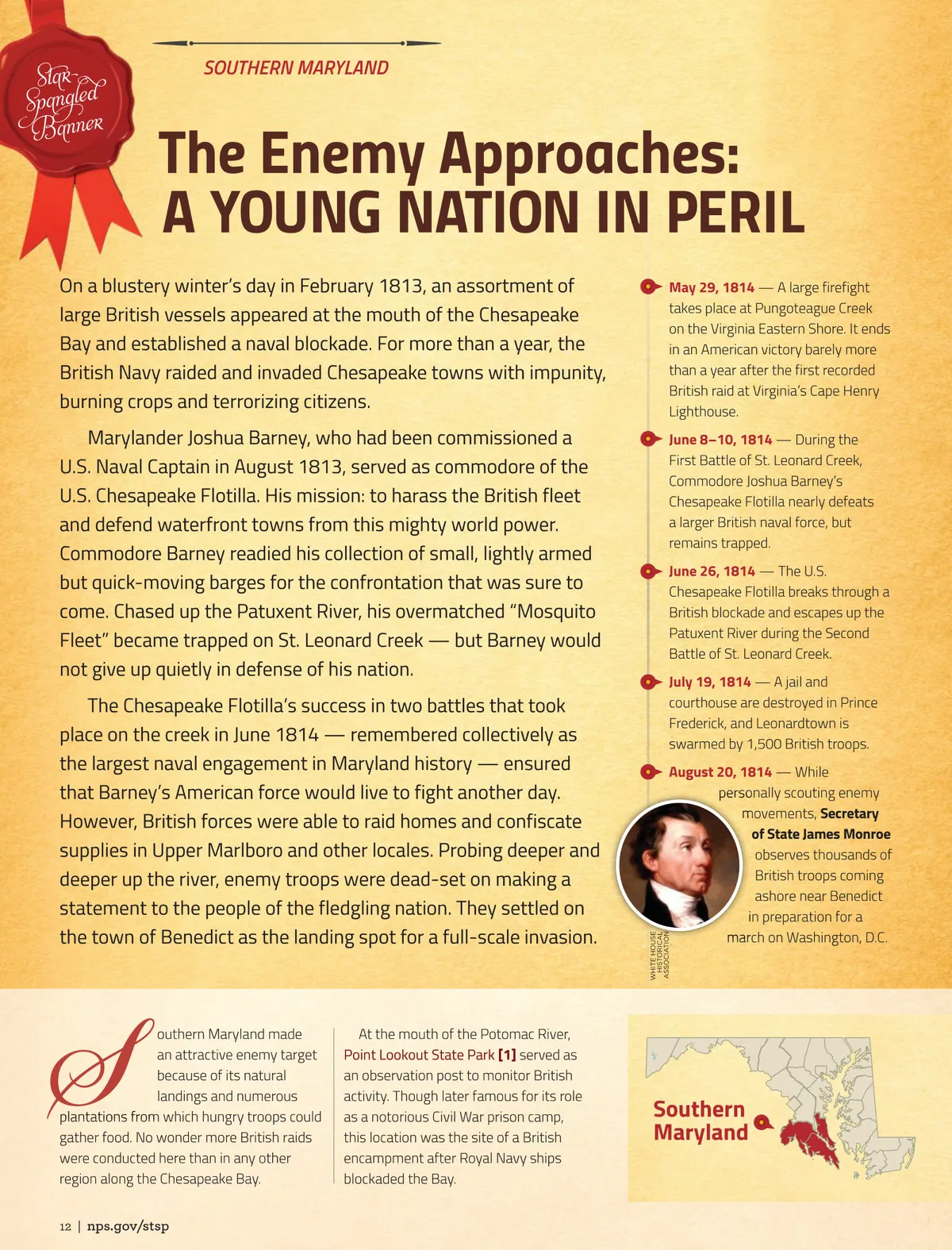
Star-Spangled Banner SOUTHERN MARYLAND The Enemy Approaches: A YOUNG NATION IN PERIL May 29, 1814 — A large firefight takes place at Pungoteague Creek on the Virginia Eastern Shore. It ends in an American victory barely more than a year after the first recorded British raid at Virginia’s Cape Henry Lighthouse. June 8–10, 1814 — During the First Battle of St. Leonard Creek, Commodore Joshua Barney’s Chesapeake Flotilla nearly defeats a larger British naval force, but remains trapped. June 26, 1814 — The U.S. Chesapeake Flotilla breaks through a British blockade and escapes up the Patuxent River during the Second Battle of St. Leonard Creek. July 19, 1814 — A jail and courthouse are destroyed in Prince Frederick, and Leonardtown is swarmed by 1,500 British troops. August 20, 1814 — While personally scouting enemy movements, Secretary of State James Monroe observes thousands of British troops coming ashore near Benedict in preparation for a march on Washington, D.C. On a blustery winter’s day in February 1813, an assortment of large British vessels appeared at the mouth of the Chesapeake Bay and established a naval blockade. For more than a year, the British Navy raided and invaded Chesapeake towns with impunity, burning crops and terrorizing citizens. Marylander Joshua Barney, who had been commissioned a U.S. Naval Captain in August 1813, served as commodore of the U.S. Chesapeake Flotilla. His mission: to harass the British fleet and defend waterfront towns from this mighty world power. Commodore Barney readied his collection of small, lightly armed but quick-moving barges for the confrontation that was sure to come. Chased up the Patuxent River, his overmatched “Mosquito Fleet” became trapped on St. Leonard Creek — but Barney would not give up quietly in defense of his nation. The Chesapeake Flotilla’s success in two battles that took place on the creek in June 1814 — remembered collectively as the largest naval engagement in Maryland history — ensured that Barney’s American force would live to fight another day. However, British forces were able to raid homes and confiscate supplies in Upper Marlboro and other locales. Probing deeper and deeper up the river, enemy troops were dead-set on making a statement to the people of the fledgling nation. They settled on the town of Benedict as the landing spot for a full-scale invasion. outhern Maryland made an attractive enemy target because of its natural landings and numerous plantations from which hungry troops could gather food. No wonder more British raids were conducted here than in any other region along the Chesapeake Bay. 12 | nps.gov/stsp At the mouth of the Potomac River, Point Lookout State Park [1] served as an observation post to monitor British activity. Though later famous for its role as a notorious Civil War prison camp, this location was the site of a British encampment after Royal Navy ships blockaded the Bay. WHITE HOUSE HISTORICAL ASSOCIATION Southern Maryland
Star-Spangled Banner Star-Spangled Banner 2018: Page 12