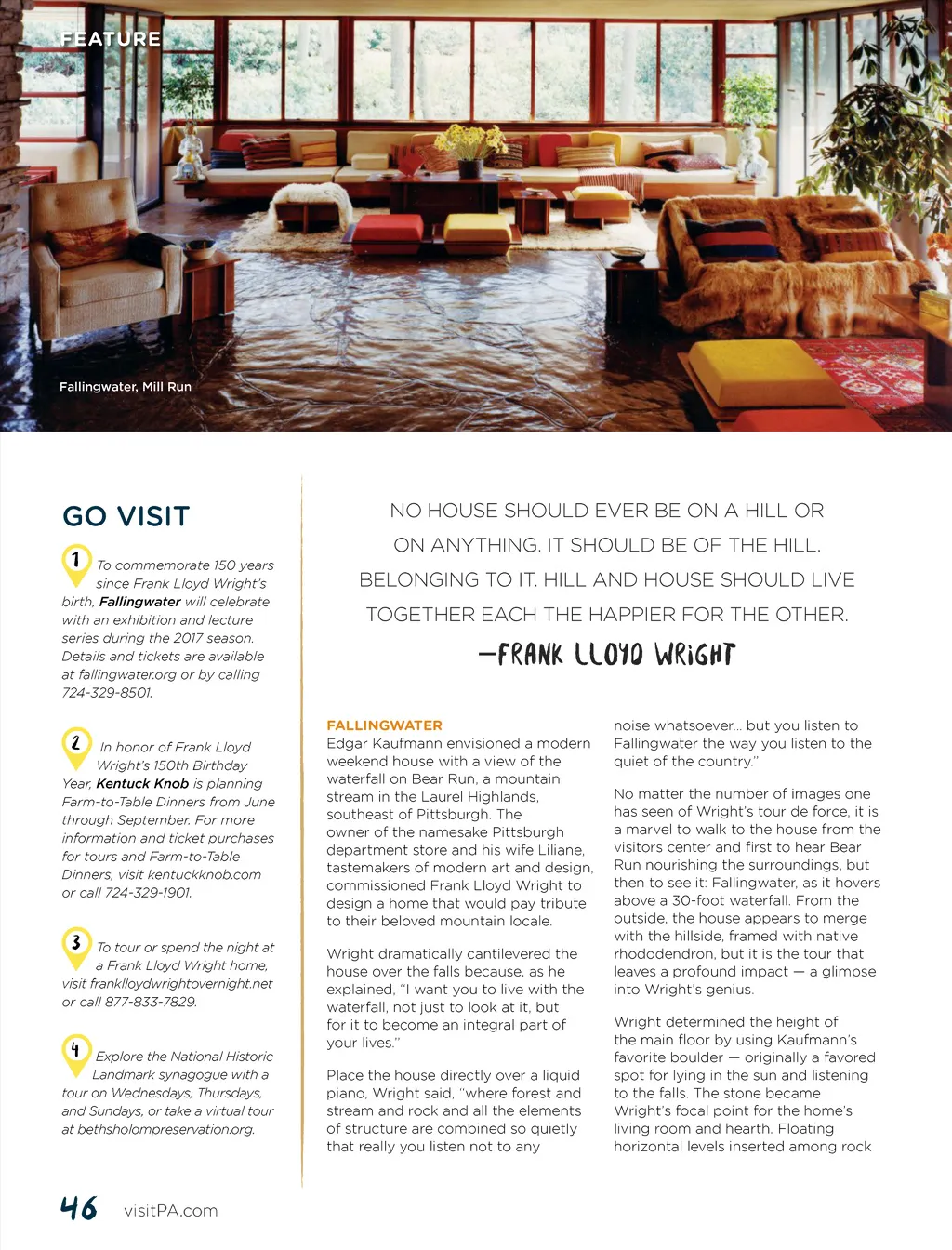
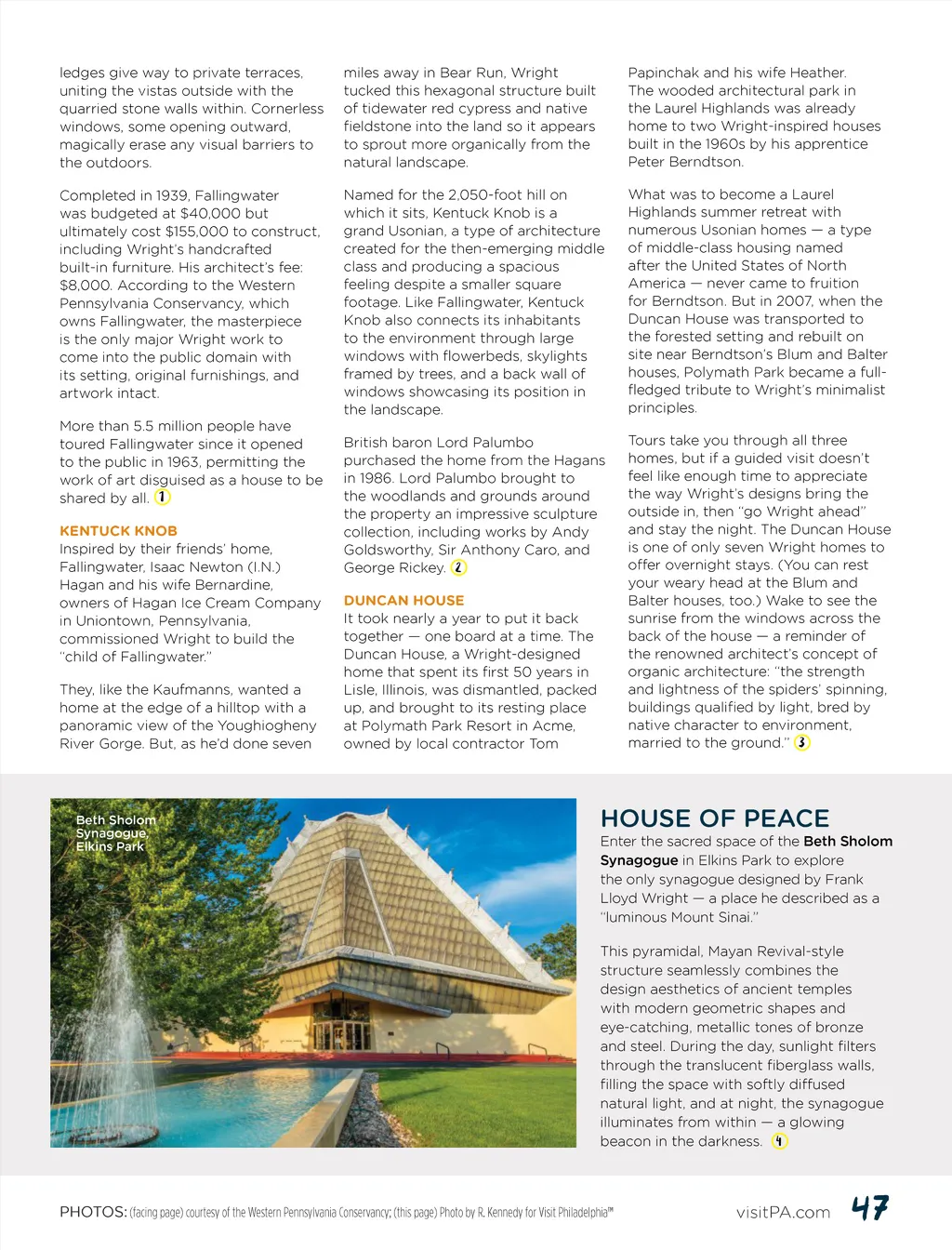
ledges give way to private terraces, uniting the vistas outside with the quarried stone walls within. Cornerless windows, some opening outward, magically erase any visual barriers to the outdoors. Completed in 1939, Fallingwater was budgeted at $40,000 but ultimately cost $155,000 to construct, including Wright’s handcrafted built-in furniture. His architect’s fee: $8,000. According to the Western Pennsylvania Conservancy, which owns Fallingwater, the masterpiece is the only major Wright work to come into the public domain with its setting, original furnishings, and artwork intact. More than 5.5 million people have toured Fallingwater since it opened to the public in 1963, permitting the work of art disguised as a house to be shared by all. 1 KENTUCK KNOB Inspired by their friends’ home, Fallingwater, Isaac Newton (I.N.) Hagan and his wife Bernardine, owners of Hagan Ice Cream Company in Uniontown, Pennsylvania, commissioned Wright to build the “child of Fallingwater.” They, like the Kaufmanns, wanted a home at the edge of a hilltop with a panoramic view of the Youghiogheny River Gorge. But, as he’d done seven miles away in Bear Run, Wright tucked this hexagonal structure built of tidewater red cypress and native fieldstone into the land so it appears to sprout more organically from the natural landscape. Named for the 2,050-foot hill on which it sits, Kentuck Knob is a grand Usonian, a type of architecture created for the then-emerging middle class and producing a spacious feeling despite a smaller square footage. Like Fallingwater, Kentuck Knob also connects its inhabitants to the environment through large windows with flowerbeds, skylights framed by trees, and a back wall of windows showcasing its position in the landscape. British baron Lord Palumbo purchased the home from the Hagans in 1986. Lord Palumbo brought to the woodlands and grounds around the property an impressive sculpture collection, including works by Andy Goldsworthy, Sir Anthony Caro, and George Rickey. 2 DUNCAN HOUSE It took nearly a year to put it back together — one board at a time. The Duncan House, a Wright-designed home that spent its first 50 years in Lisle, Illinois, was dismantled, packed up, and brought to its resting place at Polymath Park Resort in Acme, owned by local contractor Tom Papinchak and his wife Heather. The wooded architectural park in the Laurel Highlands was already home to two Wright-inspired houses built in the 1960s by his apprentice Peter Berndtson. What was to become a Laurel Highlands summer retreat with numerous Usonian homes — a type of middle-class housing named after the United States of North America — never came to fruition for Berndtson. But in 2007, when the Duncan House was transported to the forested setting and rebuilt on site near Berndtson’s Blum and Balter houses, Polymath Park became a full-fledged tribute to Wright’s minimalist principles. Tours take you through all three homes, but if a guided visit doesn’t feel like enough time to appreciate the way Wright’s designs bring the outside in, then “go Wright ahead” and stay the night. The Duncan House is one of only seven Wright homes to offer overnight stays. (You can rest your weary head at the Blum and Balter houses, too.) Wake to see the sunrise from the windows across the back of the house — a reminder of the renowned architect’s concept of organic architecture: “the strength and lightness of the spiders’ spinning, buildings qualified by light, bred by native character to environment, married to the ground.” 3 Beth Sholom Synagogue, Elkins Park HOUSE OF PEACE Enter the sacred space of the Beth Sholom Synagogue in Elkins Park to explore the only synagogue designed by Frank Lloyd Wright — a place he described as a “luminous Mount Sinai.” This pyramidal, Mayan Revival-style structure seamlessly combines the design aesthetics of ancient temples with modern geometric shapes and eye-catching, metallic tones of bronze and steel. During the day, sunlight filters through the translucent fiberglass walls, filling the space with softly diffused natural light, and at night, the synagogue illuminates from within — a glowing beacon in the darkness. 4 PHOTOS: (facing page) courtesy of the Western Pennsylvania Conservancy; (this page) Photo by R. Kennedy for Visit Philadelphia™ visitPA.com 47
Pennsylvania PA 2017 Happy Traveler: Page 47