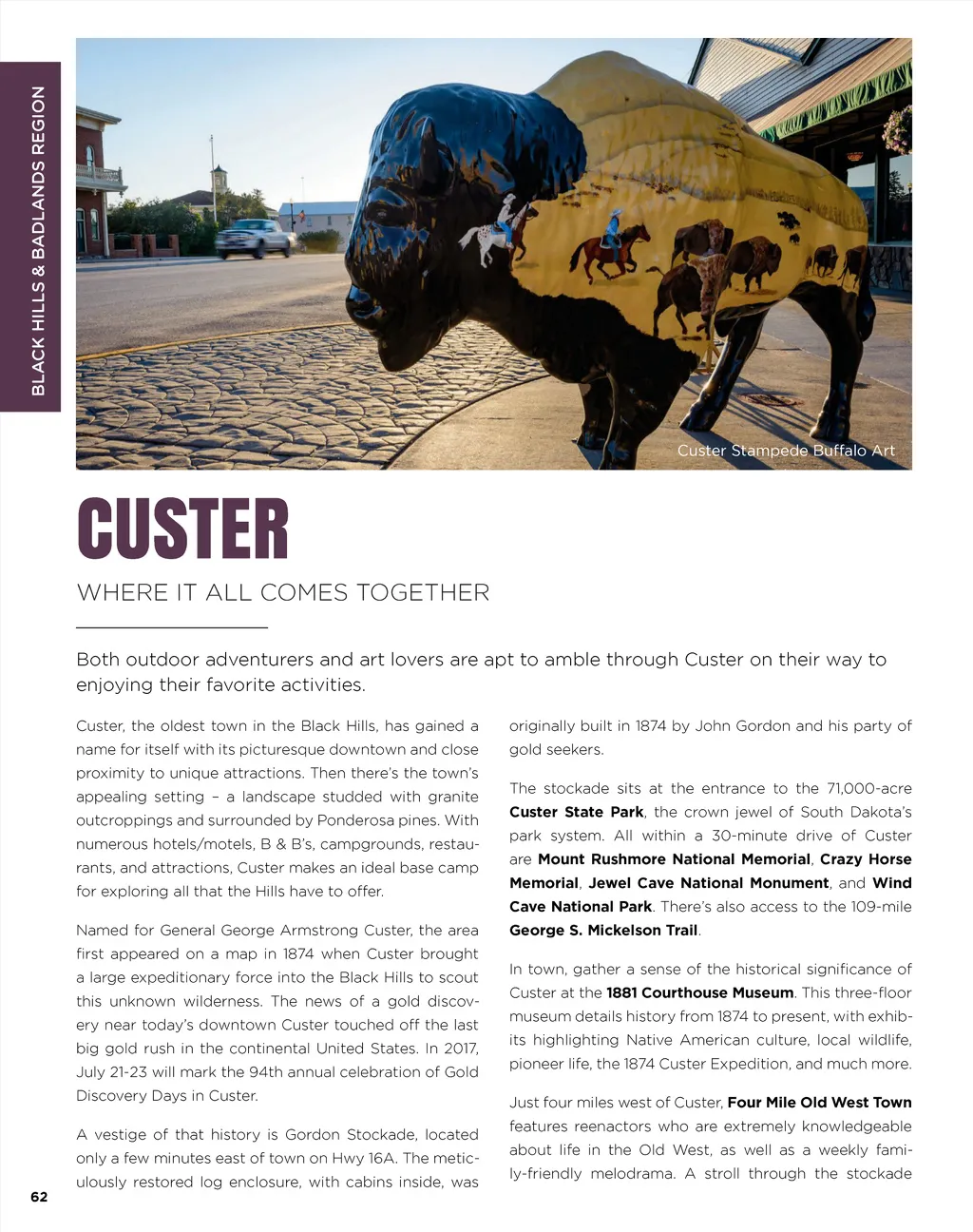
BLACK HILLS & BADLANDS REGION Custer Stampede Buffalo Art CUSTER WHERE IT ALL COMES TOGETHER Both outdoor adventurers and art lovers are apt to amble through Custer on their way to enjoying their favorite activities. Custer, the oldest town in the Black Hills, has gained a name for itself with its picturesque downtown and close proximity to unique attractions. Then there’s the town’s appealing setting – a landscape studded with granite outcroppings and surrounded by Ponderosa pines. With numerous hotels/motels, B & B’s, campgrounds, restau-rants, and attractions, Custer makes an ideal base camp for exploring all that the Hills have to offer. Named for General George Armstrong Custer, the area first appeared on a map in 1874 when Custer brought a large expeditionary force into the Black Hills to scout this unknown wilderness. The news of a gold discov-ery near today’s downtown Custer touched off the last big gold rush in the continental United States. In 2017, July 21-23 will mark the 94th annual celebration of Gold Discovery Days in Custer. A vestige of that history is Gordon Stockade, located only a few minutes east of town on Hwy 16A. The metic-62 originally built in 1874 by John Gordon and his party of gold seekers. The stockade sits at the entrance to the 71,000-acre Custer State Park , the crown jewel of South Dakota’s park system. All within a 30-minute drive of Custer are Mount Rushmore National Memorial , Crazy Horse Memorial , Jewel Cave National Monument , and Wind Cave National Park . There’s also access to the 109-mile George S. Mickelson Trail . In town, gather a sense of the historical significance of Custer at the 1881 Courthouse Museum . This three-floor museum details history from 1874 to present, with exhib-its highlighting Native American culture, local wildlife, pioneer life, the 1874 Custer Expedition, and much more. Just four miles west of Custer, Four Mile Old West Town features reenactors who are extremely knowledgeable about life in the Old West, as well as a weekly fami-ly-friendly melodrama. A stroll through the stockade ulously restored log enclosure, with cabins inside, was
South Dakota Vacation Guide SD Vacation Guide 2017: Page 62