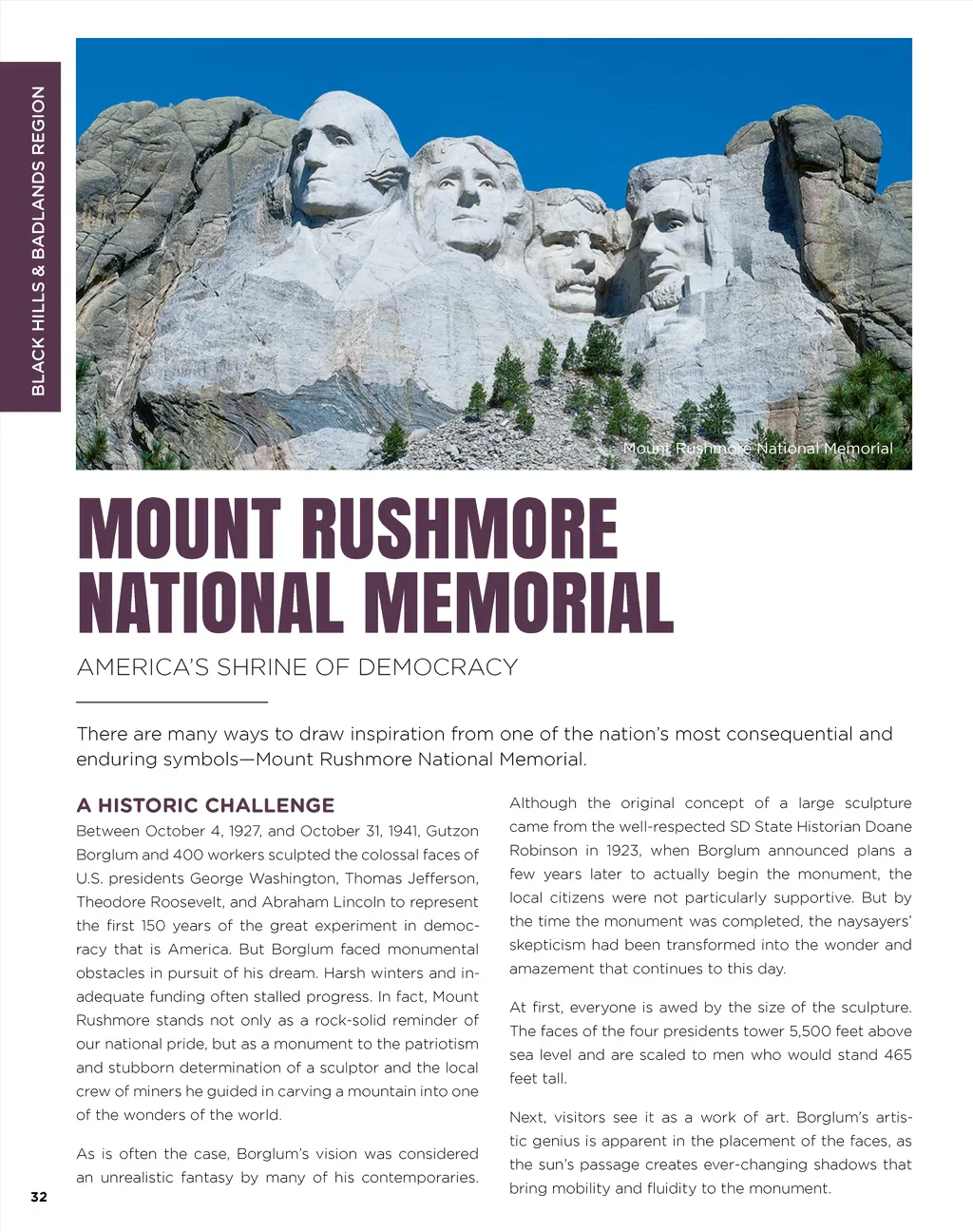
BLACK HILLS & BADLANDS REGION Mount Rushmore National Memorial MOUNT RUSHMORE NATIONAL MEMORIAL AMERICA’S SHRINE OF DEMOCRACY There are many ways to draw inspiration from one of the nation’s most consequential and enduring symbols—Mount Rushmore National Memorial. A HISTORIC CHALLENGE Between October 4, 1927, and October 31, 1941, Gutzon Borglum and 400 workers sculpted the colossal faces of U.S. presidents George Washington, Thomas Jefferson, Theodore Roosevelt, and Abraham Lincoln to represent the first 150 years of the great experiment in democ-racy that is America. But Borglum faced monumental obstacles in pursuit of his dream. Harsh winters and in-adequate funding often stalled progress. In fact, Mount Rushmore stands not only as a rock-solid reminder of our national pride, but as a monument to the patriotism and stubborn determination of a sculptor and the local crew of miners he guided in carving a mountain into one of the wonders of the world. As is often the case, Borglum’s vision was considered an unrealistic fantasy by many of his contemporaries. 32 Although the original concept of a large sculpture came from the well-respected SD State Historian Doane Robinson in 1923, when Borglum announced plans a few years later to actually begin the monument, the local citizens were not particularly supportive. But by the time the monument was completed, the naysayers’ skepticism had been transformed into the wonder and amazement that continues to this day. At first, everyone is awed by the size of the sculpture. The faces of the four presidents tower 5,500 feet above sea level and are scaled to men who would stand 465 feet tall. Next, visitors see it as a work of art. Borglum’s artis-tic genius is apparent in the placement of the faces, as the sun’s passage creates ever-changing shadows that bring mobility and fluidity to the monument.
South Dakota Vacation Guide SD Vacation Guide 2017: Page 32