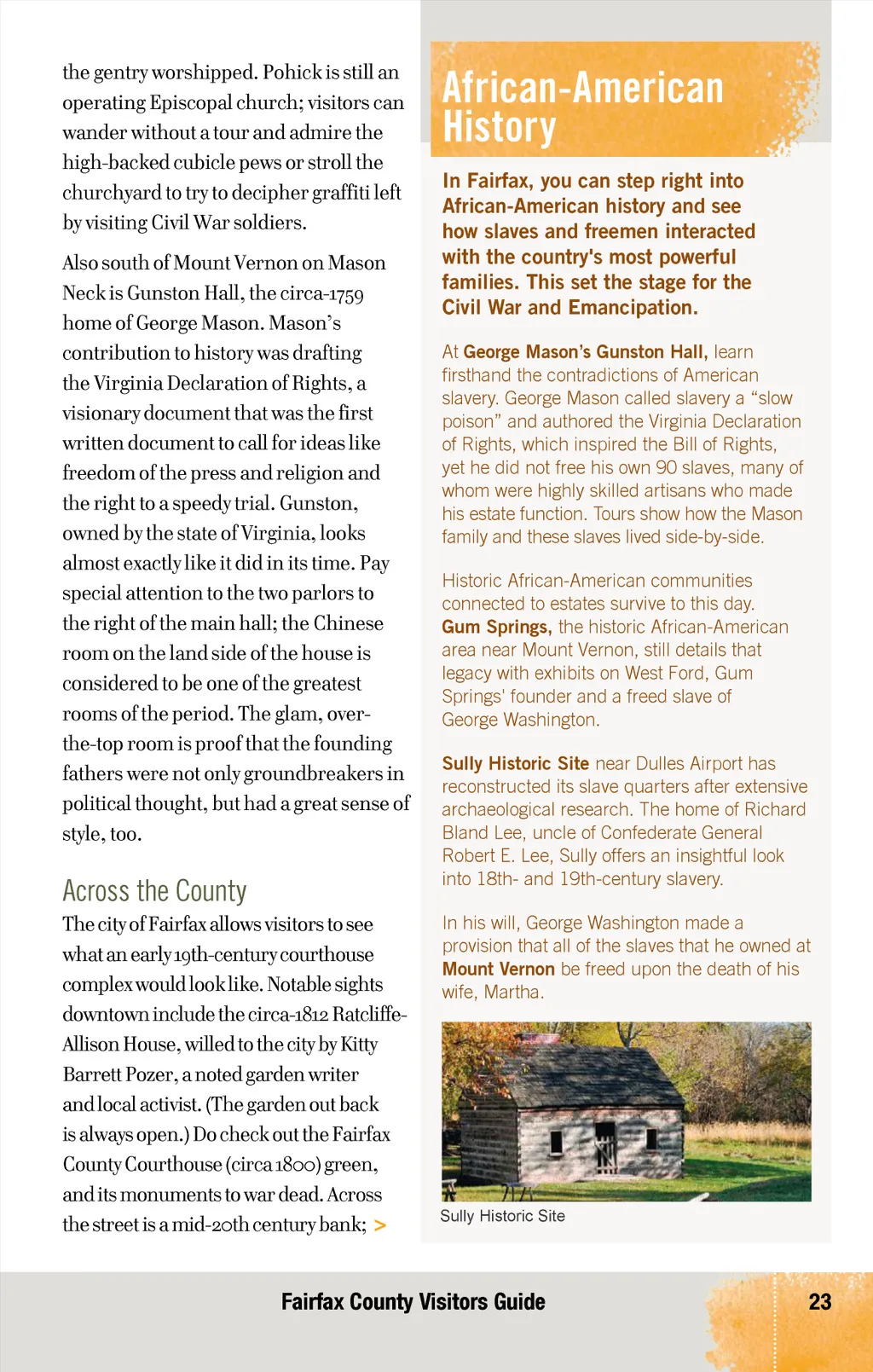
the gentry worshipped. Pohick is still an operating Episcopal church; visitors can wander without a tour and admire the high-backed cubicle pews or stroll the churchyard to try to decipher graffiti left by visiting Civil War soldiers. Also south of Mount Vernon on Mason Neck is Gunston Hall, the circa-1759 home of George Mason. Mason’s contribution to history was drafting the Virginia Declaration of Rights, a visionary document that was the first written document to call for ideas like freedom of the press and religion and the right to a speedy trial. Gunston, owned by the state of Virginia, looks almost exactly like it did in its time. Pay special attention to the two parlors to the right of the main hall; the Chinese room on the land side of the house is considered to be one of the greatest rooms of the period. The glam, over-the-top room is proof that the founding fathers were not only groundbreakers in political thought, but had a great sense of style, too. African-American History In Fairfax, you can step right into African-American history and see how slaves and freemen interacted with the country's most powerful families. This set the stage for the Civil War and Emancipation. At George Mason’s Gunston Hall, learn firsthand the contradictions of American slavery. George Mason called slavery a “slow poison” and authored the Virginia Declaration of Rights, which inspired the Bill of Rights, yet he did not free his own 90 slaves, many of whom were highly skilled artisans who made his estate function. Tours show how the Mason family and these slaves lived side-by-side. Historic African-American communities connected to estates survive to this day. Gum Springs, the historic African-American area near Mount Vernon, still details that legacy with exhibits on West Ford, Gum Springs' founder and a freed slave of George Washington. Sully Historic Site near Dulles Airport has reconstructed its slave quarters after extensive archaeological research. The home of Richard Bland Lee, uncle of Confederate General Robert E. Lee, Sully offers an insightful look into 18th-and 19th-century slavery. In his will, George Washington made a provision that all of the slaves that he owned at Mount Vernon be freed upon the death of his wife, Martha. Across the County The city of Fairfax allows visitors to see what an early 19th-century courthouse complex would look like. Notable sights downtown include the circa-1812 Ratcliffe-Allison House, willed to the city by Kitty Barrett Pozer, a noted garden writer and local activist. (The garden out back is always open.) Do check out the Fairfax County Courthouse (circa 1800) green, and its monuments to war dead. Across the street is a mid-20th century bank; > Sully Historic Site Fairfax County Visitors Guide 23
Fairfax County Official Visitors Guide 2017: Page 23